
Why Your Ad Metrics Never Match: Navigating the Three Referees of Cross-Border Attribution
 Why Your Ad Metrics Never Match: Three Parallel Referees of Ad Attribution
People in industry groups constantly emphasize the need to run paid acquisition, yet many have never actually opened Google, TikTok, or Meta Ads Manager. Opening and funding an ad account is easy; the real hurdle after spending budget is calculating whether that spend generated genuine conversions—that is, Attribution.
At first, I thought attribution was just appending UTM parameters, dropping in an SDK, and reading reports. Only after architecting a cross-platform ad system did I realize attribution spans three distinct domains: ad platform mechanics, front-end tracking engineering, and product monetization economics. Without front-end technical fluency, you cannot spot where data drops off; without understanding ad platform black-box rules, budgets get burned on phantom conversions; and without modeling product LTV (Lifetime Value), even pinpoint attribution cannot produce sound media-buying decisions.
Earlier in my career, I built browser extensions, websites, and ad measurement scripts, so I knew web-side URL parameters and cookie propagation inside out. From a web perspective, data flows like water through a clear glass pipe—sources, paths, and drop-off points are transparent.
Wendy, our paid acquisition lead who previously ran overseas UA at TikTok, knew IDFA, MMPs, and Adjust inside out—my engineering colleague Guazi and I called her the "Attribution Expert." Yet whenever we built attribution pipelines together, we clashed over details such as TikTok's probabilistic iOS attribution or the self-attributing (SAN) boundaries between TikTok and Meta.
Those disagreements stemmed from our opposite vantage points. I reasoned from the browser front end—focused on UTMs, cookies, and sign-up events—while she reasoned from mobile SDKs and MMPs—focused on device IDs, Last-Click rules, and app installs. Standing at opposite ends of the same data pipeline, we naturally saw different cross-sections. This article steps outside any single platform perspective to map the complete attribution architecture across Web, App, MMPs, and ad networks.
Core Attribution Glossary
Different platforms give different names to the same tracking identifiers. Even for device identity alone, iOS uses IDFA, Android uses GAID, Web relies on cookies, and TikTok, Meta, and Google maintain internal conventions. Before diving into models, let us standardize nine core terms:
UTM (Urchin Tracking Module): The foundational URL tracking parameters for web attribution. Appending parameters such as?utm_source=googleto a landing page URL tags visitors arriving from Google.IDFA / GAID: Advertising identifiers on iOS and Android devices. Having the device ID enables 100% deterministic attribution; without it, platforms must fall back to probabilistic estimation using device attributes.ATT (App Tracking Transparency): Apple's tracking consent prompt ("Allow App to Track") shown on app launch. Developers can access IDFA only if the user taps Allow. The industry-average opt-in rate sits around 14%, leaving roughly 86% of iOS users anonymous.MMP (Mobile Measurement Partner): Independent third-party mobile attribution platforms (such as Adjust and AppsFlyer). Operating independently of ad networks, an MMP acts like a video assistant referee (VAR) in sports to adjudicate install credit.SAN (Self-Attributing Network): The self-attribution model used by major ad platforms such as Meta and TikTok. Instead of waiting for an MMP to rule independently, SANs match impressions and clicks against their own internal logs and proactively claim conversion credit from the MMP.SKAN / AAK (AdAttributionKit): Apple's official privacy-preserving attribution framework. It strips user-level granularity, returns aggregated and obfuscated conversion results, and enforces noticeable reporting delays.CTA (Click-Through Attribution): Attribution credited when a user clicks an ad before converting—representing strong deterministic intent.VTA (View-Through Attribution): Attribution credited when a user sees an ad without clicking and later searches for and installs the app organically—common in short-form video feeds.First-Click / Last-Click: First-touch vs. last-touch attribution. Suppose a user sees a Google ad first, then a TikTok ad, and finally clicks a Meta ad to download. First-Click gives credit to Google (initial discovery), whereas Last-Click gives credit to Meta (the final closing touchpoint).
Four Core Multi-Platform Attribution Models
When user journeys span desktop web and mobile apps, different attribution models are required. Ranked from lowest to highest complexity, there are four primary models.
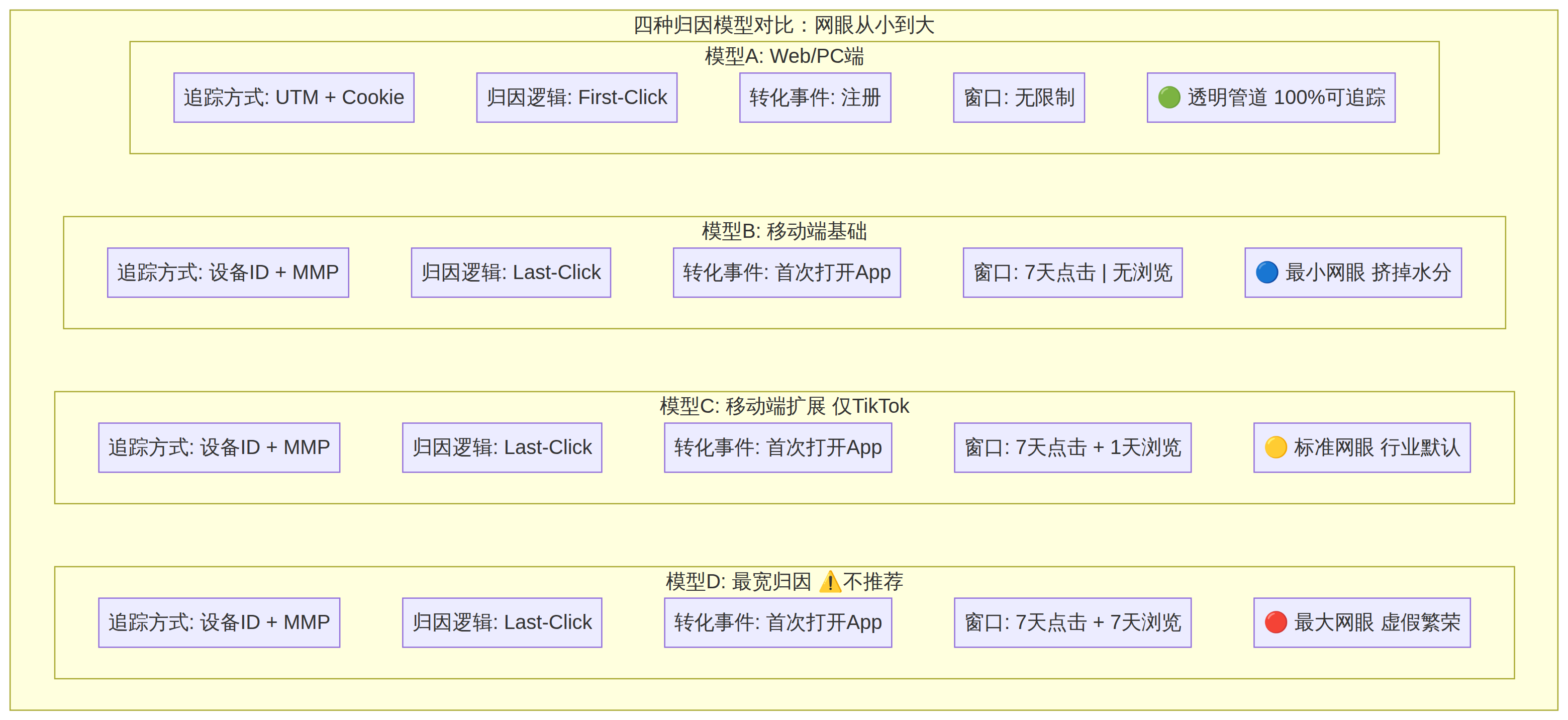 Comparison of the four ad attribution models across Google, Meta, and TikTok Ads
Model A: Basic Web and Desktop Attribution (UTM + First-Click)
The web funnel is the most transparent link in the attribution chain. When a user clicks an ad URL carrying UTM parameters, front-end JavaScript persists those UTM parameters into a cookie or LocalStorage. When the user completes registration, the parameters are written alongside the registration request into the production database, recording the exact acquisition channel.
Model A applies a First-Click rule, crediting the channel that originally introduced the user. Even if the visitor returns later via another channel to register, conversion credit remains tied to the initial acquisition touchpoint. From URL parsing and cookie persistence to database ingestion, the entire data flow stays clear and auditable.
Three Mobile Attribution Windows (Device ID + Last-Click)
Mobile apps cannot rely on cookies to track across environments the way web browsers do. When a user taps an ad, jumps to the App Store, downloads, and opens the app, tracking breaks inside the store boundary and must be stitched back together by an MMP using device IDs (IDFA or GAID).
The mobile conversion milestone is typically set to First App Open, defaulting to Last-Click rules so credit goes to the last valid touchpoint prior to install. Depending on window strictness, mobile attribution splits into three models. Think of attribution windows like fishing-net mesh: wider windows capture more conversions, but also sweep in more organic traffic noise.
Model B (MMP Standard Attribution): 7-Day Click, View-Through Disabled
An install counts as a channel conversion only if the user clicked an ad within the past 7 days before installing; view-through attribution (VTA) is disabled completely. We currently apply Model B across Google UAC, Meta mobile, Yahoo, and Line so every attributed conversion is backed by a real click event, squeezing inflation out of the numbers.
Model C (MMP Extended Attribution): 7-Day Click + 1-Day View
Model C adds a 24-hour view-through window on top of the 7-day click window. If a user sees an ad without clicking and installs the app within 24 hours, the channel still receives conversion credit. This aligns with the default attribution window in Meta Ads and Adjust.
We enable Model C exclusively for TikTok. On Google, someone searching "translator app" and tapping an ad demonstrates active intent where click-through attribution suffices. On TikTok, users browse passively—they frequently watch an ad without tapping, then open the App Store a few hours later to search and install. Turning off VTA would severely undercount TikTok's real acquisition contribution.
Inside Adjust's attribution waterfall, clicks always outrank views. If a user clicked Ad A within 7 days and viewed Ad B within 1 day, the install is attributed to Ad A because it holds the deterministic click record.
Model D (MMP Broad Attribution): 7-Day Click + 7-Day View
Any install occurring within 7 days of an ad impression is credited to that ad channel, even without a single click.
Our business explicitly prohibits Model D. An overly wide view-through window cannibalizes Organic traffic and creates artificial paid performance. For example, if reports claim TikTok drove 1,000 installs, 400 of those might have been organic search users who happened to scroll past a video ad within the prior week—severely distorting budget allocation.
Three Parallel Attribution Referees
Mobile user acquisition teams run into a constant frustration: internal BI dashboards, MMP consoles, and ad platforms (Meta or TikTok) never show matching conversion counts. At first I suspected a data pipeline bug, only to find after three days of debugging that every pipeline was completely healthy.
Data conflicts happen because mobile runs three parallel attribution referees simultaneously, each operating under independent measurement rules with zero hierarchy among them.
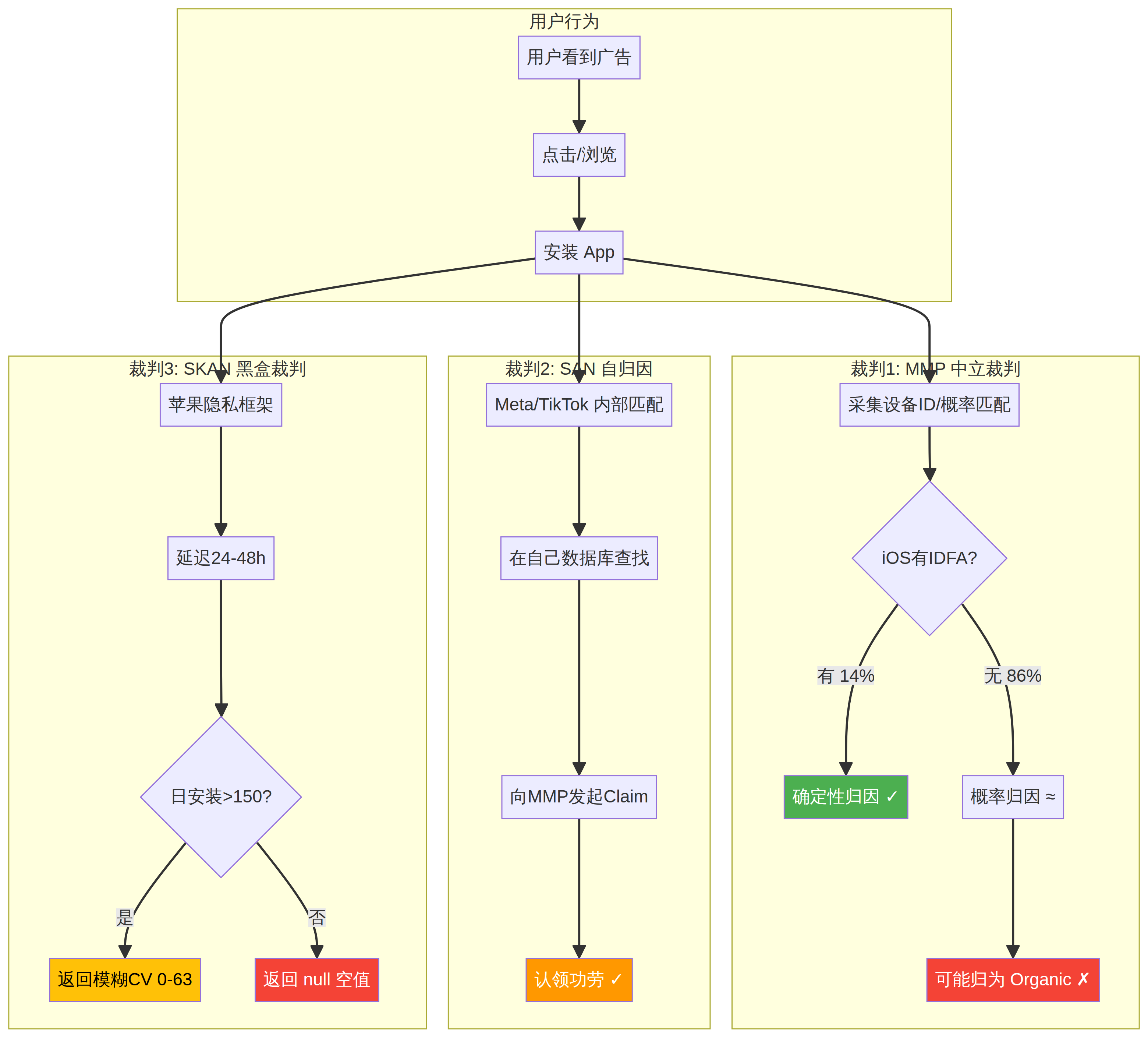 Data flow across the three parallel ad attribution referees
Referee 1: MMP (Third-Party Measurement Platforms, e.g., Adjust)
The MMP acts as a neutral arbiter. On Android, the MMP captures GAID (Google Advertising ID) and matches ad clicks directly against app installs for 100% deterministic attribution.
On iOS, reality is starkly different. Constrained by ATT opt-in rates hovering near 14%, MMPs rarely obtain IDFA and must fall back to probabilistic matching using IP addresses, device models, and OS versions. As Apple continues tightening anti-fingerprinting restrictions, probabilistic accuracy has plunged—causing large numbers of ad-driven installs to leak into Organic traffic.
Referee 2: SAN (Self-Attributing Networks, e.g., Meta and TikTok)
This was the single biggest point of contention between Wendy and me early on. Major platforms like Meta and TikTok both sell the media and referee their own performance. When an MMP forwards an install event to a SAN, the platform searches its internal logs for recent impressions or clicks by that user and issues a Claim back to the MMP.
Because each SAN files claims independently, a single installed user can be claimed as a conversion inside Meta Ads Manager, simultaneously claimed inside TikTok Ads Manager, and categorized as Organic inside the MMP report. One real user produces three conflicting attribution records across three dashboards.
Referee 3: Apple SKAN / AAK (Privacy Black-Box Referee)
Apple's privacy attribution framework offers the lowest transparency and imposes three hard constraints on live UA optimization:
- Delayed postbacks: Conversion data arrives with a 24- to 48-hour delay. Budget spent today yields conversion feedback two days later.
- Privacy Thresholds: If a campaign generates fewer than roughly 100–150 daily installs, Apple returns
null, masking exact conversion performance. - Aggregated data limits: Instead of user-level logs, Apple returns only a coarse Conversion Value from
0to63. Teams have just 6 bits (64 buckets) to encode purchase revenue, core feature usage, and retention milestones.
Four Direct Causes of Cross-Platform Data Discrepancies
Putting the three referees' counting rules side by side explains why reports diverge across four direct dimensions:
- Different attribution windows: SANs enable VTA (view-through attribution) by default, whereas internal BI reports often count only CTA (click-through attribution), creating an apples-to-oranges baseline.
- Different attribution timestamps: SANs typically log conversions on the click date, while MMPs log them on the install date. If a user clicks an ad on Monday and installs on Wednesday, Meta logs it on Monday (e.g., 100 installs) while Adjust logs it on Wednesday (Monday shows only 60), misaligning daily reports.
- Time-zone mismatches: Your internal warehouse may settle on GMT+0 while ad accounts operate on GMT+8. A cross-timezone cutoff easily shifts daily revenue by over 20%—a basic mismatch that has cost teams entire weeks of debugging.
- iOS probabilistic leakage: When MMP probabilistic matching fails on iOS, genuinely paid installs drop into the Organic bucket—making organic growth appear artificially strong while paid attribution leaks.
Production Configuration: Attribution Matrix Across 12 Major Channels
Combining multiple debugging cycles and cross-functional alignment, we standardized our attribution settings across 12 major acquisition channels (split across Web and Mobile) as follows:
Web and Desktop Channels (Standardized on Model A)
- Google Desktop: Click + engaged-view using a Data-driven attribution model.
- Meta Desktop: UTM + click + registration.
- Naver Desktop: UTM + click + registration.
- Bing Desktop: UTM + click + registration.
Mobile Channels (Routed via Adjust: ATT Matching First, SKAN Fallback)
- TikTok Android / iOS: Model C (7-day click + 1-day view)—the sole mobile channel with VTA enabled.
- Google UAC Android / iOS: Model B (7-day click, no view).
- Meta Android / iOS: Model B (7-day click, no view).
- Yahoo / Line Android / iOS: Model B (7-day click, no view).
- Apple Ads (ASA): Routed via SAN self-attribution (click), reported into Adjust, and adjudicated by Last-Click when overlapping other channels.
Preserving VTA exclusively for TikTok protects incremental channel evaluation. Short-video viewers often see an ad and search the App Store hours later to install; disabling VTA dumps those installs into Organic, artificially depressing TikTok's reported ROAS and tricking UA teams into cutting genuinely incremental spend.
The Subscription Dilemma: Sending Long-Term LTV Signals Inside a 7-Day Window
Once tracking pipes were clean, we standardized on Server-to-Server (S2S) postbacks and stripped out duplicate client-side SDK events. After eliminating double-counted revenue, an even harder challenge emerged from the product's business model itself.
We operate a subscription product. Unlike impulse-purchase games or short-drama apps with rapid payback, subscription LTV (Lifetime Value) unfolds slowly. Users frequently start with a 7-day free trial, renew monthly for three months, and convert to annual plans later—meaning high-value cohorts only become clear after 60 to 90 days.
That timeline collides directly with ad platform learning algorithms:
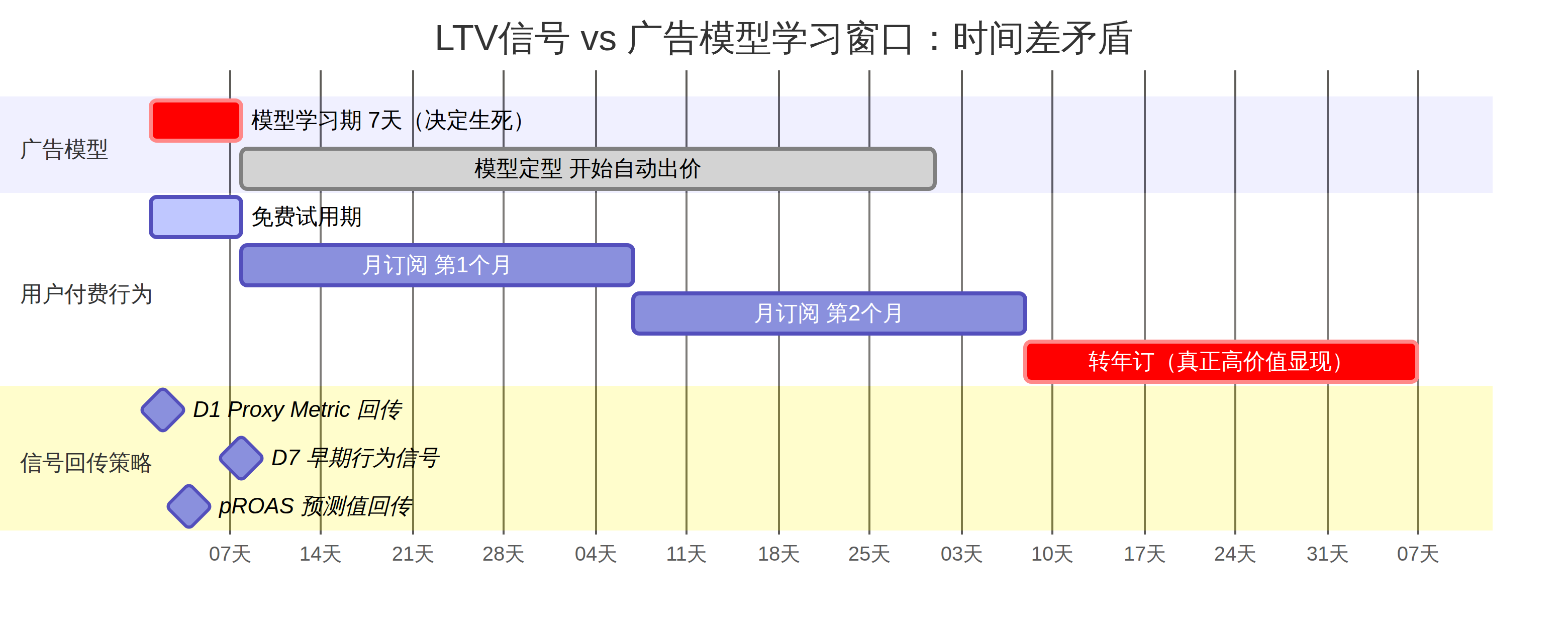 The LTV timing conflict between 60-day payback and 7-day ad optimization windows
Modern bidding engines such as Google UAC and Meta Advantage+ typically complete initial model training within the first 7 days. If the algorithm fails to receive high-value conversion signals inside those first 7 days, it assumes audience quality is poor and pivots toward cheap, shallow conversions that never renew.
Long-term LTV takes 60 days to materialize, yet ad models grant only a 7-day learning window. Bridging that timing gap requires three engineering and analytics tactics:
- Identify Early Proxy Metrics: Run regression analysis on historical cohorts to uncover Day-1 or Day-7 deep engagement actions strongly correlated with long-term subscription retention. For instance, if users who "trigger a core feature 3+ times on Day 1 convert at 5x the 60-day paid rate," fire that action as a Proxy Metric in real time on Day 1 so bidding algorithms hunt for high-intent users within the 7-day window.
- Build Predictive ROAS (pROAS): Train machine-learning models on early behavioral features to forecast 60-day expected revenue, then encode that forecast into Conversion Values sent back to ad networks. Under SKAN's tight
0–63(64-bucket) constraint, design revenue and behavioral value mappings with surgical precision. - Run Incrementality Testing: Under restrictive iOS user-level tracking, step outside the MMP vs. SAN vs. SKAN debate altogether by comparing total install volume between exposed test geos and unexposed control geos. Measuring natural lift between test and holdout regions reveals true incremental impact without relying on any device ID or third-party attribution tag.
Troubleshooting and Implementation Recommendations
No single report delivers absolute cross-platform attribution truth. You have to read web front-end requests, mobile SDK rules, and product LTV payback curves together. Cross-validating all three layers lets you make resilient budget decisions even inside lossy reporting environments. The next time your dashboards disagree, audit attribution windows first, align click vs. install timestamps second, and verify account settlement time zones last.
References
[1] Moburst. "Mobile Attribution in 2026: What Marketers Actually Need to Know". https://www.moburst.com/blog/mobile-attribution-in-2026-what-marketers-actually-need-to-know/
[2] Adjust Help Center. "Attribution methods". https://help.adjust.com/en/article/attribution-methods
[3] TikTok Business Help Center. "About Self-Attributing Network (SAN) integration with MMPs". https://ads.tiktok.com/help/article/about-self-attribution-transition?lang=en
[4] Apple Developer. "AdAttributionKit". https://developer.apple.com/documentation/adattributionkit
[5] Adjust Help Center. "Data discrepancies". https://help.adjust.com/en/article/data-discrepancies
[6] RevenueCat Docs. "Event Types and Fields". https://www.revenuecat.com/docs/integrations/webhooks/event-types-and-fields
[7] RevenueCat Docs. "Adjust Integration". https://www.revenuecat.com/docs/integrations/attribution/adjust
[8] AppsFlyer. "App Tracking Transparency (ATT)". https://www.appsflyer.com/glossary/app-tracking-transparency/
Found this actionable? Copy standard citation & summary
Formatted with canonical attribution link and executive summary—ready for Slack, Notion, or LLM context.
Put Into Practice: Companion Browser Workbenches
Shopify GTM & GA4 Web Pixel Generator
Generate production-ready Shopify Customer Events Web Pixel code for GA4, Meta, and TikTok.
UTM Builder Pro Matrix Workspace
Reverse URL parser, GA4 channel group diagnostics, and dynamic ad macro batch CSV export.