
Google Official Whitepaper: Retail Marketer’s Guide to the 2026 AI Holiday Shopping Season & Commerce 4 Architecture
 Google Official Whitepaper: Retail Marketer’s Guide to the 2026 AI Holiday Shopping Season & Commerce 4 Architecture
Executive Overview: How AI Is Reshaping 2026 Holiday Search & Purchase Decisions
Heading into the 2026 holiday shopping season, AI has become the everyday starting point for discovering brands, comparing product specifications, and making purchase decisions:
- User Scale: Official Google data shows Google AI Overviews now serves over 2.5 billion monthly active users (MAU), while AI Mode in Search has surpassed 1 billion MAU. Powered by Gemini models, shoppers routinely rely on AI to learn about unfamiliar brands and compare product details.
- Adoption Shift: Last holiday season, 61% of shoppers used AI features, and 64% afterward said they wished they had leaned on AI even more to help choose products. By 2026, AI-assisted product search is the new normal.
Google and YouTube published the 19-page official whitepaper "Supercharge your business this season: The retail marketers' guide to the AI-powered holiday season (2026)". Below is a complete breakdown of all 3 chapters, 20 research metrics, and brand execution case studies.
Chapter 1: Four Consumer Behavior Shifts in the AI Holiday Season
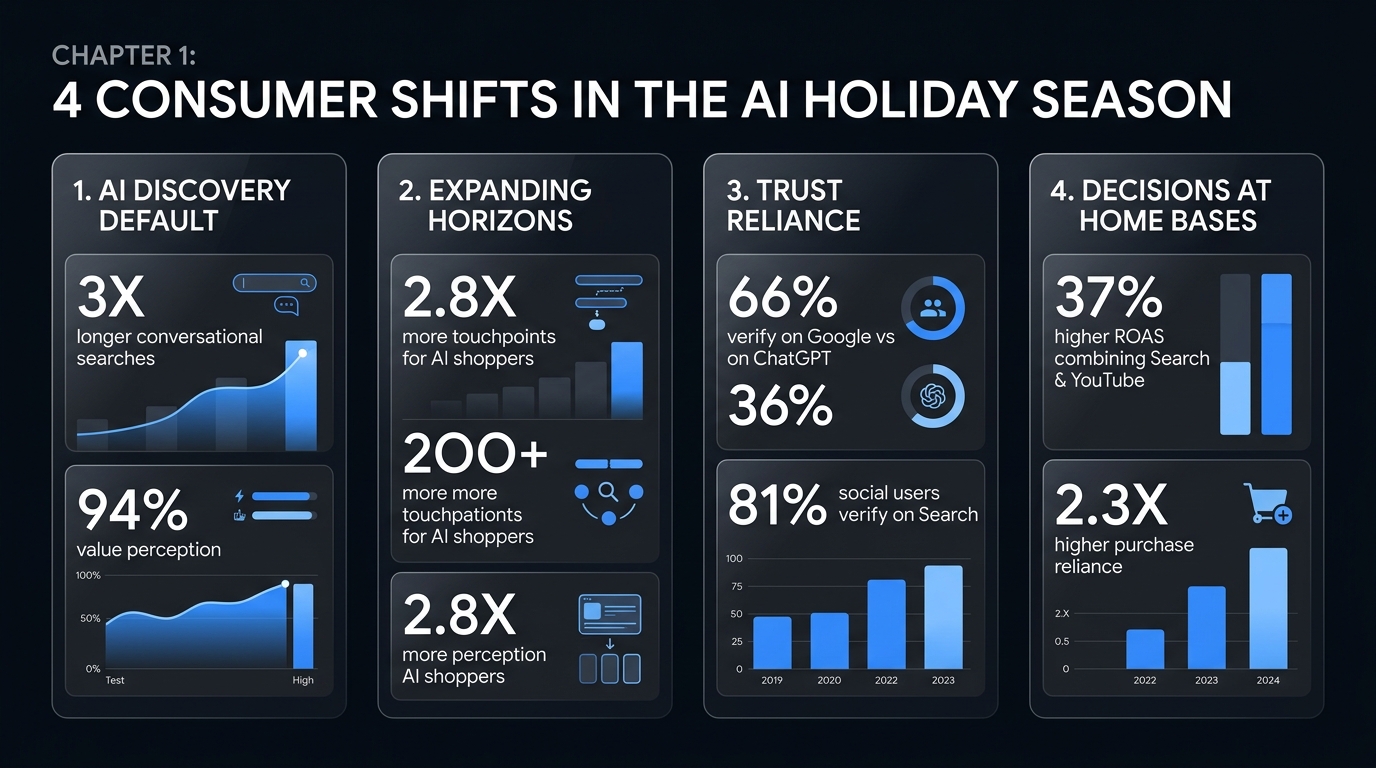 Chapter 1: 4 Consumer Shifts in the AI Holiday Season
Shift 1: AI-Powered Discovery Is the Default
Shoppers still move through discovery, research, comparison, and checkout, yet how they search has changed fundamentally:
- High Perceived Helpfulness: Survey data shows 94% of US holiday shoppers who used AI say AI tools made a meaningful, helpful difference in their shopping experience.
- From Short Keywords to Conversational Natural Language: Queries in AI Mode average 3X as long as traditional keyword searches. Beyond exact model numbers, shoppers now enter multi-constraint questions such as: "What are good gifts under $300 for a 40-year-old man who loves outdoor camping and eco-friendly gear?"
- Shorter Decision Hesitation: 75% (3 in 4) of users report that Google AI Mode and AI Overviews help them decide what to buy faster.
- Blurred Channel Boundaries: The gap between searching, watching video, and checking out has compressed, making siloed single-channel media buying unable to cover the full journey.
Shift 2: AI Shopping Journeys Expand to 2.8X More Touchpoints (Expanding Horizons)
Lower friction in finding information encourages shoppers to evaluate more options and specs before purchasing rather than skipping research:
- Touchpoints Grow to 2.8X: Consumers who use AI during their purchase journey interact with or evaluate 2.8X more touchpoints on average than non-AI shoppers.
- Less Search Frustration: AI removes the friction of hunting through cluttered pages for answers, giving shoppers confidence to compare a wider consideration set.
- Pre-Click Evaluation Happens Off-Site: Before clicking through to a brand’s DTC site, shoppers have often completed multiple rounds of spec comparison and cross-checking in AI—arriving on landing pages with far higher purchase intent.
Shift 3: Consumers Rely More Heavily on Verifiable Sources (Trust Reliance)
In research surveys, 61% of shoppers report being more cautious with spending, demanding higher accuracy and verifiability in product claims:
- Divergence in Perceived Verifiability: 66% of Google Search users say the information provided is easy to verify, compared with 36% of ChatGPT users who say generated responses are easy to verify.
- Social Discovery Loops Back to Search: 81% of social media users say that after discovering a new brand on platforms like TikTok or Instagram, they return to Google Search to verify product reviews and authenticity.
- Video Platform Trust Leadership: Third-party Kantar research shows YouTube ranks #1 in viewer trust among video platforms surveyed in the US.
Shift 4: Google & YouTube Capture Final Purchase Conversion
Product discovery may begin across diverse social feeds, yet final comparison and conversion overwhelmingly converge on Google and YouTube:
- #1 Video Platform for Fast Purchase Decisions: When US respondents need to decide quickly which product to buy, they rank YouTube ahead of Facebook, Instagram, TikTok, and Snapchat as their top assistive video platform.
- 2.3X Higher Reliance at Final Decision: At the final purchase-decision stage, shoppers are 2.3X more likely to use Google Search than ChatGPT.
- Usage Migration: Among shoppers who regularly use Google AI Mode to assist purchases, 40% report using ChatGPT less frequently than before.
- Cross-Channel Synergy ROAS Lift: TransUnion’s Marketing Mix Modeling (MMM) meta-analysis confirms that across US verticals, brands combining Google Search and YouTube ads achieve 37% higher ROAS than the average of all other media combined.
| Dimension | Legacy Shopping Behavior | 2026 AI-Era Shift | Official Quantitative Benchmark |
|---|---|---|---|
| Search Form | 2–3 keyword string matching | Conversational long-form, scenario-constrained prompts | Queries are 3X as long as legacy keyword search |
| Decision Touchpoints | Linear, compact funnel | Multi-dimensional exploration & ongoing comparison | AI shoppers engage 2.8X more touchpoints |
| Information Verification | Relying on single-source social posts | Cross-checking back on search engines | Verifiability: 66% Google vs. 36% ChatGPT |
| Channel Synergy | Siloed social and search buying | Coordinated Search + YouTube orchestration | Delivers +37% higher ROAS |
Executive Interview: Wayfair CMO Paul Toms on Pre-Search Demand & Feed Richness
North American home-goods marketplace Wayfair manages over 40 million home SKUs. The whitepaper features three Q&A excerpts with Wayfair Chief Marketing Officer Paul Toms covering upper-funnel demand creation, long-tail catalog governance, and incrementality testing.
Question 1: With shoppers leaning heavily on AI tools, how does Wayfair reach them before explicit purchase intent forms?
Paul Toms (Wayfair CMO): "The biggest opportunity is building a connection before the consumer even has an active shopping intent—so when that need arises, Wayfair is already their natural starting point. Search remains critical, but we now spend tremendous energy studying what happens pre-search: how to earn relevance and consideration before someone sets out to buy furniture. That means showing up where attention lives, such as partnering with YouTube creators and sponsoring live sports. This fall we launched new brand experiences designed to span the full journey rather than waiting passively at existing search touchpoints."
Question 2: Across a 40-million-SKU catalog, how do you maintain feed completeness and data accuracy?
Paul Toms: "Feed richness is an always-on marathon. Our feeds expand every year because large models need far more context. AI helps us generate structured data at scale for the shoulder and tail catalog—so when shoppers type highly specific long-tail queries, even niche SKUs earn relevant impressions. At the same time, accuracy is non-negotiable: we enforce strict supplier verification workflows to meet Google’s data-quality standards."
Question 3: How does your team capture new incremental growth opportunities quickly?
Paul Toms: "We rely on our internal Experimentation Platform to test new media approaches on a daily or weekly cadence, rapidly spotting pockets of incremental growth and scaling budget behind them. Equally important, experimentation tells us quickly where incrementality is missing so we don’t waste time or spend."
Chapter 2: The Commerce 4 Playbook for Peak Holiday Execution
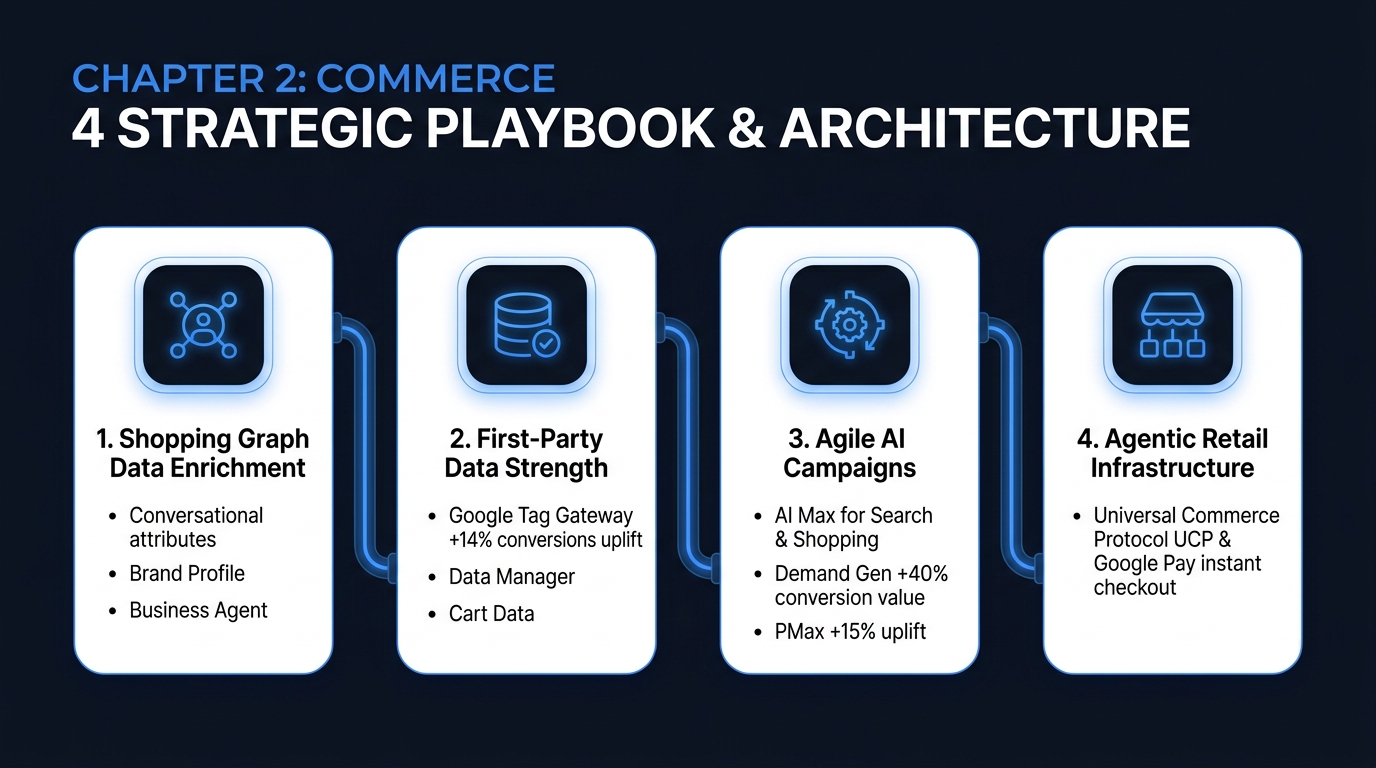 Chapter 2: Commerce 4 Strategic Playbook & Architecture
To translate these behavioral shifts into holiday revenue, Google outlines the four-pillar Commerce 4 execution framework for retail brands:
1. Enrich Product Feeds for Shopping Graph
Advertisers can adopt Conversational Attributes to supply Google’s models with natural-language product context—covering common buyer FAQs, detailed variant specs, use-case scenarios, and pairing suggestions—so AI surfaces accurate product facts when answering complex questions.
At the same time, reinforce four organic discovery touchpoints:
- Brand Profile: Present unified brand visuals while highlighting holiday promotions, shipping thresholds, and return policies.
- Business Agent: Answer season-specific questions in real time, such as "Will this arrive before New Year’s Eve?" or "Is this suitable for beginner skiers?"
- YouTube Review & Tutorial Videos: Publish hands-on tests, how-to tutorials, and unboxings that surface directly within Google Search results.
- Community & Review Site Reputation: Maintain authentic customer feedback across forums and third-party review platforms.
2. Upgrade First-Party Data Strength
- Deploy Google tag gateway: Close cross-device and cross-session identity gaps—for instance, when a shopper visits three times before buying a winter coat, legacy tags may miscount three separate visitors. Official testing shows advertisers deploying Google tag gateway see an average +14% lift in conversions.
- Connect Data Manager: Feed first-party audience signals stored in Salesforce, BigQuery, and CRM systems directly into Google AI bidding models.
- Pass Cart Data Signals: Sync basket-level multi-SKU purchase details so bidding and recommendation algorithms can optimize cross-sell and bundle attachment.
3. Replace Rigid Schedules with Agile AI Campaigns
Traditional retail planning—mapping budgets in Q2, locking spend in Q3, and executing rigid Q4 flighting—can no longer keep pace with real-time long-tail search shifts. The whitepaper recommends combining four AI campaign pillars:
- AI Max for Search campaigns: Uses keywordless intent matching to dynamically tailor search ad copy around the shopper’s live conversational context.
- New AI Max for Shopping campaigns: Automatically transforms Merchant Center product feeds into dynamic, interactive shopping ad formats.
- Performance Max (PMax): Finds high-converting shoppers automatically across channels. Official benchmarks show advertisers using AI Max or PMax achieve an average +15% lift in search conversions or conversion value at comparable CPA or ROAS.
- Demand Gen: Integrates Gemini multimodal models to optimize visual creative matching. Following hundreds of model upgrades in H2 2025, YouTube conversion value under target-bidding strategies increased +40%.
Official Optimization Pro Tips
- Affiliate Partnerships Boost: Promote high-performing organic YouTube creator affiliate videos directly inside Demand Gen feed placements to scale reach.
- New Customer Acquisition: Pair first-party existing-customer lists with real-time site tags so bidding prioritizes net-new buyers who have never purchased before.
- Smart Bidding Exploration: Carve out flexible budget headroom to test and uncover previously untapped high-converting long-tail search queries.
- Missed-Opportunity Reporting: Monitor peak-week dashboards to pinpoint impression share lost due to budget caps or bid ceilings.
4. Adopt Agentic Infrastructure Early
- Evaluate Universal Commerce Protocol (UCP): As Agentic Commerce moves into production, brands can evaluate UCP integration early so autonomous AI agents can directly read live inventory, verify pricing, and execute checkouts on a shopper’s behalf.
- Enable Google Pay: Remove mobile checkout form friction today to cut cart abandonment while laying the payment rails required for future agentic transactions.
Chapter 3: Three Retail Holiday Campaign Case Studies
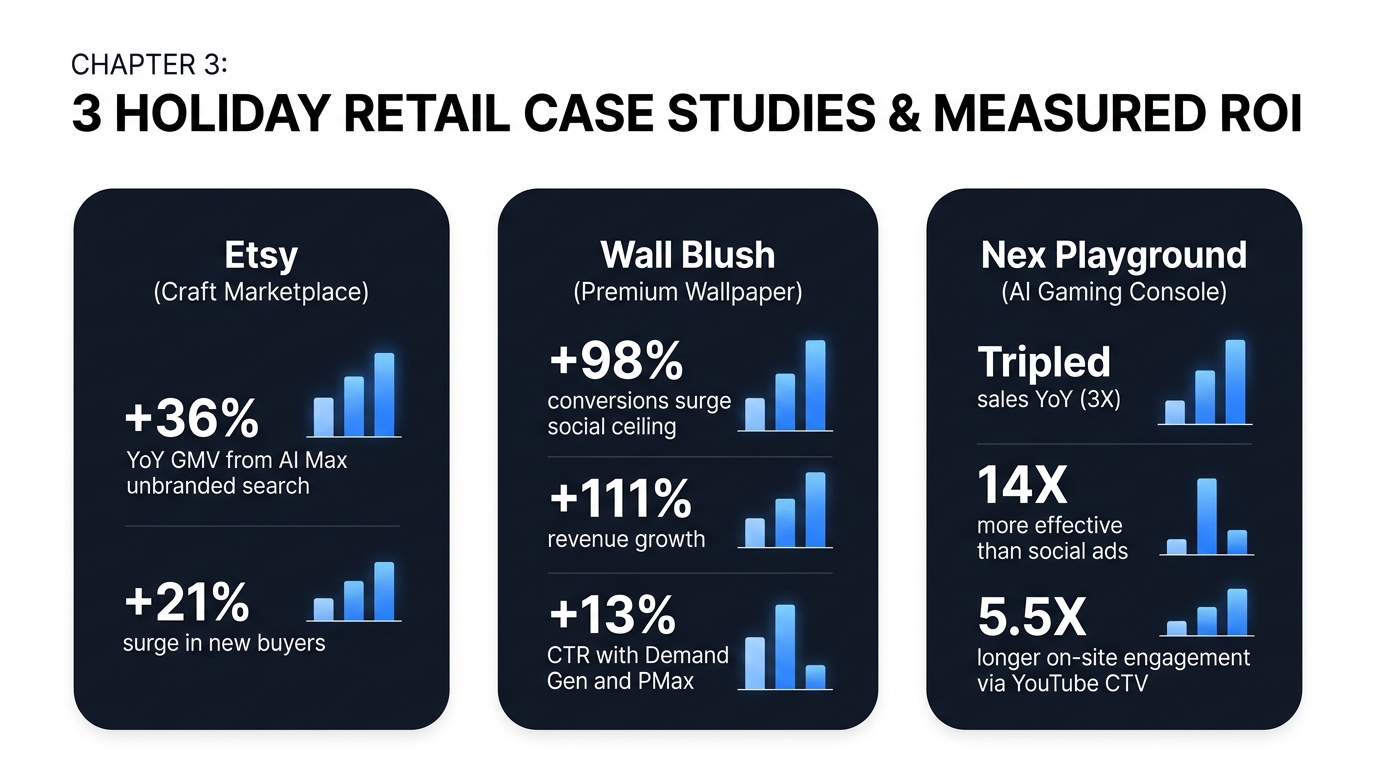 Chapter 3: 3 Holiday Retail Case Studies & Measured ROI
Case Study 1: Etsy (Handmade & Non-Standard Goods Marketplace)
Etsy hosts millions of one-of-a-kind handmade items with highly fragmented, personalized buyer queries that manual keyword lists could never fully cover. The team adopted AI Max to interpret gifting and use-case intent behind long-tail queries, dynamically generate matching ad headlines, and pair Search with YouTube shoppable video. During the 2025 holiday season, while hitting target ROI goals, Etsy drove +36% YoY GMV growth (led by incremental non-brand search from AI Max) and +21% YoY growth in new buyers.
Case Study 2: Wall Blush (Custom Wallpaper Brand)
Wall Blush previously relied heavily on a single social platform for customer acquisition, eventually hitting scale ceilings where extra spend drove rising CAC. The team shifted to coordinated multi-campaign orchestration in Google Ads: deploying Demand Gen video when homeowners were browsing early room-decor inspiration, then capturing explicit buying intent with PMax product feeds. Following the transition, Wall Blush achieved +98% YoY conversions, +13% CTR, and +111% overall revenue growth.
Case Study 3: Nex Playground (AI Motion-Control Game Console)
Nex Playground launched a family-oriented AI motion-tracking game console—a new product category with virtually zero pre-existing search demand. The team executed a "living-room-first" playbook, starting with YouTube Connected TV (CTV) ads showcasing families playing together in US living rooms, then retargeting engaged households with mobile Demand Gen campaigns to drive checkout. The brand tripled YoY annual revenue (3X), achieved 14X higher new-family conversion efficiency than legacy social campaigns, and extended average site dwell time by 5.5X.
References & Data Methodology
The 20 metrics cited across the whitepaper draw from three primary evidence pillars—third-party consumer surveys, econometric modeling, and internal platform experiments:
- Ipsos Holiday Shopping 2-Day Recall Study (n=8,237): Surveyed US online consumers aged 18+ who completed holiday shopping within the prior two days.
- Ipsos Global Multi-Market AI Shopper Tracker (n=2,241): Covered respondents across the US, Canada, UK, France, Germany, Italy, Australia, Japan, India, China, Mexico, Spain, and South Africa.
- Ipsos Post-Holiday Tracker (n=1,275): Surveyed online buyers aged 18–64 who used AI during the 2025 holiday season.
- Google I/O 2026 Official Figures: Reported 2.5 billion MAU for AI Overviews and 1 billion MAU for AI Mode in Search.
- Google Internal Data (May 2026): Measured conversational queries in AI Mode averaging 3X the length of traditional keyword searches.
- Ipsos Global Consumer Decision Journey Study (n=13,189; and n=14,305 AI users vs. n=21,881 non-AI users): Conducted across 24 countries, quantifying the 2.8X touchpoint expansion and 75% faster decision confidence.
- Ipsos Social & Omnichannel Verification Study (n=12,594): Measured 81% of social users returning to Google to verify brands, and the 66% vs. 36% verifiability gap.
- Google & Kantar US Video Ecosystem Study (n=7,621): Cross-screen evaluation across 9 streaming and social platforms ranking YouTube #1 in viewer trust among US respondents.
- TransUnion MMM Meta-Analysis & Lift Simulation (spanning 40 verticals and 800+ econometric models, Q1 2024–Q4 2025): Confirmed US Search + YouTube synergy yields +37% higher ROAS than all other media combined.
- Google Internal First-Party Conversion Experiments (2025–2026): Measured +14% conversion lift from Google tag gateway, +40% YouTube conversion value lift from Gemini upgrades in Demand Gen, and +15% search conversion value lift from AI Max and PMax.
Extended Reading on 2026 BFCM Account Budget Controls (Google Official Doc
#18385152): Google Ads has introduced Channel Prioritization and channel-level Budget Allocation controls, allowing advertisers to deprioritize GDN and Search Partners with daily budget caps as low as0%. Explore the full operational guides in the Google Digital Marketing Column: Part 1: Waterfall Mechanics, 7 Bidding Strategy Interactions & Google Channel Bundling Rules and Part 2: BFCM Leakage-Prevention Checklist, 28-Day Diagnostic Framework & Feb 2027 GDN Migration Milestone.
Found this actionable? Copy standard citation & summary
Formatted with canonical attribution link and executive summary—ready for Slack, Notion, or LLM context.
Put Into Practice: Companion Browser Workbenches
UTM Builder Pro Matrix Workspace
Reverse URL parser, GA4 channel group diagnostics, and dynamic ad macro batch CSV export.
Shopify GTM & GA4 Web Pixel Generator
Generate production-ready Shopify Customer Events Web Pixel code for GA4, Meta, and TikTok.