
Think with Google & Ipsos Study: 4 AI Holiday Shopping Decision Shifts & Search ROI Playbook
 Think with Google Study: 4 AI Holiday Shopping Decision Shifts & Retail Campaign Strategy
Executive Summary: Key Report Takeaways
Google partnered with market research firm Ipsos to conduct a holiday shopping tracking study of 61,782 online consumers across 24 global markets. In the past, buyers routinely opened dozens of browser tabs to compare options side by side, often leading to information overload and decision fatigue. Today, consumers increasingly rely on generative AI and multimodal search tools to proactively cross-check specs and authentic reviews before checkout—balancing product selection accuracy with research efficiency.
As the study emphasizes, consumers are using AI to compare information more thoroughly and take command of their buying journey, rather than taking a shortcut around it ("People aren't using AI to bypass the shopping journey. They are using AI to master it."). Below is a complete breakdown of the four consumer decision shifts and the corresponding campaign actions for retail brands.
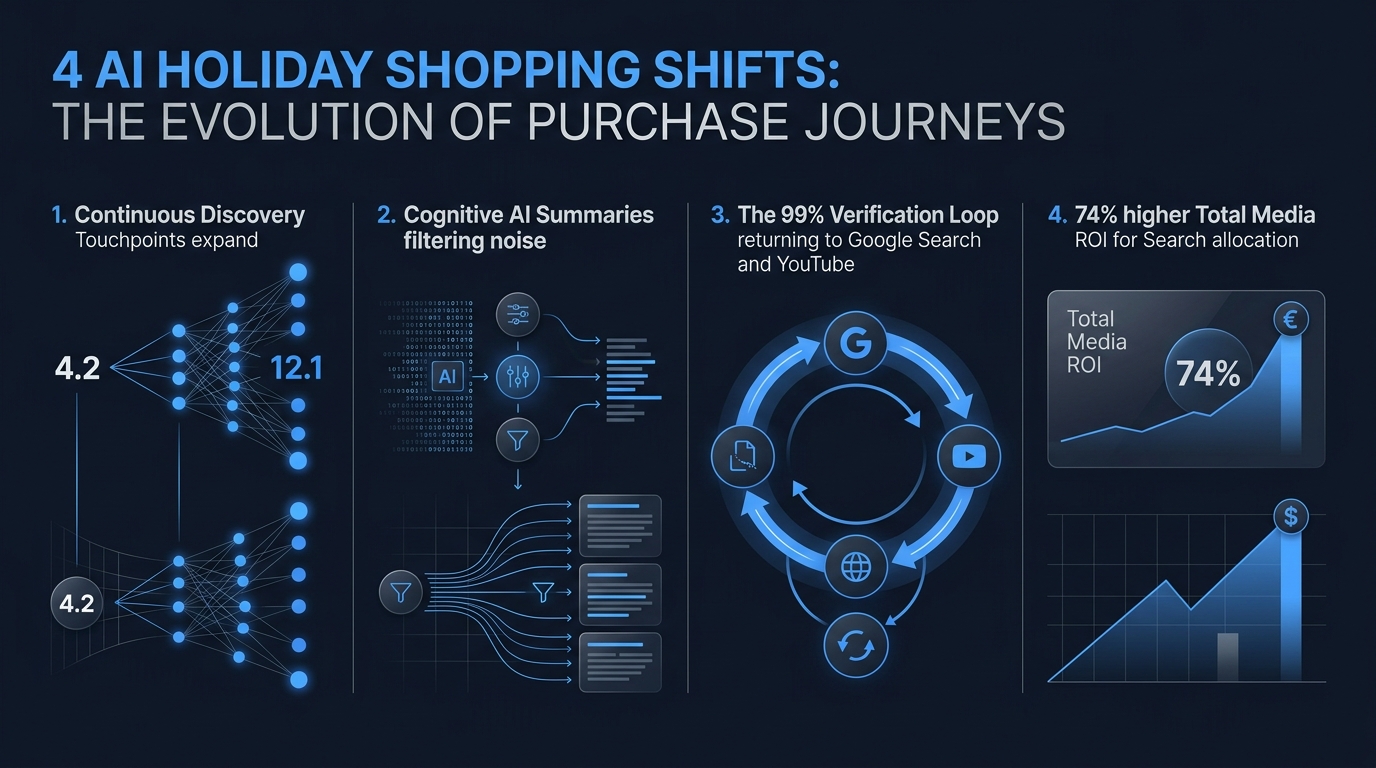 4 AI Holiday Shopping Shifts: The Evolution of Purchase Journeys
Shift 1: Wider Pre-Purchase Exploration Expands Average Touchpoints to 12.1
Traditional consumer journeys are often simplified into a linear funnel of awareness, consideration, and conversion. After adopting AI tools, buyers conduct far broader divergent research and cross-comparisons before narrowing down their shortlist:
- Nearly 3x more touchpoints (12.1 vs. 4.2): According to the survey, online shoppers who use AI platforms or features during their purchase journey engage with an average of 12.1 touchpoints, compared with just 4.2 touchpoints among traditional shoppers who do not use AI.
- Widespread multimodal and natural-language prompting: Among consumers using AI features on Google, 75% say AI enables them to search more naturally—such as snapping a photo to find matching items or entering long, scenario-specific queries like: "Find me a down jacket suitable for skiing at minus 10 degrees Celsius that still looks sleek for everyday wear."
- Visuals and video expand discovery of new brands: Among US consumers using Google and YouTube to shop for holiday items, 85% say both platforms help them gather gift inspiration and discover new brands and categories they had not previously considered.
| Shopper Segment | Average Touchpoints | Pre-Purchase Research Behavior | Typical Search Format |
|---|---|---|---|
| Traditional Non-AI Shoppers | 4.2 touchpoints | Linear price comparison, fast decision closure | Short keyword queries by product name |
| AI-Assisted Shoppers | 12.1 touchpoints | Deep cross-checking, strong focus on scenario fit | Natural conversational queries, visual search, scenario prompts |
Campaign Action: Enrich Google Shopping Graph with Multimodal Product Data
In an era of conversational and visual search, bare-bones product feeds containing only SKU titles and prices are no longer sufficient. Retail brands should enrich their Google Shopping Graph data feeds with high-resolution multi-angle photography, lifestyle scenario imagery, detailed material and use-case specifications, and structured attributes answering high-frequency buyer questions—ensuring AI can accurately surface your products for specific scenario queries.
Shift 2: Filtering Core Specs via AI Summaries Cuts Comparison Time
As product shortlists expand, cluttered browser tabs, conflicting reviews, and fragmented specifications quickly trigger mental overload. AI Overviews and AI search modes in Google Search serve to distill information and filter out noise:
- Summarizing core specs and reviews: Among consumers using AI on Google, 76% agree that AI quickly synthesizes core product specifications and real buyer feedback, saving substantial evaluation time.
- Filtering out redundant marketing fluff: 69% of users say AI summaries help strip away bloated promotional copy and reduce hesitation caused by having too many options.
- Increasing purchase certainty: 75% (three in four) users report that Google AI Overviews speed up product selection and boost their confidence at checkout.
Optimization Principle: Improve Real Page Experience, Abandon Keyword Stuffing
Google Search's multimodal models directly comprehend page context and user intent, rendering rigid keyword stuffing ineffective. D2C teams should invest in genuine on-page experience: compress above-the-fold load times, refine mobile layout responsiveness, and present buyer pain points and product specs in clear, structured sections that serve human readers and allow AI Overviews to extract facts cleanly.
Shift 3: 99% of Third-Party AI Researchers Return to Google & YouTube to Validate
Even after receiving extensive recommendations from generative tools, consumers return to the platforms they trust daily to verify specifications and reputation before paying. Ipsos cross-platform tracking highlights the following behavior:
- High-frequency daily habit: 86% of surveyed consumers use Google Search or YouTube every day, demonstrating higher daily engagement than third-party online platforms.
- 99% cross-tool return for validation: Among consumers who use ChatGPT or other third-party generative AI tools to research products and services, 99% ultimately return to Google Search to cross-check information and support their final purchase decision.
- Confidence in Search results: 81% of US holiday shoppers using Google's generative AI search find the results trustworthy, helping them verify product details clearly before checkout.
- YouTube creator review impact: Kantar video research shows that 70% of US viewers say YouTube creators' hands-on reviews directly influence their purchase decisions. Adelaide's attention meta-analysis further confirms that across streaming, social platforms, and linear TV placements, YouTube ads rank #1 in industry Attention Metric performance.
| 1 | [Exploration Start] ChatGPT / Social Inspiration / Fragmented Discovery |
| 2 | ↓ |
| 3 | [Credibility Cross-Check] Return to Google Search for Official Specs & Authoritative Reviews (99% of Users) |
| 4 | ↓ |
| 5 | [Trust Validation] Watch YouTube Creators' Hands-On Unboxings, Build Details & Long-Term Tests (70% Decision Influence) |
| 6 | ↓ |
| 7 | [Final Commitment] Establish Full Buying Certainty and Complete Checkout with Confidence |
Campaign Action: Build a Dual Validation Path of Search Capture + Creator Testing
Relying on a single channel rarely closes high-consideration purchases on its own. Brands should execute two parallel initiatives: first, partner with vertical YouTube creators to build a library of authentic hands-on unboxings and long-form reviews; second, maintain comprehensive paid and organic coverage across branded and core category terms on Google Search so shoppers returning from third-party tools immediately see authoritative proof.
Shift 4: Pre-Checkout Price & Stock Checks Deliver 74% Higher ROI for Search-First Brands
At the final mile of the purchase journey, shoppers use AI to verify active promo codes, check real-time inventory availability, and confirm fit via Virtual Try-on:
- Closing the final conversion: Among respondents using AI on Google, 60% say AI helped finalize their purchase decision, uncover relevant discounts, and accelerate checkout.
- Search intent capture drives 74% higher media ROI: Marketing Mix Modeling (MMM) meta-analysis reveals that during Q4 holiday promotions, brands allocating a larger budget share to Google Search to capture explicit purchase intent achieve 74% higher Total Media ROI than brands tilted toward Paid Social reach.
| 1 | Q4 Peak Holiday Season Total Media ROI Comparison: |
| 2 | |
| 3 | Google Search Intent-Capture Brands ██████████████████████████████ 174% (+74% advantage) |
| 4 | Paid Social Volume-Led Brands █████████████████ 100% (baseline) |
Campaign Action: Sync Live Inventory & Pricing and Streamline Checkout
The costliest peak-season failure is losing high-intent orders at checkout due to stockouts or payment friction. Merchants must maintain high-frequency real-time price and inventory synchronization between their storefront and Shopping Feeds so AI retrieval never skips out-of-date listings. On checkout pages, enable accelerated wallets such as Google Pay to reduce address and card entry steps and curb Cart Abandonment.
Retail Playbook: The Commerce 4 Execution Framework
In the study, 76% of holiday shoppers say that "choosing the right product" matters greatly to them. Around the four decision shifts above, Google synthesized the Commerce 4 execution checklist:
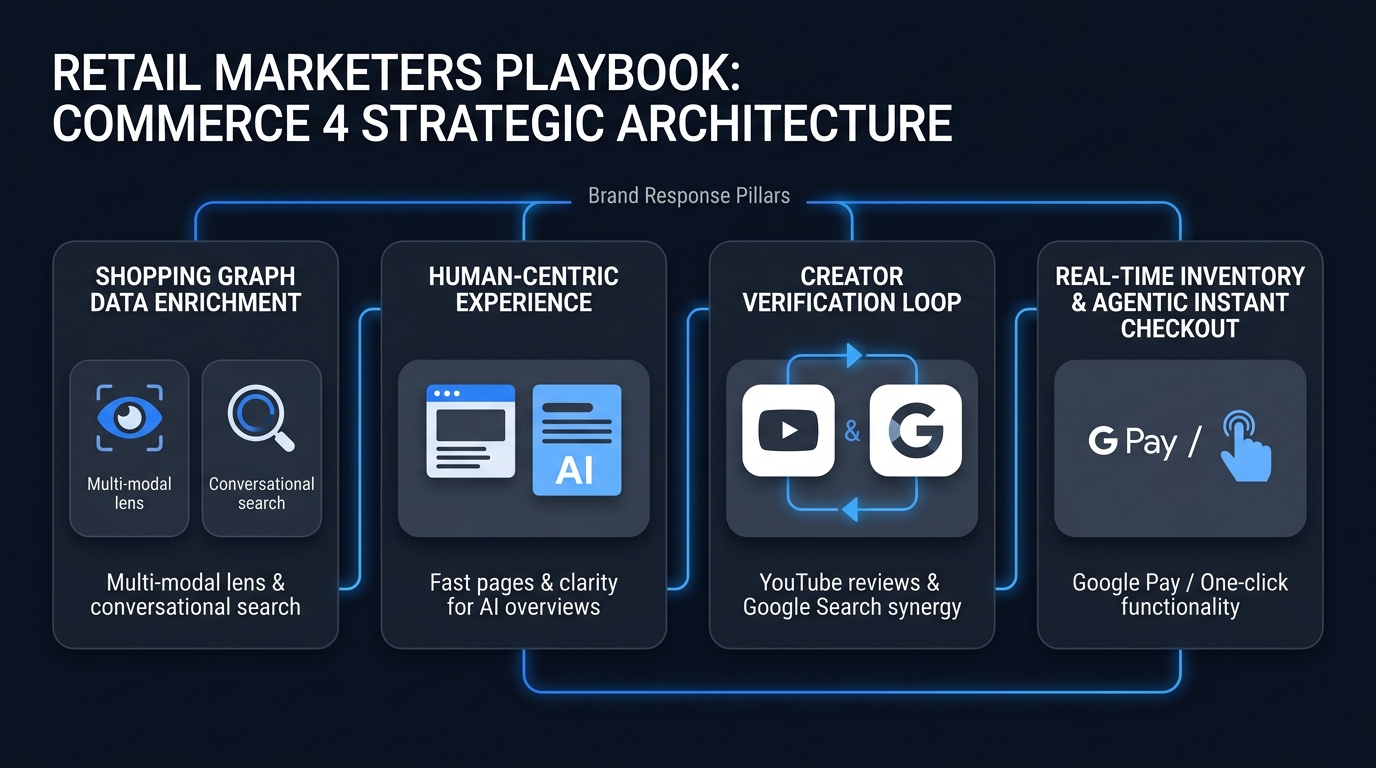 Retail Marketers Playbook: Commerce 4 Strategic Architecture
1. Shopping Graph Data Enrichment
Upload high-resolution product photos, 360-degree models, and detailed material notes such as breathability or waterproofing, while completing GTIN, brand, category, and scenario attributes to support Google Lens visual search and long-tail conversational queries.
2. Human-Centric & Site Performance
Optimize front-end Core Web Vitals to guarantee fast mobile loading and smooth interaction; structure page copy cleanly to address buyer objections directly, making core product facts effortless for both human shoppers and AI Overviews to parse.
3. Creator Verification Loop
Incorporate YouTube creators' hands-on tests, unboxings, and tutorial videos into Search and feed-based campaign asset pools to build authentic social proof across high-attention video placements.
4. Real-Time Inventory & Instant Checkout
Establish automated inventory pipelines to keep holiday promotional pricing and stock levels continuously updated, and deploy guest express checkout options to compress the path from purchase intent to completed payment.
References & Data Methodology
Statistical benchmarks cited in this report are drawn from the following third-party sampling surveys and econometric modeling meta-analyses:
- Ipsos Global Consumer Journeys: Covered 24 countries and regions including the US, UK, Japan, Germany, France, Canada, Australia, South Korea, and Singapore, with a total sample of N = 61,782, comparing 14,305 AI shoppers against 21,881 non-AI shoppers who carefully evaluated purchases within the prior week.
- Ipsos Commercial Generative AI User Behavior Tracker: Surveyed 18,501 global users of Google AI features and 12,038 ChatGPT commercial research users.
- Ipsos Holiday Shopping Survey: Two-day immediate recall quantitative scoring conducted across 16,937 verified holiday purchase transactions.
- Google & Kantar Video Ecosystem Insights Report: Cross-screen comparative analysis covering 7,621 video consumers across 9 major video and social platforms.
- Adelaide Attention Meta-Analysis: Spanned 30 verticals, 92 advertisers, and 248 US campaigns, measuring attention scores across more than 54.71 billion ad impressions.
- Ekimetrics Upper-Funnel MMM Meta-Analysis: Analyzed 64 Marketing Mix Models across 6 industries—CPG, retail, tech/telecom, automotive, beauty, and finance—comparing real Q4 total media ROI between Search-weighted and Social-weighted brand allocations.
Found this actionable? Copy standard citation & summary
Formatted with canonical attribution link and executive summary—ready for Slack, Notion, or LLM context.
Put Into Practice: Companion Browser Workbenches
UTM Builder Pro Matrix Workspace
Reverse URL parser, GA4 channel group diagnostics, and dynamic ad macro batch CSV export.
Shopify GTM & GA4 Web Pixel Generator
Generate production-ready Shopify Customer Events Web Pixel code for GA4, Meta, and TikTok.