
Google Maps Local SEO Playbook: Ex-FAANG Ranking Engineer's 8-Step System to Hit #1 Across All 169 City Grid Points (With 8 AI Prompts & 90-Day Plan)
 Google Maps Local SEO Playbook: 8 Steps to Hit #1 Across All 169 City Grid Points
Core Empirical Takeaway: Across local service searches, high-intent phone calls concentrate overwhelmingly in the top 3 spots on Google Maps, while position #4 gets scraps. First Page Sage measured Local Pack click shares at 14.8%, 12.6%, and 11.9% (39.3% combined) for spots #1–#3. Across real client call logs, climbing from #3 to #2 roughly doubles inbound calls, and climbing from #2 to #1 roughly doubles them again. Unlike cold paid leads, people searching Google Maps with city or "near me" intent have already decided they need help and typically pick directly from the first three names they see.
Many local operators and multi-location brands sit stuck at position #7 for years even while paying monthly agency retainers—not because local search is mysterious, but because the execution behind Maps rankings is repetitive and tedious, and the tedious pieces are the exact ones teams skip. Drawn from an ex-FAANG search ranking engineer whose team has ranked 50+ law firms #1 on Google, this guide documents every step in exact operational sequence—complete with 8 ready-to-paste ChatGPT / Claude prompts and a 90-day execution plan.
1. The Running Case Study, Deliverables & Prerequisite Checklist
To keep every tactic concrete, this playbook tracks one client transformation from start to finish:
- Day 1 Baseline: A local divorce lawyer receiving roughly 4 calls a month from Google, sitting at 0 of 169 tracked grid points in the top 3 across his city (mostly ranking #8–#20).
- Day 90 Outcome: Scaling to 50+ inbound calls per month while hitting #1 at all 169 tracked grid points citywide.
- Cross-Industry Fit: Whether you operate local retail/service branches, medical clinics, med spas, roofing and home services, legal practices, or regional DTC showrooms, the identical 8 steps apply—only your primary categories and directory targets change.
7 Core Assets You Will Build by Following All 8 Steps
- A multi-point citywide grid scan benchmark showing exact rankings street by street;
- A Google Business Profile (GBP) engineered around the specific calls you want most;
- 20–100 character-identical directory citations matching competitors where it actually counts;
- A consistent weekly review velocity loop plus 24–48h reply discipline;
- Dedicated service & town landing pages built to convert mobile searchers into booked calls;
- Earned local & industry backlinks strictly free of toxic link-farm footprints;
- ChatGPT Local search visibility paired with a 90-day attribution & reporting cadence.
Before Step 1: Make Sure Someone Actually Answers the Phone Every optimization below generates inbound calls. If nobody picks up, high Maps visibility simply hands warm callers directly to the #2 business right below you. Clio's 2024 research found that 60% of law firms failed to answer when a prospective client called. Because accidents happen on highways and legal/home searches happen after work hours, answering speed matters just as much as ranking position.
Google Maps SEO is built for three specific criteria (purely online nationwide e-commerce brands without physical offices or local service areas should focus on classic organic SEO instead—see our Google SEO Fundamentals Playbook and GEO Content Architecture Guide):
- Customers search for your service combined with a city name or "near me";
- You maintain a physical office or serve a clearly defined geographic radius;
- Trained staff or an answering service pick up during every hour listed on your profile.
2. Step 1: Scan Where You Rank Across the Entire City
Skip baseline measurement and you risk spending months fixing bottlenecks that aren't holding you back. Google Maps rankings vary dramatically by physical block: you can rank #1 outside your own front door while sitting at #11 two miles down the road.
Googling your own service from your office desk proves nothing because Google already knows your device sits on top of your business pin. Instead, run a geo-grid scan via Local Falcon or BrightLocal across dozens or hundreds of coordinates spanning your metro area:
- Run Two Baseline Scans Immediately:
- Core Service Keyword: e.g.,
"divorce lawyer"; - "Near Me" Modifier: e.g.,
"divorce lawyer near me".
- Core Service Keyword: e.g.,
For the case-study divorce firm, Day 1 came back at 0 / 169 grid points in the top 3, with most neighborhoods trapped between #8 and #20. Ninety days later, the exact same 169-point scan turned solid green at 169 / 169 (#1 citywide). Save that initial scan permanently as your "before" benchmark.
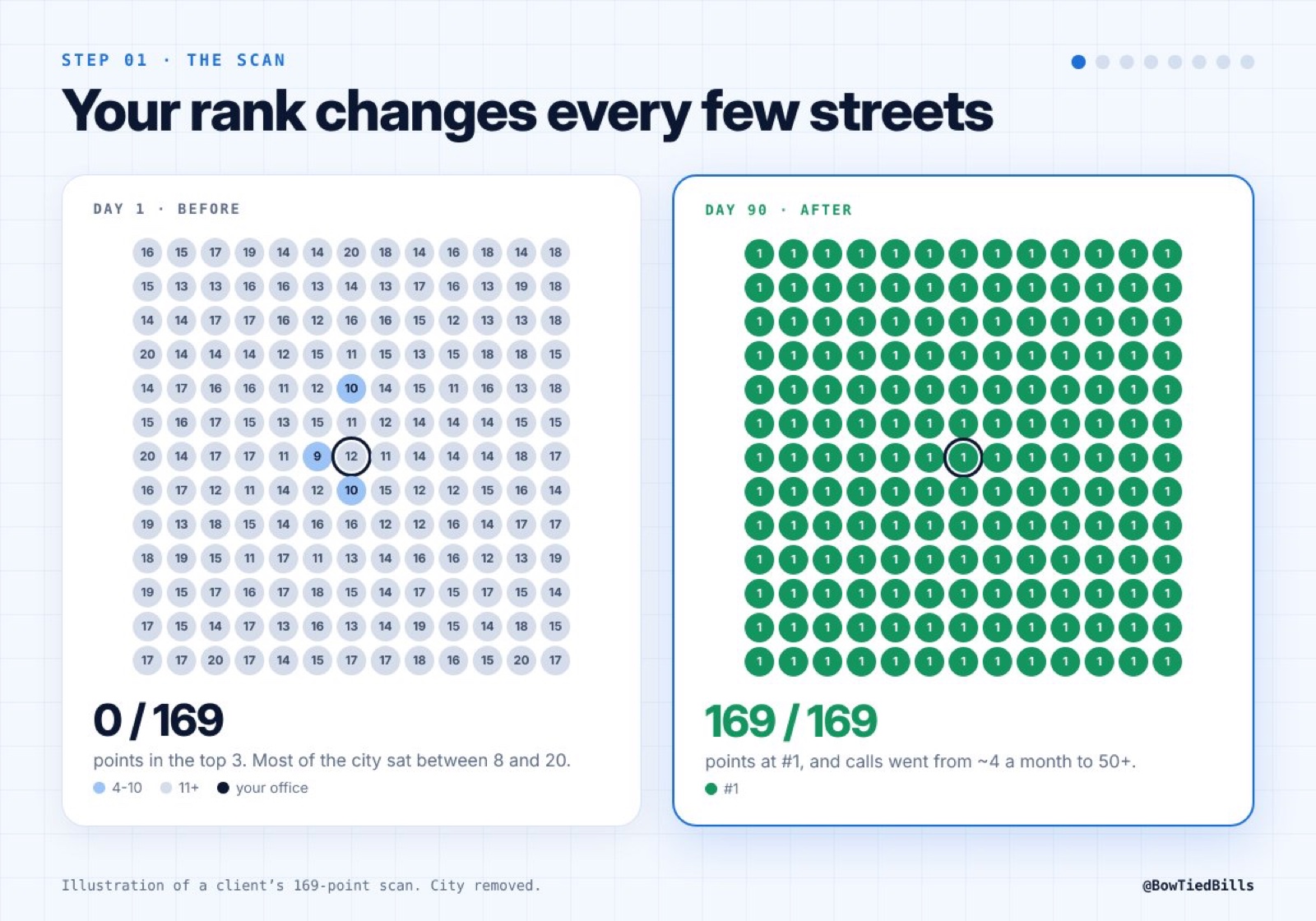 Google Maps 169-Point City Grid Scan Before vs. After 90 Days
📋 Step 1 Copy-Paste AI Prompt (Baseline Grid Audit & Weak-Zone Gap Analysis)
| 1 | I run [business] in [city]. I want more calls for [main service]. |
| 2 | |
| 3 | Attached are two grid scans of my Google Maps rankings: one for |
| 4 | "[main service]" and one for "[main service] near me". |
| 5 | |
| 6 | 1. Count the points where I'm in the top 3, 4-10, and 11 or lower. |
| 7 | 2. Tell me which parts of the city I'm strongest and weakest in. |
| 8 | 3. Where I'm weakest, name the businesses ranking in the top 3. |
| 9 | I'll paste their primary category and review count from Google. |
| 10 | 4. Save it all as my "before" table with today's date. |
| 11 | |
| 12 | Only use numbers you can see in the screenshots. If something is |
| 13 | unclear, ask me instead of guessing. |
3. Step 2: Fix Your Google Business Profile, Starting With Primary Category
When business owners ask what moves Google Maps rankings most, they almost always guess reviews. Yet the very first field an experienced ranking engineer audits is your Primary category.
Whitespark's ranking factors survey ranks Primary category as the #1 factor for Local Pack visibility. Google relies on it first to decide which commercial searches you are even eligible to enter. Too many operators pick broad buckets—like "Law firm" instead of "Personal injury attorney", or "Contractor" instead of "Roofing contractor"—giving Google zero specificity for high-value calls.
- Verified Field Result: A personal injury client came in listed under generic
"Law firm". Switching the primary category strictly to"Personal injury attorney"alongside launching the Step 4 review cadence doubled monthly calls in the very first month.
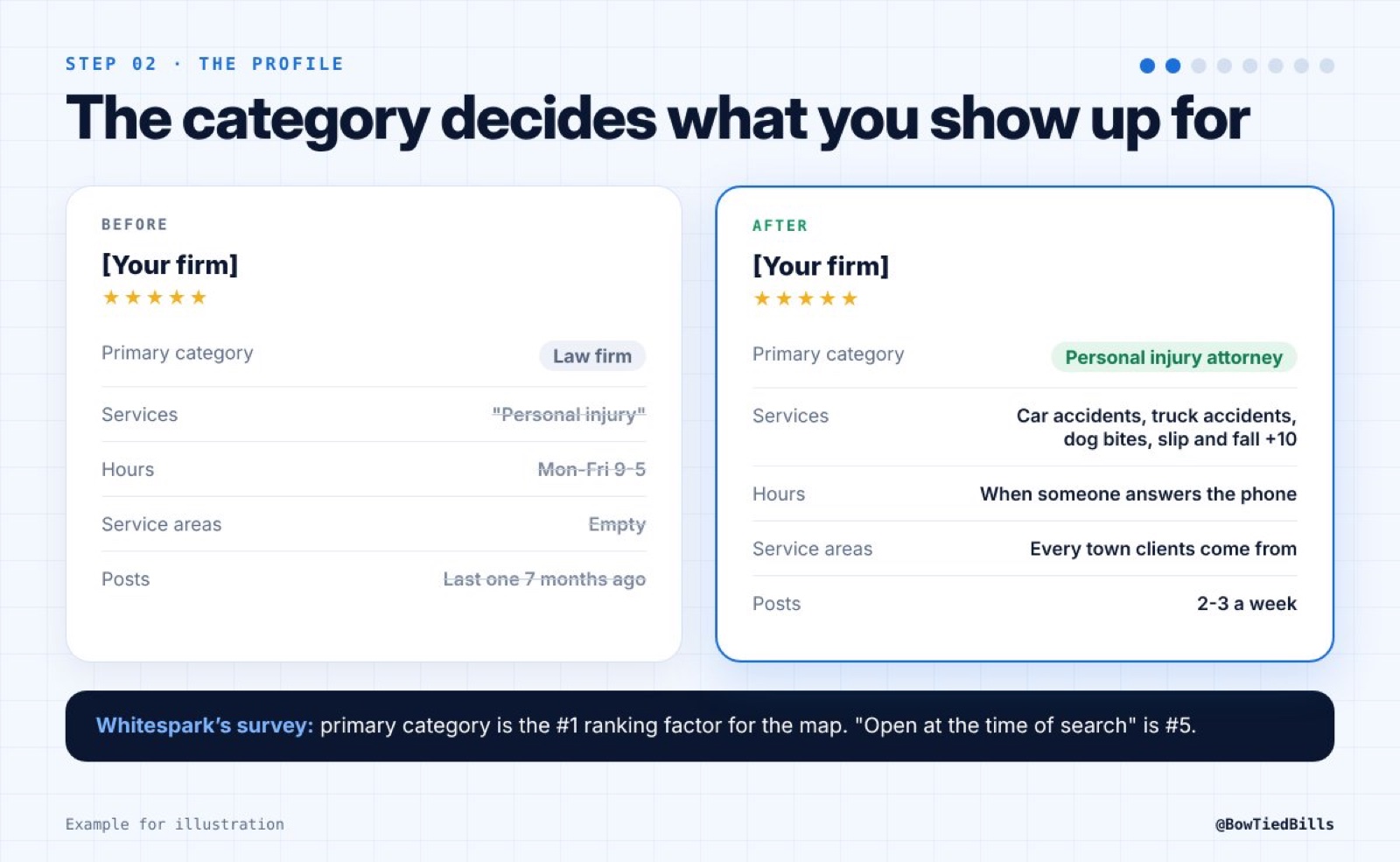 Google Business Profile Primary Category, Services & Hours Before vs. After
Seven Essential Google Business Profile Upgrades
- Primary category = the exact single service you want the most calls for;
- Secondary categories covering every distinct complementary service you legally provide;
- Every granular service listed line by line: Someone searching for a
"dog bite lawyer"wants a specialist;"Dog bites"deserves its own explicit service entry; - Service areas populated with every surrounding municipality and neighborhood you actively serve;
- Authentic office and team photos showing your real workplace and staff in action;
- 2–3 profile posts every week signaling ongoing operational activity;
- Accurate hours matching real phone coverage: Whitespark ranks "open at the time of search" among the top 5 map signals. If someone searches
"personal injury lawyer near me"at 9 PM, Google favors providers whose profile indicates they are open right now. If a live after-hours intake service answers your line, reflect those verified answering hours on your profile—one multi-attorney client explicitly credited that single update for an immediate call lift.
Two Red Lines That Trigger Immediate Google Profile Suspension:
- Stuffing keywords or a city name into your business name when it is not on your legal registration or permanent storefront signage;
- Using a virtual office, P.O. box, or another company's address. Google's Business Profile guidelines prohibit both. A suspended listing vanishes from the map entirely until you submit verification documentation and pass reinstatement review.
📋 Step 2 Copy-Paste AI Prompt (Category Calibration & 4 Weeks of Profile Posts)
| 1 | Here's my Google Business Profile, copied from Google: |
| 2 | Name: [ ] |
| 3 | Primary category: [ ] |
| 4 | Secondary categories: [ ] |
| 5 | Services: [ ] |
| 6 | Hours: [ ] |
| 7 | Service areas: [ ] |
| 8 | |
| 9 | Here are the top 3 businesses for "[main service]" in [city], with the |
| 10 | category shown under each name on Google: [paste] |
| 11 | |
| 12 | 1. Compare my primary category with theirs. If mine is broader than |
| 13 | the service I want calls for, tell me the exact category to switch to. |
| 14 | 2. Suggest secondary categories for the other services I offer. |
| 15 | 3. Turn my services into a full list, one per line, written the way a |
| 16 | client would search for each one. |
| 17 | 4. Check my business name. Flag anything that isn't on my sign and my |
| 18 | paperwork (keywords or a city). |
| 19 | 5. Write 8 profile posts, two a week for four weeks, about my services |
| 20 | and my area. Use only facts I've given you. |
4. Step 3: Build Exact NAP Citations Everywhere Competitors Appear
A citation is any external mention of your exact Name, Address, and Phone Number (NAP) on third-party sites such as Apple Business Connect, Bing Places, Yelp, BBB, chamber directories, and industry portals. Think of citations as third-party references: the more authoritative directories agree on exactly who and where you are, the higher Google's confidence becomes in placing you in the top 3.
A 3-Minute Free Diagnostic to Quantify Your Citation Deficit
- Copy the exact business name of whichever competitor currently holds #1 in your city;
- Search that exact name in Google wrapped in quotation marks (
"[Competitor Exact Name]"); - Record the approximate indexed result count;
- Repeat the exact quoted search for your own business name.
Leading #1 firms routinely return several thousand results (e.g., 3,900+), whereas struggling businesses often sit at 20 or 30—you cannot compete for the top slot with a 100x entity authority gap. Next, search your #1 competitor's phone number in quotes—every domain that surfaces is an active directory listing they hold and you are missing.
- Verified Field Impact: An immigration law firm built out profiles across roughly 100 core state and industry directories. Monthly inbound calls climbed from ~32 to 104 within the first 4 months, while statewide rankings across 225 tracked grid points moved from
0in the top 3 to #1 at every point.
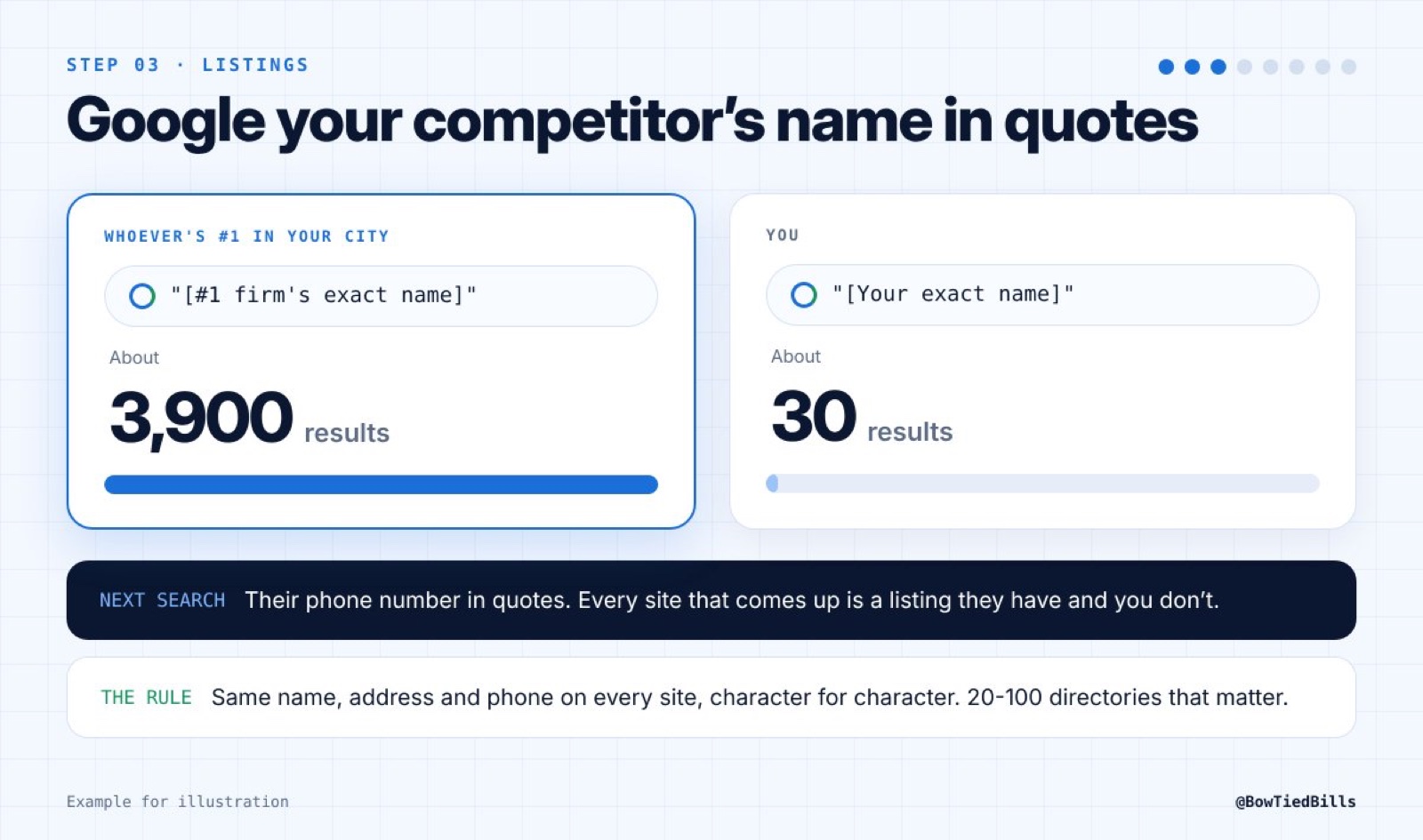 Exact Quoted Search Diagnostic for Competitor Citation Gap
Two Non-Negotiable Citation Rules
- Character-for-character NAP consistency: Business name, suite formatting, phone digits, and domain URL must match your Google Business Profile character for character on every platform. If you changed phone numbers three years ago, stale listings still displaying your legacy number actively contradict your profile signals;
- Focus on 20–100 high-signal directories only: Prioritize core platforms (Bing Places, Apple Business Connect, Yelp, BBB, Facebook), vertical industry hubs, and local directories—never pay for automated 5,000-directory spam blasts.
📋 Step 3 Copy-Paste AI Prompt (40 Priority Directories & Old-Number Cleanup Checklist)
| 1 | My business details exactly as they appear on my Google profile: |
| 2 | Name: [ ] |
| 3 | Address: [ ] |
| 4 | Phone: [ ] |
| 5 | Website: [ ] |
| 6 | Industry: [ ] |
| 7 | City and country: [ ] |
| 8 | |
| 9 | 1. List the 40 directories that matter most for my industry and country. |
| 10 | Start with the main ones (Bing Places, Apple Business Connect, Yelp, |
| 11 | BBB, Facebook), then industry sites, then local ones. |
| 12 | 2. For each one, give me the sign-up link and whether it's free or paid. |
| 13 | 3. I'll paste what comes up when I Google my phone number (and my old |
| 14 | number, if I had one) in quotes. Flag every listing where my name, |
| 15 | address or phone doesn't match the details above. |
| 16 | 4. Give me a checklist: directory, status (listed, missing or wrong |
| 17 | details), date fixed. |
| 18 | |
| 19 | If you're not sure a directory exists, say so. Don't make one up. |
5. Step 4: Engineer Steady Weekly Review Velocity (Last 90 Days Beat Raw Totals)
Total lifetime review count matters far less than most operators assume: Google heavily weights recent review velocity—especially over the trailing 90 days—relative to surrounding competitors. Firms with fewer than half a neighbor's total review count routinely outrank incumbents because 40 stale reviews from five years ago prove little about current operations, while 8 detailed reviews from the past month send an unmistakable freshness signal.
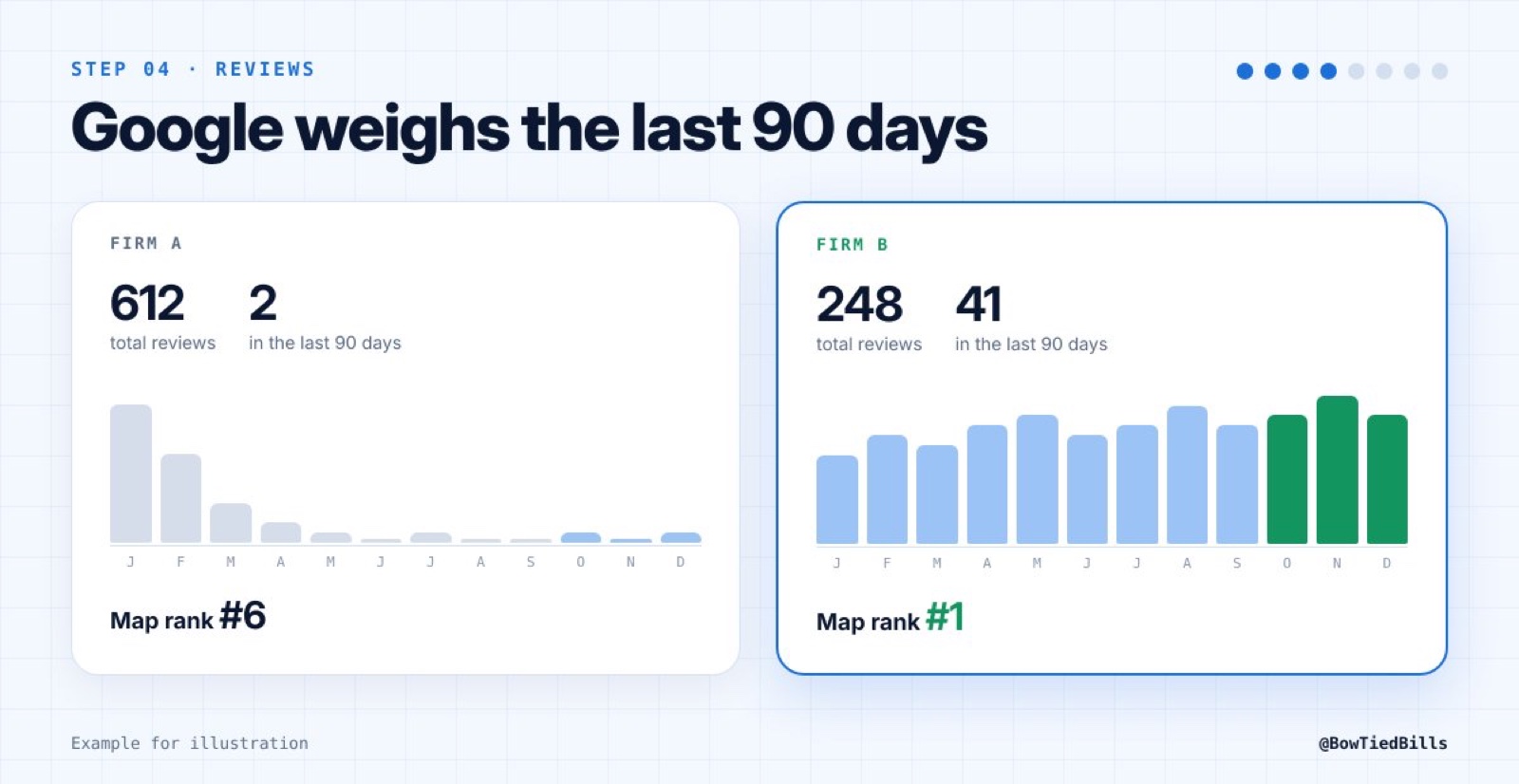 Google Maps 90-Day Review Velocity Comparison: Firm A vs. Firm B
Target 5–20 new authentic reviews per month scaled to city competitiveness—steady weekly cadence vastly outperforms a one-off spike followed by silence.
Five Components of an Automated Review System
- Trigger requests automatically at job or case completion—never rely on memory;
- Send a direct Google review form deep-link, never vague instructions like "find us and leave a review";
- Sequence over 7 days: Email first, follow up by SMS text, and add a brief phone touch for high-touch engagements;
- Run 2–3 gentle follow-ups, because willing clients frequently intend to leave feedback and simply forget;
- Reply to every review—5-star, 3-star, and 1-star—within 24–48 hours: Owner response activity is itself an active ranking and conversion signal.
Critical Compliance & Legal Guardrails (Zero Review Gating or Incentives): Never offer payments, gift cards, rebates, or discounts in exchange for reviews, and never filter requests only toward happy clients (Review Gating). Selective gating violates Google's review policies, and under FTC enforcement rules, fake or deceptive review practices carry civil penalties of up to $53,088 per violation. Send the exact same neutral ask to every completed client regardless of sentiment.
📋 Step 4 Copy-Paste AI Prompt (7-Day Compliant Ask Sequence & Reply Drafts)
| 1 | I run [business]. A client is finished with me when [the case closes / |
| 2 | the treatment ends / the job is signed off]. |
| 3 | |
| 4 | My review link: [link] |
| 5 | |
| 6 | 1. Write the ask: one email, one text and a short phone script, sent in |
| 7 | that order over 7 days. Under 60 words each, plain and friendly. |
| 8 | 2. Invite them to mention the service they used and their town, without |
| 9 | telling them what to write. |
| 10 | 3. Write 2 follow-ups for clients who don't leave one. |
| 11 | 4. Write reply drafts for a 5-star, a 3-star and a 1-star review that |
| 12 | I'll edit before sending. |
| 13 | |
| 14 | Rules: no incentives or discounts, and the same ask goes to every |
| 15 | client, whatever their experience was. |
6. Step 5: Build a Dedicated Page for Every Service You Want Calls For
Your Google Business Profile links to your website, and Google crawls those destination URLs to confirm your site backs up the search query. One generic homepage briefly listing 8 services rarely ranks competitively for any of them. Google wants dedicated pages built specifically to prove deep relevance for each high-margin service.
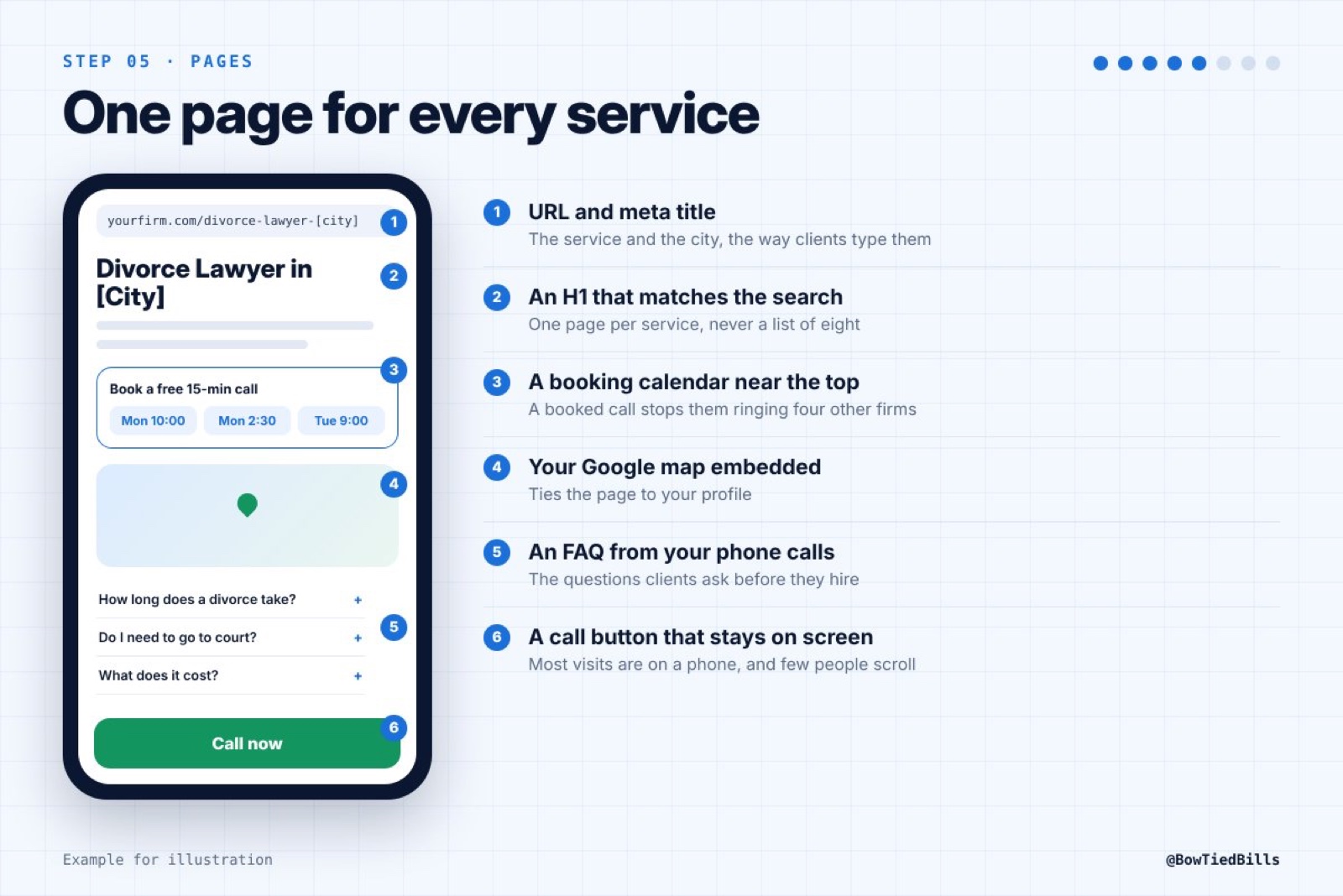 High-Converting Local Service Landing Page 6-Element Anatomy
Six Mandatory Elements on Every Local Service Page
- Primary Service + City in Meta Title, Meta Description, and H1: These remain the three highest-weighted on-page elements; write them naturally the exact way local prospects search (keeping clean semantic paths—see our Google URL Structure Guide);
- Sticky Mobile Tap-to-Call Button: Most local searches happen on smartphones, and urgent callers rarely scroll to the footer;
- 15-Minute Booking Calendar Near the Top: Right after a car crash or emergency repair, prospects call five providers sequentially until someone locks them in. A booked calendar slot takes that buyer off the market before competitor #2 even answers;
- Embedded Google Business Profile Map: Reinforces entity alignment between your landing URL and verified map pin;
- FAQ Section Built From Real Sales/Intake Phone Questions addressing timelines, pricing variables, and next steps;
- Dedicated Pages for Surrounding Towns: Include unique local H1s, authentic municipal details (courthouses, highways, landmarks), and internal links pointing back up to the core service page—never duplicate one template and swap city tokens, as Google ignores thin doorway variants.
Two high-ROI additions worth considering: embed a case/project value calculator page if prospects frequently ask "what is my case or job worth?", and build native Spanish (or secondary local metro language) service pages where local demographics warrant it. Write strictly for buyers ready to hire this week—publishing DIY "how-to" articles on commercial service URLs attracts do-it-yourself readers who never call.
📋 Step 5 Copy-Paste AI Prompt (Service-Page Gap Audit, Metadata & Town Blueprints)
| 1 | My services, in order of what they earn me: [list] |
| 2 | My website's current pages: [paste your menu or sitemap] |
| 3 | My city and the towns my clients come from: [list] |
| 4 | |
| 5 | 1. Match each service to a page. List every service with no page. |
| 6 | 2. For my top 3 services, write the URL, a meta title under 60 |
| 7 | characters, a meta description under 155 and the H1. Each one names |
| 8 | the service and the city the way a client would type them. |
| 9 | 3. Outline each page in order, with the call button and booking |
| 10 | calendar near the top and an FAQ built from questions clients ask. |
| 11 | 4. List the towns that deserve their own page, and for each one, the |
| 12 | local details I'd need to give you (courthouse, landmarks). |
| 13 | 5. If clients ask what their case or job is worth, suggest a calculator |
| 14 | page and the inputs it needs. |
| 15 | |
| 16 | Write for people ready to hire someone this week. |
7. Step 6: Earn Real Local & Industry Backlinks (Never Touch Link Marketplaces)
Steps 2–5 define what you do and where you operate; backlinks tell Google who vouches for your authority. A link acts as an online referral—an endorsement from a trusted community institution carries orders of magnitude more ranking weight than anonymous low-trust mentions.
Focus link acquisition exclusively on domains that are local, industry-specific, or ideally both:
- Local Chamber of Commerce membership profiles;
- Local news outlets, neighborhood magazines, and city blogs;
- Community sponsorships (youth sports teams, local 5K charity runs, civic events);
- Accredited industry associations and licensing boards;
- Suppliers, vendors, and complementary local referral partners.
Why Paid "High-DR" Link Marketplaces Destroy Rankings: Domains sold on public guest-post marketplaces frequently display inflated domain ratings and traffic charts on paper. Yet when inspecting actual traffic origin on marketplace sites audited by the author, roughly ~99% of traffic came from unrelated searches in India. Because dozens of buyers buy from the exact same public link inventory, Google's spam systems detect the shared graph footprint easily—penalizing every business connected to those paid placements.
📋 Step 6 Copy-Paste AI Prompt (30 Vetted Local Link Prospects & Custom Outreach)
| 1 | I run [business] in [city]. My website: [URL] |
| 2 | |
| 3 | 1. Find 30 local and industry websites that could link to me: local |
| 4 | news, community sites, associations, sponsorships, suppliers and |
| 5 | partners. Give me the link and the contact page for each. |
| 6 | 2. For each one, tell me why they'd want to link to me. |
| 7 | 3. Write a short outreach email for the top 10, under 100 words each, |
| 8 | with a reason specific to that site. |
| 9 | 4. Leave out any site that sells links or lists "guest post" prices. |
8. Step 7: Get Named When Prospects Ask ChatGPT for Local Recommendations
A growing share of local buyers now ask ChatGPT who to hire before opening Google at all. Because ChatGPT's live web search draws heavily from top-ranking search entities, Steps 1–6 already do most of the heavy lifting. One multi-attorney client who reached #2 in ChatGPT for their metro reported signing ~20 new clients within 6 weeks, forcing them to hire an additional paralegal just to handle intake volume.
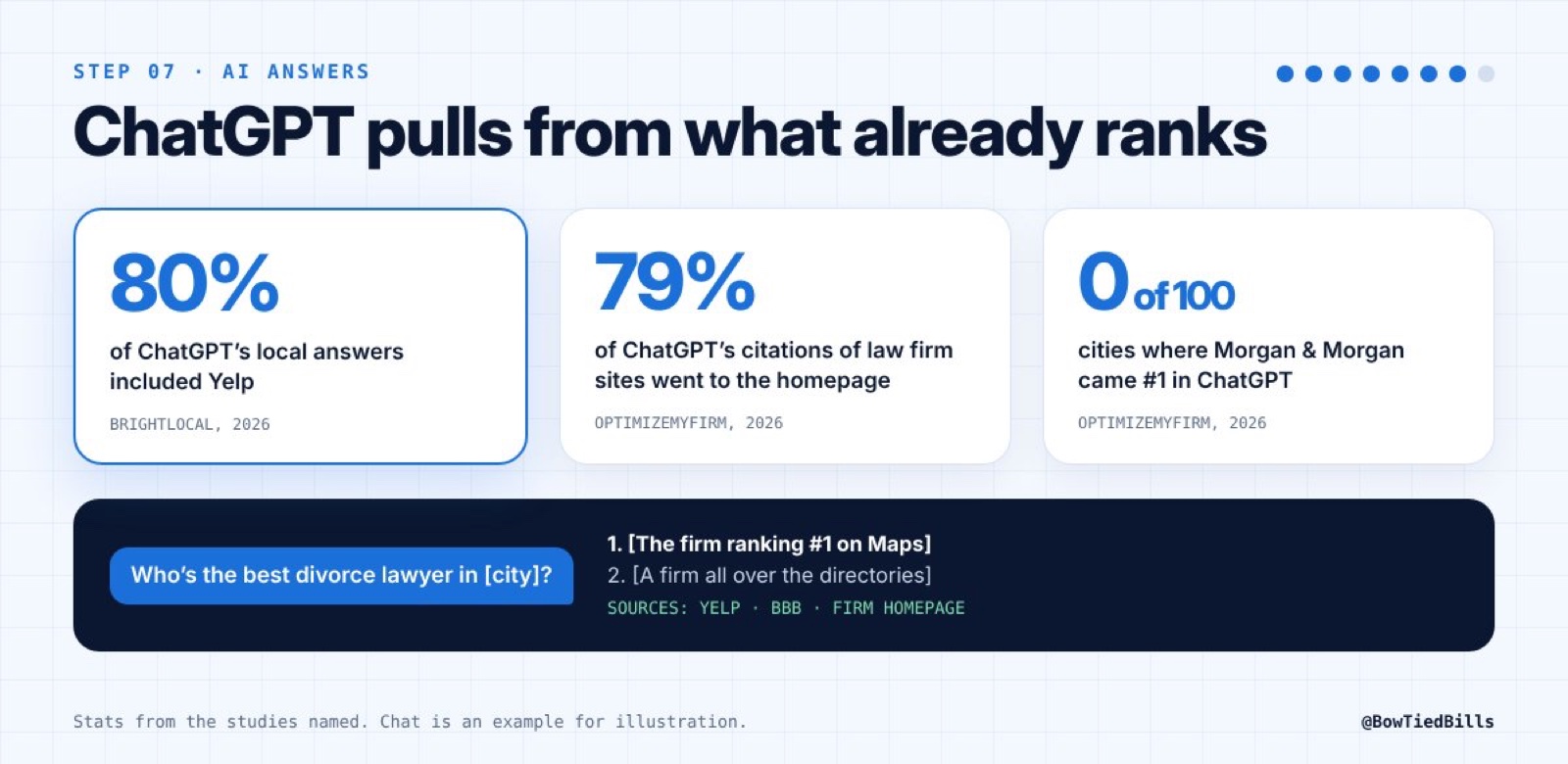 Where ChatGPT Pulls Local Recommendations: BrightLocal & OptimizeMyFirm Data
Complement your Maps foundation with three research-backed AI Search (GEO) moves (aligned with our EVAOO GEO Playbook):
- Claim and optimize your Yelp profile: BrightLocal found Yelp cited in 80% of ChatGPT's local recommendations;
- State your exact core services and city plainly on your website Homepage: OptimizeMyFirm found that when ChatGPT cited a law firm's own domain, 79% of citations pointed directly to the homepage;
- Audit ChatGPT monthly using customer queries, identify every third-party site cited in the answers, and ensure your business is listed across those cited sources.
- Ad Spend Cannot Buy AI Visibility: In OptimizeMyFirm's 100-city benchmark, Morgan & Morgan—backed by $600M+ in annual advertising spend—ranked #1 in 0 of 100 cities inside ChatGPT recommendations. Watch closely for ChatGPT's business profile claiming rollout across service verticals and claim yours as soon as your category opens.
📋 Step 7 Copy-Paste AI Prompt (Monthly ChatGPT Live-Search Citation Audit)
| 1 | Search the web and answer these the way you would for a customer: |
| 2 | - "Who's the best [service] in [city]?" |
| 3 | - "[service] near [neighbourhood]" |
| 4 | - "Who should I call about [specific problem] in [city]?" |
| 5 | |
| 6 | Then: |
| 7 | 1. List every business you named, in order, for each question. |
| 8 | 2. List every website you cited for each answer. |
| 9 | 3. Tell me where [my business] appears, or say that it doesn't. |
| 10 | 4. For the cited sites I'm not on, tell me how to get listed. |
| 11 | |
| 12 | Put it in a table with today's date. I'll run this every month. |
9. Step 8: Track Inbound Calls Monthly & Judge Execution at 90 Days
Expect GBP updates to impact map results within days, while on-page website improvements absorb as Google recrawls every 2–4 weeks:
- First 30 days: Noticeable lift in GBP profile clicks and inbound calls (the author's fastest turnaround generated a tracked client lead on Day 6);
- Around Month 3: #1 visibility across a 20–25 square mile core radius;
- Up to Month 6: Full citywide dominance across large, hyper-competitive metro areas.
Like monthly index investing into the S&P 500, compounding rewards go strictly to operators who stay consistent past month two. Review four concrete metrics on a fixed monthly schedule:
- Profile Calls directly inside Google Business Profile Performance;
- Current Geo-Grid Scan diffed against your saved Day 1 "Before" table;
- Net New Monthly Reviews vs. your
#1local competitor; - Booked, Paid Clients—the bottom-line revenue number that validates every other metric.
📋 Step 8 Copy-Paste AI Prompt (Monthly Grid & Call Log Progress Audit)
| 1 | Here's my "before" table from my first grid scan: [paste] |
| 2 | Attached: this month's grid scan, my Google profile Performance |
| 3 | screenshot and my call log. |
| 4 | |
| 5 | 1. Compare this month with my "before": points in the top 3, average |
| 6 | rank, calls, website clicks and direction requests. |
| 7 | 2. Show the change for each as a number and a %. |
| 8 | 3. Tell me which parts of the city moved and which didn't. |
| 9 | 4. Tell me the one thing to work on next month, based on which step |
| 10 | (profile, listings, reviews, pages or links) looks weakest. |
| 11 | |
| 12 | Use only the numbers in what I've attached. |
10. Five Ways This Fails & The Complete 90-Day Execution Roadmap
| Failure Mode | Common Operator Mistake | Ranking & Revenue Consequence |
|---|---|---|
| 1. Profile Suspension | Adding keywords/city names to GBP business title or using virtual offices | Profile vanishes completely from Google Maps until verified reinstatement |
| 2. Purchased Reviews or Links | Paying for fake reviews or "high-DR" guest-post marketplace backlinks | Footprint detected by Google spam systems; penalties wipe out domain authority |
| 3. Broad Category Overload | Trying to rank one profile across every service under a generic parent category | Fails relevance filtering against specialist competitors across every query |
| 4. 24/7 Hours Unanswered | Listing 24/7 open hours while calls ring unanswered at 9 PM | Costliest self-inflicted wound: you earn the #1 impression only to hand the live call to #2 |
| 5. Quitting at Month 2 | Stopping cadence before geo-grid maps turn uniformly green | Abandons foundation just weeks before citation, review, and page authority compound |
🗓️ Week-by-Week 90-Day Local SEO Execution Plan
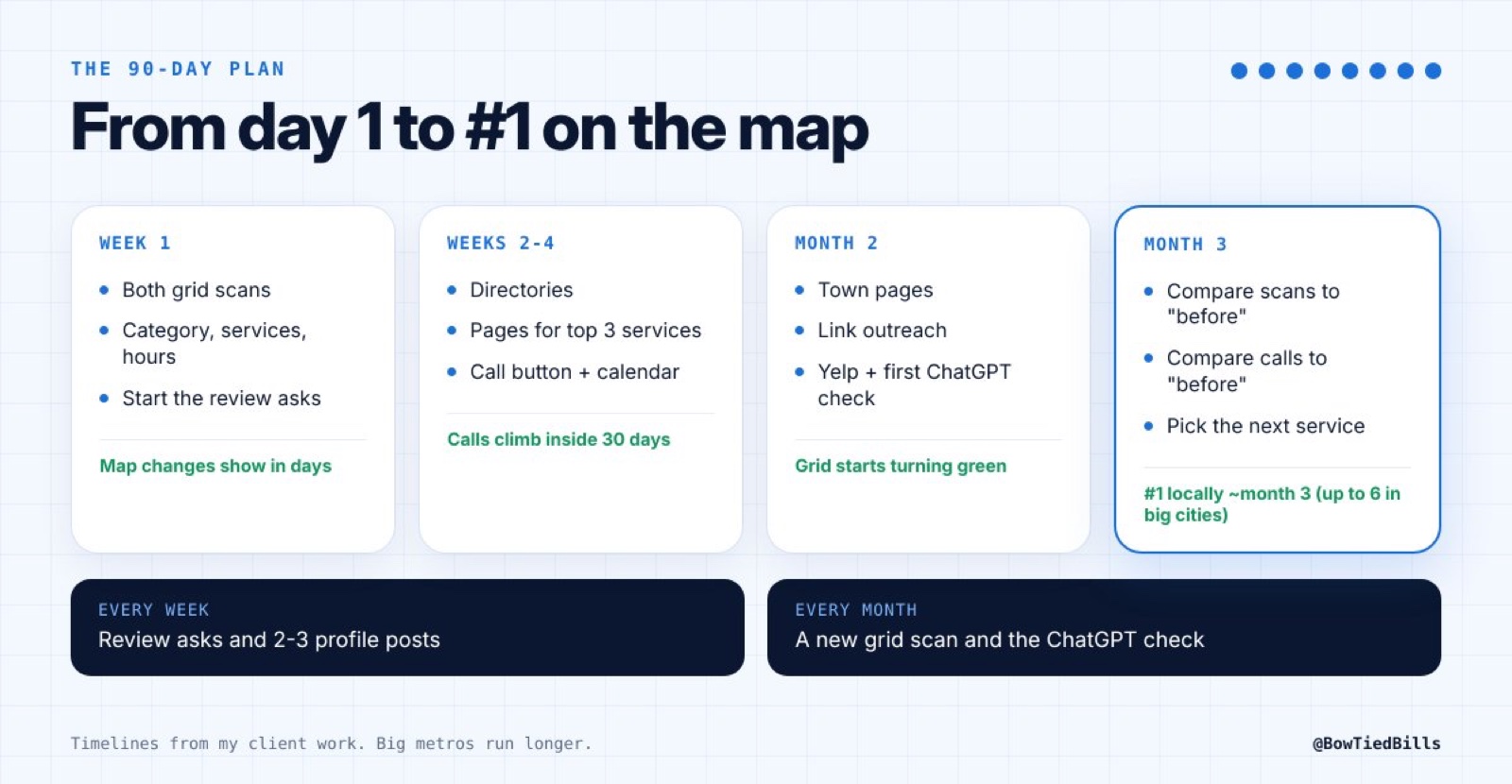 90-Day Google Maps Execution Plan: From Day 1 Baseline to #1 Citywide
| Timeline | Core Action Items | Recurring Cadence & Expected Milestone |
|---|---|---|
| Week 1 | 1. Run both core keyword + "near me" grid scans2. Fix GBP primary/secondary categories, granular services, hours & photos 3. Launch equal-ask 7-day review automation | • Map ranking shifts surface within days • Early clicks & calls begin picking up |
| Weeks 2–4 | 1. Build 20–100 priority directory citations with exact NAP matching 2. Publish dedicated landing pages for your top 3 revenue services 3. Add sticky mobile call button + top-of-page booking calendar | • Weekly: review asks + 2–3 GBP posts • Inbound call volume climbs within first 30 days |
| Month 2 | 1. Build unique local town pages with real regional landmarks 2. Launch local news, sponsor, partner & association outreach 3. Claim/optimize Yelp, update homepage service/city copy & run ChatGPT audit | • Citywide geo-grid begins flipping green into Top 3 • Continuous white-hat link outreach ongoing |
| Month 3+ | 1. Compare Month 3 grid scans & call volume against Day 1 "Before" table 2. Isolate lagging grid quadrants & expand to next core service line | • Monthly: fresh grid scan + ChatGPT citation check • ~#1 across 20–25 sq mi (up to 6 mo in major metros) |
Cross-Channel Attribution Tip for Hybrid Brands: If you run paid Google Ads alongside regional stores or local service offices, pair this local organic engine with unified first-party conversion tracking—explore our Google Data Manager Guide to connect offline store calls and booked CRM orders back into Google Ads without double counting.
Primary Source & Research Citations: Methodology, operational sequence, client metrics, and all 8 engineering prompts are adapted from ex-FAANG search ranking engineer BowTiedBills' detailed walkthrough "How To Book So Many Calls From Google Maps It Feels Illegal" (published November 22, 2026). External benchmarks cite First Page Sage (Local Pack Top 3 CTR share), Whitespark Local Search Ranking Factors (Primary Category #1 & Open at Time of Search Top 5), Clio 2024 Legal Trends Report (60% missed calls rate), BrightLocal (80% Yelp inclusion in ChatGPT local answers), OptimizeMyFirm (79% homepage citations & 100-city benchmark), and FTC statutory penalty caps ($53,088 per deceptive review).
Found this actionable? Copy standard citation & summary
Formatted with canonical attribution link and executive summary—ready for Slack, Notion, or LLM context.
Put Into Practice: Companion Browser Workbenches
AI Readiness & GEO 5-Stage Checker
Audit 26 atomic signals across 5 GEO stages including llms.txt, Product Schema & MCP readiness.
OpenGraph & Social Card Live Debugger
Audit and preview Open Graph, Twitter Cards, and meta tags across global social platforms.