
Shopify CEO Tobi Lütke on AI: When Generation Gets Cheap, Human Judgment Becomes Priceless
 Shopify CEO Tobi Lütke on AI: When Output Gets Cheap, Judgment Matters More
Overview
In The Knowledge Project Podcast episode Shopify CEO: Most Businesses Are Using AI Wrong, Shopify co-founder and CEO Tobi Lütke sits down with host Shane Parrish for a 1-hour, 4-minute conversation.
Across Shopify's 7,000 employees and 10,000 Slack channels, Lütke explains how internal AI colleague River is woven into daily teamwork—and why, as AI makes code and content generation virtually free, the truly scarce enterprise capabilities are review rigor, trade-off clarity, taste, and the commercial judgment to own the consequences.
01 | How River Turns Slack Chat into Shipped Work
In day-to-day life at Shopify, whenever employees debate a feature in a Slack channel, they can pull River straight into the thread. River synthesizes the discussion, checks academic papers or competitor benchmarks, and writes working feature prototypes on the spot.
Built internally at Shopify, River has changed how code ships: Lütke notes that roughly 50% of Shopify's pull requests now originate directly from this kind of conversational collaboration.
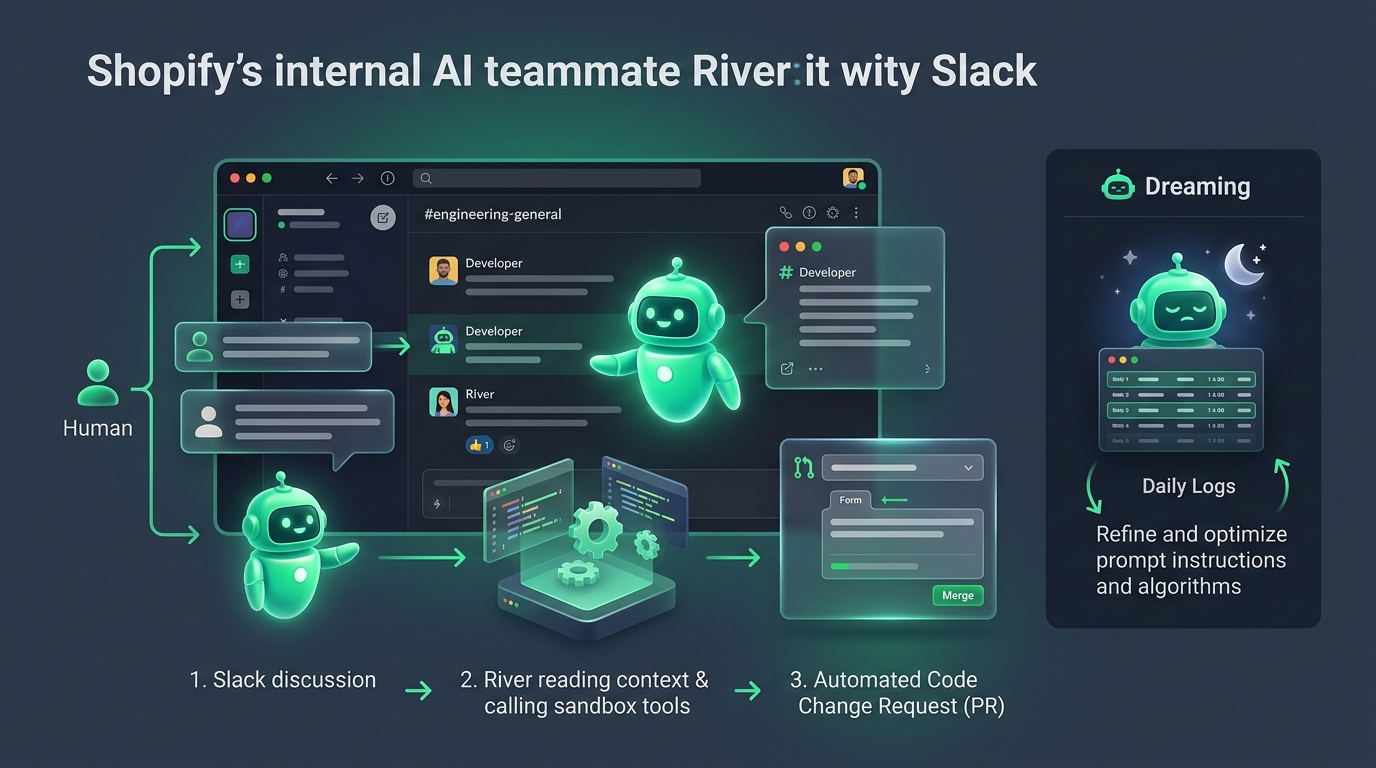 Collaboration architecture and workflow of Shopify's internal AI colleague River in Slack
In the same conversation, however, Lütke flags a growing side effect of widespread AI adoption: employees use AI to generate mountains of code or documents they haven't even read closely themselves, then toss them over the wall for colleagues to review.
Core Thesis: As generating output gets easier, organizations still need humans to judge whether something is worth building, whether it is actually right, and who owns the outcome when something breaks. River's UX design, Shopify's multi-model council workflow, and its management philosophy all revolve around this principle.
Lütke describes an AI agent built directly into the company's existing work fabric:
- Connected to the company-wide communication graph: Shopify's Slack spans 7,000 employees and 10,000 active channels. Teams can invite River into any public channel to read context, call codebases, internal systems, and sandboxed tools, and open properly formatted pull requests.
- Equipped with long-term memory and permission to push back: River has her own name, avatar, and persistent memory. The system explicitly empowers her to challenge flawed requirements—pushing back immediately even when the person making the request is the CEO.
- Grounded in skeuomorphic mental models: Just as early graphical interfaces used folders, desktops, and trash cans to lower the learning curve, giving an AI agent the recognizable persona of a teammate helps employees rapidly learn what AI can and cannot do.
This workflow has reshaped engineering habits. Fewer Shopify engineers hand-write every line of code, and some developers orchestrate 10 to 50 agent instances running in parallel. Yet defining system boundaries, managing state, and performing final code review remain strictly human responsibilities. Faster tools do not replace engineering judgment.
02 | Working in Public Channels So Teams Learn Together
River operates under one deliberate constraint: she works exclusively in internal public channels.
Here, "public" means visible across the entire company internally—never exposed to the open internet. Lütke designed this rule to recover the apprenticeship learning that used to happen naturally in physical offices. Sitting next to a senior engineer or product manager, junior teammates could watch how experienced peers framed questions, isolated bugs, and weighed trade-offs. Remote work preserved asynchronous execution, yet quietly erased much of that tacit thinking from view.
When River collaborates in public channels, everyone can watch the full interaction loop unfold:
- How to supply crisp, high-signal business context to an AI.
- Which subtasks belong to an agent and which must be tackled directly by a human.
- At which point to press deeper and ask follow-up questions.
- When an AI's output contains subtle flaws and must be rejected rather than merged.
Practical AI mastery spreads organically across the organization through real business conversations.
River also runs an offline retrospective loop called Dreaming. Late at night or during idle windows, she reviews the day's conversation logs, diagnoses mistakes and execution friction, and automatically updates her skill library and prompt instructions. Lessons learned from one person's edge case turn directly into shared capability for the entire company.
03 | The Multi-Model AI Council Prepares Briefs; Humans Decide
For high-stakes strategic decisions, Lütke runs a Multi-Model AI Council featuring distinct roles and heterogeneous models.
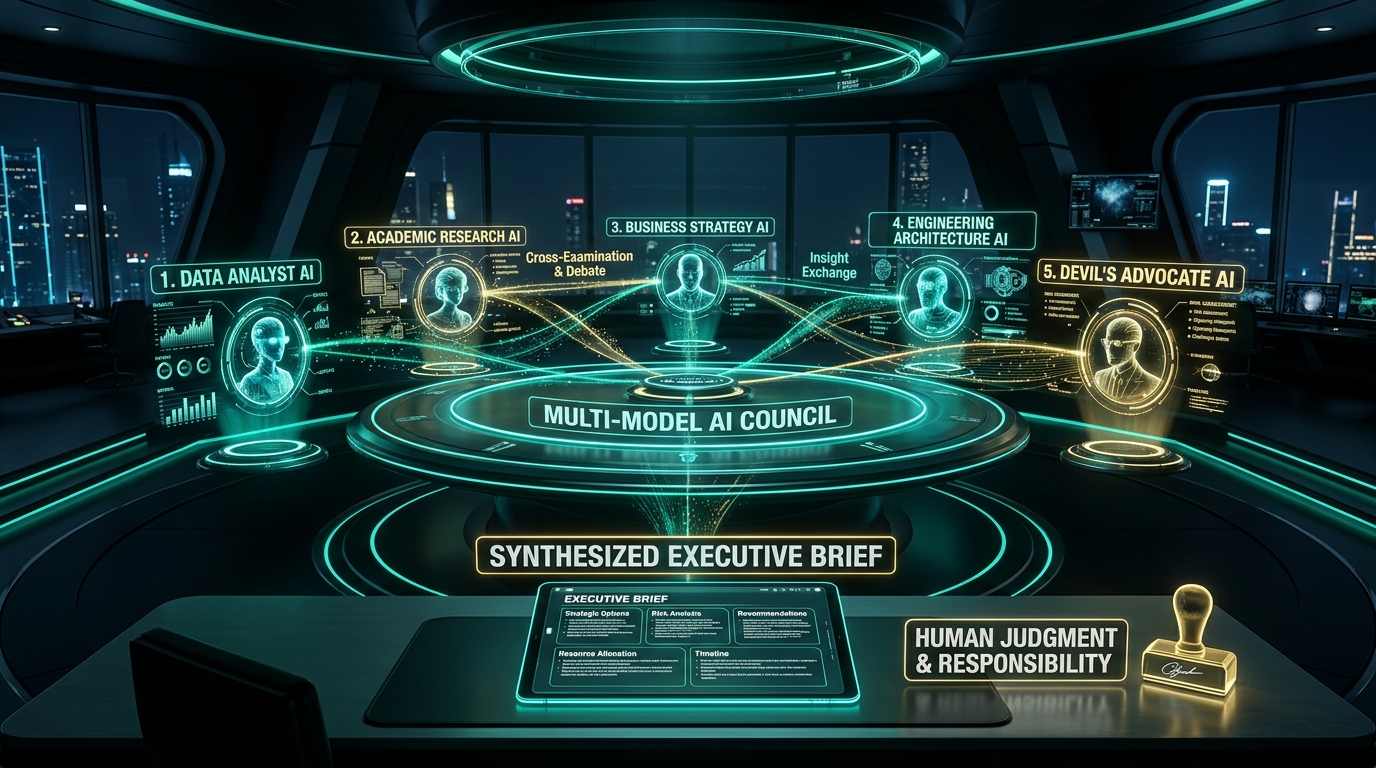 Multi-role, multi-model AI Council architecture for strategic decision-making
The council operates in four steps:
- Assign adversarial roles: Define 5 to 6 distinct personas covering quantitative data, academic research, commercial ROI, and engineering execution—plus a dedicated Devil's Advocate tasked with poking holes in the consensus.
- Route across diverse models: Match different frontier model providers to different roles so multiple models cross-examine, debate, and surface points of disagreement.
- Compile a decision brief: Within roughly 30 minutes, the system distills the debate into a structured, well-reasoned brief. Lütke often converts it to audio and listens during his morning run.
- Keep research costs negligible: A single multi-model run costs roughly $15 to $20 in API fees—producing depth that would take weeks of manual research to assemble.
Accountability Cannot Be Outsourced: Machines can synthesize evidence, stress-test options, and accelerate execution, but they cannot bear the consequences of a decision on behalf of an executive.
Even when multiple models converge on the same recommendation, the decision-maker still has to verify the fundamentals: Is the underlying data biased? Do the model's assumptions match reality inside the company? If the bet fails, can the business absorb the downside? Having more options on the table does not mean the decision has been made.
When Parrish asks whether future superintelligence can remain controllable, Lütke compares the problem to running a city like Toronto: modern society already manages systems far larger than any single human mind through specialization, rule of law, and checks and balances. Governing AI likewise depends on distributed authority, counterweights, and transparent institutional rules.
04 | When Generation Is Cheap, Review Burden Can Spike
Discussing AI's organizational side effects, Lütke highlights a phenomenon he calls Slop Grenades.
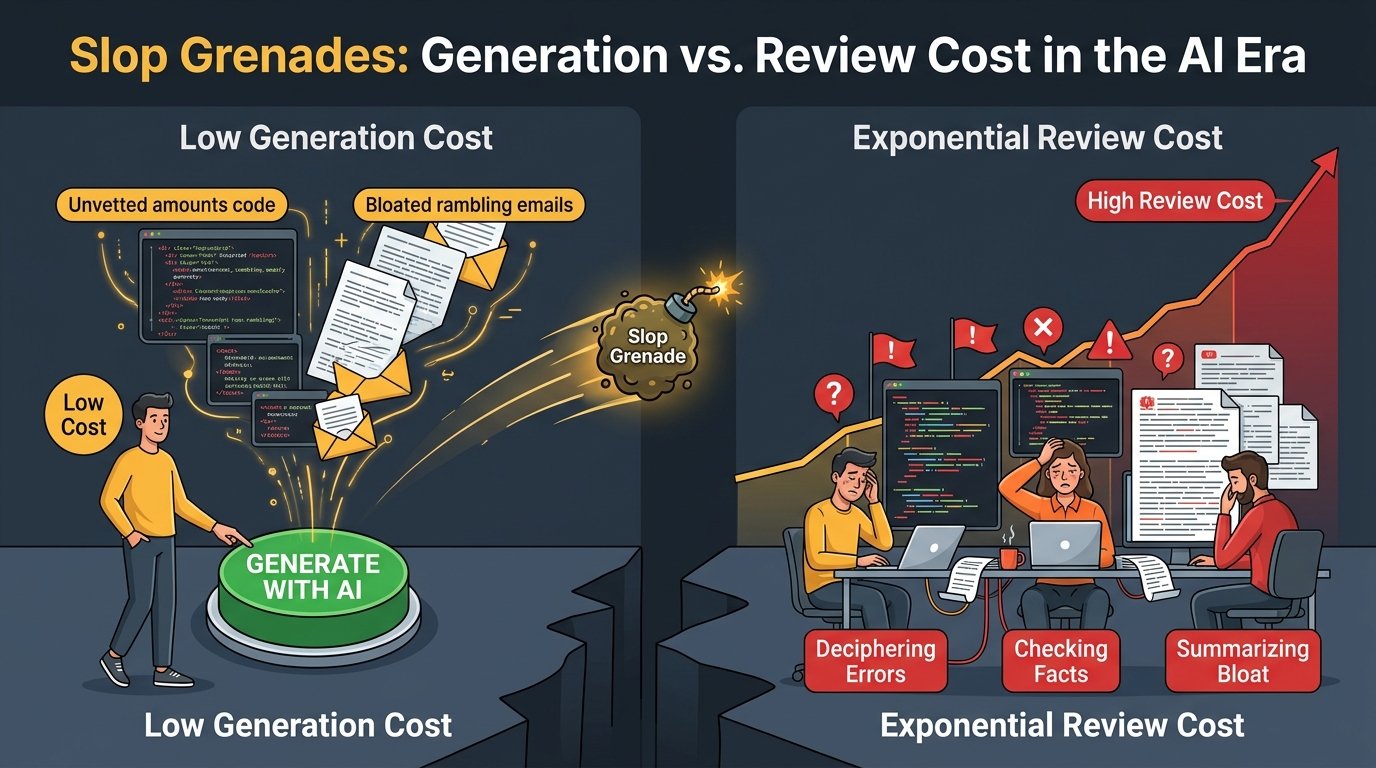 Slop Grenades: The mismatch between near-zero generation cost and surging review cost
The term captures three common workplace failure modes:
- Effortless generation on the sender's side: An employee types a two-line prompt to have AI modify hundreds of lines of code or draft a multi-thousand-word memo, skims it briefly, and fires off a PR or company-wide email.
- Crushing review load on the receiver's side: The sender looks productive in seconds, while logic bugs, edge-case failures, and fabricated claims land squarely on reviewers and teammates downstream.
- Zero-value communication loops: The sender uses AI to inflate three sentences into an 800-word email; the recipient, unwilling to wade through the filler, uses AI to compress it back down to three sentences. Compute burns at both ends while team alignment gets worse.
AI drastically cuts the cost of producing artifacts, yet the human cognitive time required to read, verify, and debug has not shrunk at the same pace. Passing half-digested AI output to colleagues simply shifts cognitive tax onto the rest of the team.
In Lütke's view, mature engineers and leaders use LLMs in the opposite direction: to distill complex ideas into something shorter, sharper, and easier to reason about. Whenever you submit a document or pull request to your team, you must be able to defend every trade-off behind it and stand behind the result.
05 | Software Begins Adapting Around the User
Turning to the future of application software, Lütke shares how he runs his own workstation. His daily driver is Omarchy, the Linux distribution created by Ruby on Rails creator David Heinemeier Hansson (DHH). Paired with coding agents, his operating system continuously adapts to his personal workflow.
He gives a concrete example: during a UI design discussion, he needed a quick way to add specific geometric annotations to screenshots. He described the tool by voice to an AI, added interaction details from reference interfaces, and after three rounds of follow-up tweaks, the AI built a working custom screenshot utility on the spot. He open-sourced it on GitHub that night, received six community pull requests by the next morning, and the tool was soon merged into future Omarchy releases.
At home, his personal AI assistant can even wake offline machines over Wake-on-LAN, diagnose network issues across devices, and run automated batch jobs.
This points directly to how Lütke envisions Shopify's product evolution: future business SaaS will stop forcing merchants to conform to rigid, one-size-fits-all admin forms. Instead, merchants will describe how their business operates in natural language, and the software interface and workflows will reshape themselves around that business.
06 | The Hard Part Is Choosing Among Several Good Options
When prototyping, literature reviews, and scenario modeling become cheap, leaders suddenly find 10 viable proposals on their desk at once—every one of them plausible, and most promising decent short-term returns.
At that point, Taste and Judgment become the decisive differentiator.
Taste comes from years of hands-on iteration, dissecting classic product mechanics, and observing human behavior and durable institutions: Why does one architecture run reliably for decades? Why does one subtle interaction feel effortless to users? Only by internalizing those patterns can you spot the option built to endure.
| Comparison Dimension | Short-Term Metric-Driven Options | Long-Term Strategic Bets |
|---|---|---|
| Feedback Loop | Driven by immediate, visible positive data (e.g., a slight quarterly GMV bump) | Long stretches with zero instant validation (e.g., multi-year core architecture rewrites) |
| Proposal Profile | Easy to present to a board with immediately quantifiable KPIs | Requires holistic subtraction and often brings short-term growing pains |
| Decision Premise | Minimize short-term risk and avoid visible mistakes | Compound long-term value aligned with core product identity |
Lütke illustrates this with Shopify's own origin story: his early online snowboard store, Snowdevil, was already profitable. Continuing to sell snowboards was the safe, obvious move—yet the team chose to pivot into building commerce infrastructure for entrepreneurs worldwide. The hardest decisions rarely sit between right and wrong; they sit between several attractive paths whose true costs only reveal themselves 5 to 10 years out.
07 | When a Metric Becomes a Target, It Can Distort the Company
When managing metrics and company governance, Lütke frequently warns teams about Goodhart's Law:
Goodhart's Law: When a measure becomes a target, it ceases to be a good measure.
He illustrates the principle with Shopify's merchant Churn Rate:
- Under conventional SaaS scorecards, every canceled account counts as a failure, and teams carry strict retention KPIs to push churn down.
- Shopify, however, serves entrepreneurs—and entrepreneurship is inherently uncertain. Many founders launch a store specifically as a low-cost way to test a new idea.
- If a merchant runs an experiment for a few months, discovers market demand isn't there, and closes the store, that is simply a healthy conclusion to a business test. Having learned from the attempt, that founder is very likely to return to Shopify with their next venture.
- If leadership turns "lowering store closures" into a rigid mandate—or adds friction to the cancellation flow—the company betrays its core mission of lowering the barrier to entrepreneurship.
Metrics are stethoscopes for spotting anomalies, never substitutes for understanding the real business context behind the numbers.
08 | To Move Forward, Companies Must Delete Legacy Baggage
Discussing how systems and organizations evolve, Lütke points to the iteration of the SpaceX Raptor Engine: early prototypes were dense tangles of plumbing and components, whereas newer versions stripped out hundreds of sensors, valves, and welds—achieving greater thrust and reliability through radical simplification.
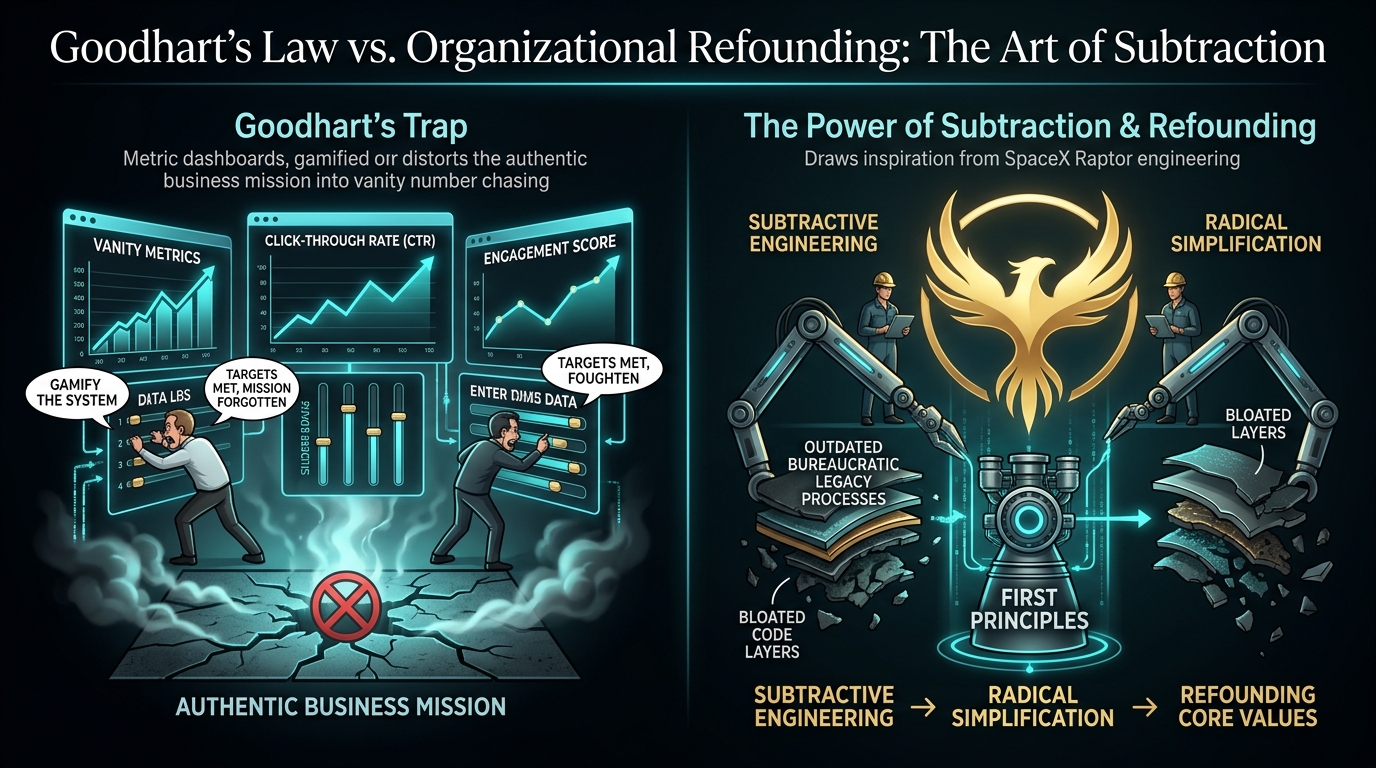 The Goodhart's Law trap and the organizational Refounding subtraction philosophy
Software architectures and companies accumulate the exact same bloat. Every isolated incident prompts leadership to add another approval gate; every new product line adds another reporting layer. Over a few years, the original risk has long vanished, yet teams spend most of their energy maintaining legacy bureaucracy and technical debt.
To counter this, Lütke runs an internal Refounding practice—periodically empowering teams, business units, and the company as a whole to challenge inherited assumptions, strip out outdated processes and legacy code created for past compromises, and refocus energy on core product engineering.
09 | Technology Evolves, Yet Cultivating Judgment Remains the Core Work
Near the end of the interview, Lütke mentions a small family habit: whenever his children say in frustration that they "can't do something," he and his wife gently add one word to the end of the sentence—"yet."
Both human skills and machine capabilities are works in progress. Even today, Lütke still re-reads several time-tested books that sharpen long-term thinking:
- The Lessons of History by Will & Ariel Durant
- Parkinson's Law by C. Northcote Parkinson
- The Managerial Revolution by James Burnham
- Meditations by Marcus Aurelius
- Foundation by Isaac Asimov and The Three-Body Problem by Liu Cixin
LLMs and agents vastly expand what a team can learn, build, and test—but raw speed in generating code or prose is only surface leverage. What separates enduring companies is still the reliability of what they ship, the trade-offs they make at critical forks in the road, and who steps up to own the outcome.
Copyright & Source Attribution
- Podcast: The Knowledge Project Podcast (Host: Shane Parrish)
- Original Interview: Shopify CEO: Most Businesses Are Using AI Wrong
- Episode Page: fs.blog/knowledge-project-podcast/tobi-lutke-3/
- Guest: Tobi Lütke (Co-founder & CEO, Shopify)
- Chinese Source Compilation: Atlasnote.ai - Shopify CEO on AI: When Output Gets Cheap, Judgment Matters More (Author: Tao)
- Publication Date: September 16, 2026
- Copyright Notice: Original interview content belongs to The Knowledge Project Podcast and the interviewee; curated here as a reference for product managers, engineers, and leaders.
Found this actionable? Copy standard citation & summary
Formatted with canonical attribution link and executive summary—ready for Slack, Notion, or LLM context.
Put Into Practice: Companion Browser Workbenches
Shopify GTM & GA4 Web Pixel Generator
Generate production-ready Shopify Customer Events Web Pixel code for GA4, Meta, and TikTok.
UTM Builder Pro Matrix Workspace
Reverse URL parser, GA4 channel group diagnostics, and dynamic ad macro batch CSV export.