
Google Ads Publishes Official Purchase Signal Annotations Docs for Shopping Ad Sales Badges

Official Product Update: Google has published new Google Ads Help documentation covering Purchase Signal Annotations. Eligible Google Shopping ads can automatically display sales-volume badges—such as "100+ sold last 30 days"—to highlight popular items with no extra ad spend or manual creative setup required, provided merchants report item-level sales via Conversions with Cart Data (CwCD) and meet privacy thresholds.
1. Real-World Sighting on Google Shopping Ads
Months before the documentation went live, Search Engine Roundtable spotted these sales-volume badges appearing directly inside live Shopping ad units, captured in the wild as shown below:
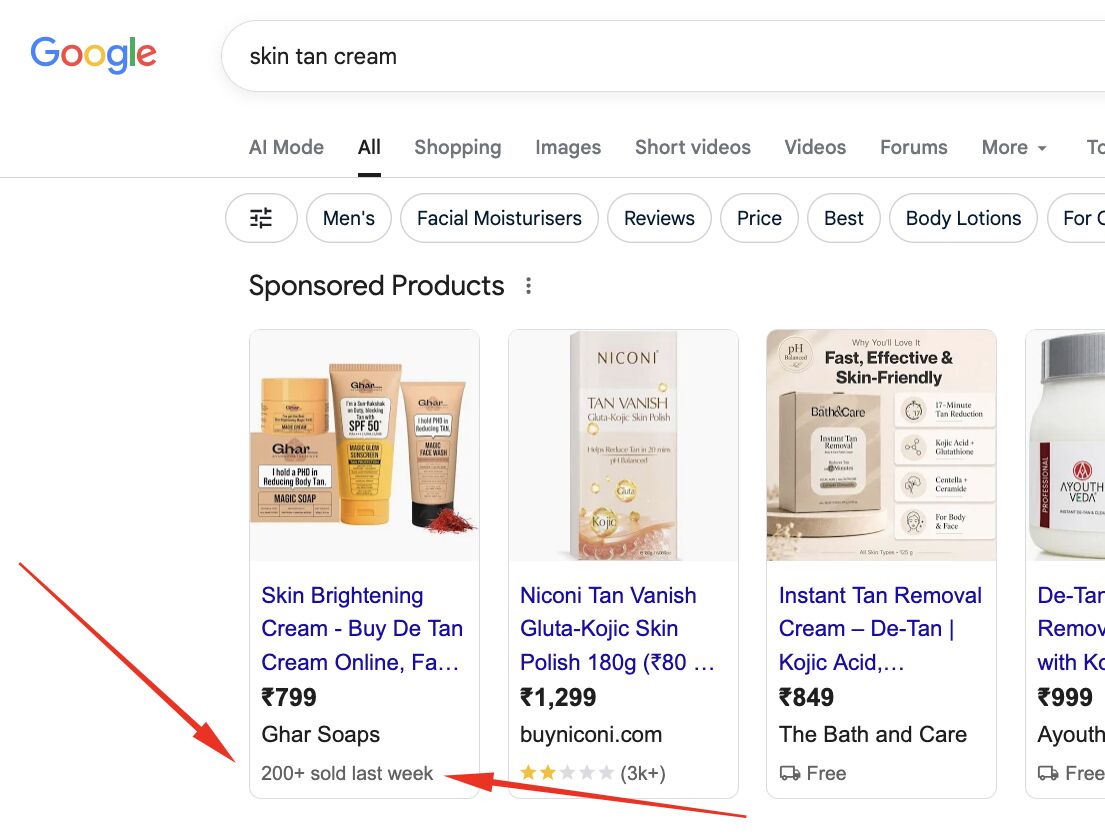 Real-world Google Shopping ad displaying a purchase signal sales badge ("sold last week")
Google's newly published Help Center page now formalizes how eligibility, data reporting, and threshold rounding work.
2. How Purchase Signal Annotations Work (Official Documentation)
In its About purchase signal annotations Help Center documentation, Google outlines four core mechanics:
- Built to Spark Shopper Interest & Trust:
- Google states: "Purchase signal annotations spark shopper interest by displaying sales volume (e.g. '100+ sold last 30 days') on eligible Shopping ads to highlight in-demand products."
- Google adds: "These annotations build shopper trust, boost engagement, and convert initial interest into sales and long-term customer value."
- Zero Extra Spend or Manual Creative Work:
- According to Google, purchase signal annotations are "designed to boost competitiveness for your top-selling products on Google Shopping, without requiring additional promotional budget or manual creative setup."
- Eligibility Requires Conversions with Cart Data (CwCD):
- To qualify, merchants must send item-level sales data through conversion tracking with cart data (CwCD), and individual product offers must meet Google's privacy thresholds and additional eligibility criteria. Once satisfied, annotations appear automatically.
- Privacy-Safe Rounded Thresholds:
- Rather than exposing exact merchant order counts, Google generalizes numbers into rounded buckets. For example, a product generating 1,500 attributed sales from Google over the past 30 days may display a badge reading "1K+ sold last 30 days"—signaling strong demand while protecting proprietary sales figures.
Screenshot of the official Google Ads Help documentation:
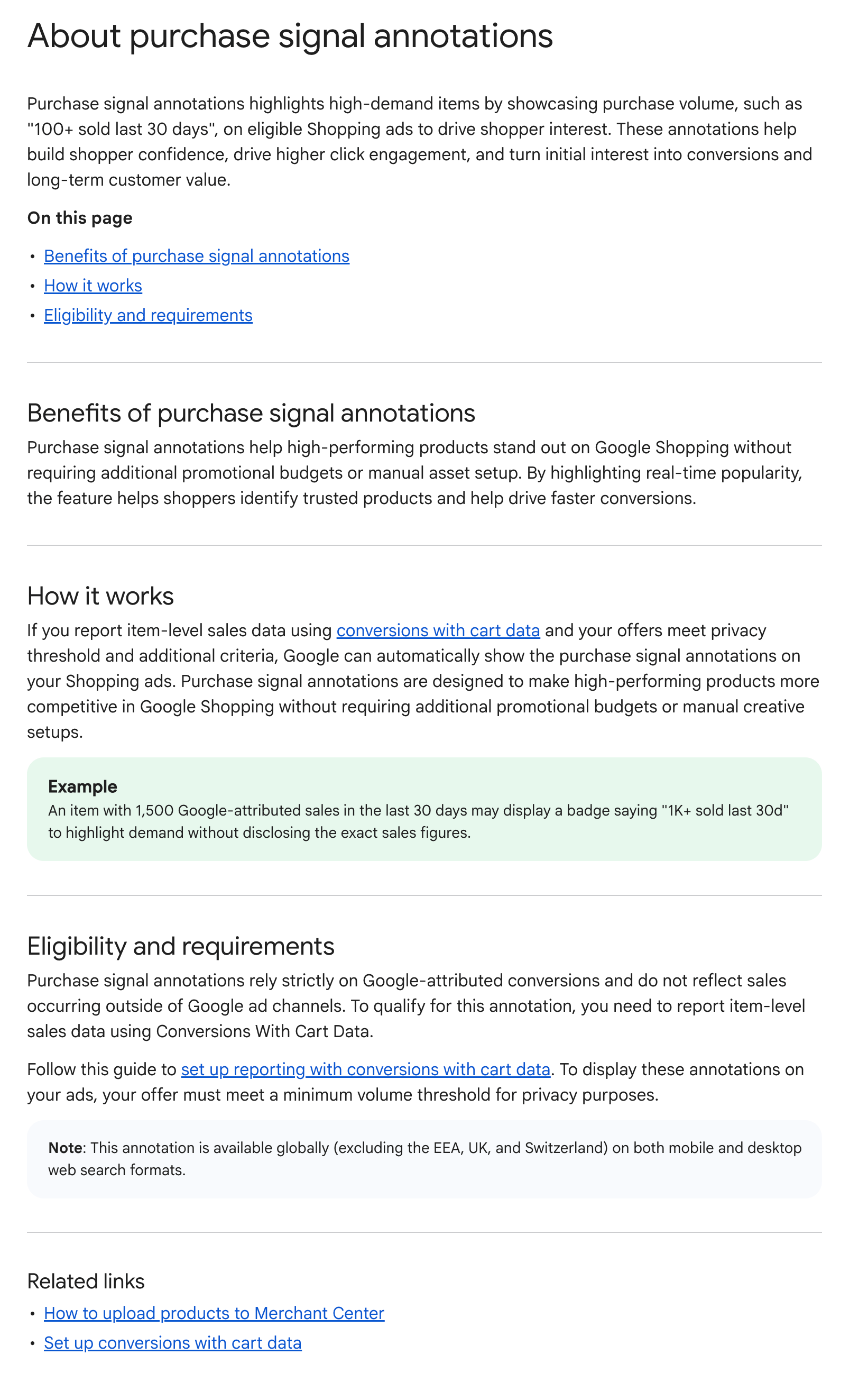 Screenshot of the official Google Ads Help page: About purchase signal annotations
3. How Ecommerce Advertisers Can Qualify
Because Purchase Signal Annotations activate automatically only when Google receives accurate item-level cart data, stores tracking only aggregate order revenue miss out on this free social-proof badge inside Shopping and Performance Max placements. Growth teams should verify two essentials:
- Deploy Conversions with Cart Data (CwCD): Ensure your checkout conversion tracking passes the full
items[]payload (item_id,price,quantity) matching your Merchant Center feed primary keys. Review our technical walkthrough: Google Ads Product Metrics Attribution & Cart Data (CwCD) Guide. - Enforce Exact Item ID Parity & Stock Continuity: Any mismatch in casing or SKU formatting between Web Pixels and Merchant Center prevents attributed sales from rolling up to the offer, keeping top-selling SKUs below the privacy threshold needed to display
100+or1K+badges.
Sources: Adapted from EVAOO News item zpaa0tm24r1r8az0msgt5uz5s, originally reported by Barry Schwartz on Search Engine Roundtable (Google Ads Purchase Signal Annotations Documentation, Nov 23, 2026; discussion on X), and Google Ads Help Center #18978095.
Found this actionable? Copy standard citation & summary
Formatted with canonical attribution link and executive summary—ready for Slack, Notion, or LLM context.
Put Into Practice: Companion Browser Workbenches
UTM Builder Pro Matrix Workspace
Reverse URL parser, GA4 channel group diagnostics, and dynamic ad macro batch CSV export.
Shopify GTM & GA4 Web Pixel Generator
Generate production-ready Shopify Customer Events Web Pixel code for GA4, Meta, and TikTok.