
Ads in Google Search AI Experiences (#18826097): AI Overviews & AI Mode Dual Matching, Gemini AI Explainers, and 12-Country Eligibility
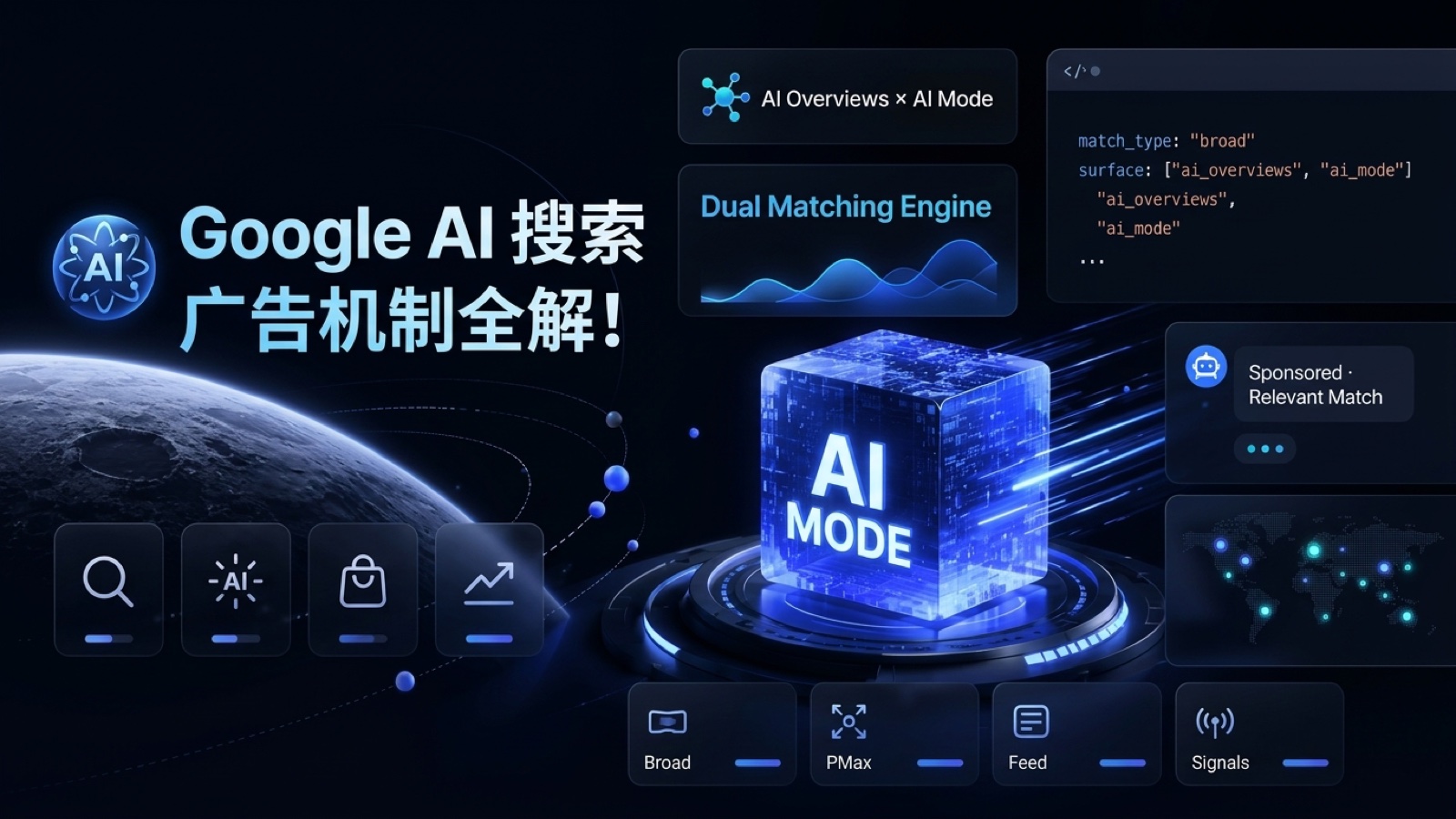 Ads in Google Search AI Experiences (#18826097): AI Overviews & AI Mode Dual Matching, Gemini AI Explainers, and 12-Country Eligibility
Guide Overview: Ads in Google Search AI Experiences (Official Doc #18826097)
Google Ads published "About ads in AI-powered experiences in Google Search" (Official Doc #18826097), detailing auction eligibility, dual-path matching mechanics, Gemini-generated AI Explainers, and market availability across AI Overviews (#14901683) and AI Mode (#16011537):
- No New Campaigns or Separate Budgets Required: Existing Search, Shopping, and Performance Max campaigns automatically participate through the standard Google Ads auction.
- Eligibility Differences by Match Type: AI Max, Broad Match, Shopping, and Performance Max support both exploratory Contextual Matching (user query plus AI response) and Direct Query Matching; Exact match and Phrase match keywords are not eligible for Contextual Matching on exploratory queries.
- Clear Ad Labeling & Organic Independence: All ads carry the "Sponsored" label. Paid advertising never influences Google's organic AI responses, and organic citation status does not affect ad auction eligibility.
1. Where Ads Appear & Co-Serving Rules Across AI Overviews and AI Mode
Google Search delivers two types of generative AI experiences tailored to different query complexities: quick SERP summaries via AI Overviews, and multi-turn conversational follow-ups and comparisons via AI Mode.
According to Official Doc #18826097, ad placements across these two experiences follow four core rules:
- Within or Alongside AI Responses: When a search query or multi-turn conversation carries commercial relevance, ads can appear directly within or alongside the AI-generated response—including responses to follow-up questions in AI Mode. All placements are housed inside sections clearly labeled "Sponsored".
- Ongoing Layout Iteration: Google continuously tests and refines ad layouts in AI Overviews and AI Mode, meaning visual formats will evolve over time.
- Standard SERP Placements Remain: Standard Search ads continue to appear above or below the AI Overview on the search results page.
- Co-Serving & Exclusion Rules (Official FAQ #3):
- Co-Serving Allowed (Above + Within): Depending on the specific query and real-time auction, your ad can appear both above and within an AI Overview on the same search.
- Strictly Mutually Exclusive (Within + Immediately Below): Ads will never appear both within an AI Overview and immediately below it on the same search.
- Pay Only for Valid Clicks: Standard Google Ads delivery and billing rules apply throughout—you only pay for valid clicks received on your ads.
2. Dual Ad Matching Mechanics & Keyword Match Type Eligibility
Traditional Search campaigns are typically structured around high-intent Exact Match or Phrase Match keyword lists. In AI Overviews and AI Mode, however, user queries are significantly longer and far more conversational or exploratory. To bridge this gap, Google introduced a Dual Ad Matching mechanism:
2.1 Comparing the Two Matching Paths (Official Pool Cleaning Example)
| Matching Path | Query Characteristics | Official Google Example (#18826097) | Commercial Intent Detection Mechanism |
|---|---|---|---|
| Path 1: Contextual Matching | Longer exploratory, troubleshooting, or multi-turn queries without an explicit product name | User searches: "why is my pool green and how do I clean it?" | The original query does not name a product, but the AI response outlines steps such as testing water chemistry, brushing walls, and vacuuming debris—surfacing commercial intent. The system then matches Text or Shopping ads for pool vacuum cleaners or algae treatment kits. |
| Path 2: Direct Query Matching | Queries that directly express commercial buying or comparison intent | User searches: "pool vacuum cleaners" | Identical to standard Google Search SERPs: the system directly matches relevant Text or Shopping ads against the user's explicit search query. |
2.2 Campaign & Keyword Match Type Auction Eligibility
Not all keyword types can enter the auction for exploratory AI traffic. Eligibility breaks down as follows:
- Dual-Path Eligible (Contextual Matching + Direct Query Matching): Requires AI-powered targeting, covering four setup types:
- AI Max for Search campaigns (#15910187) with search term matching enabled.
- Broad Match keywords in Search campaigns.
- Shopping campaigns.
- Performance Max campaigns (#10724817).
- Direct Query Matching Only (Excluded from Exploratory Traffic): Exact match and Phrase match keywords in Search campaigns only enter auctions when the user's query itself carries direct commercial intent (e.g., searching "pool vacuum cleaners" directly). They are not eligible for contextual matching on exploratory questions.
3. Eligible Campaigns, Supported Formats & 12-Country English Availability
Advertisers do not need to build dedicated AI campaigns or split budgets; existing campaigns that meet the criteria automatically enter the auction:
- Eligible Campaign Types: Existing Search, Shopping, and Performance Max campaigns are automatically eligible.
- Supported Ad Formats:
- Live Now: Text ads and Shopping ads.
- In Testing: Local inventory ads and Vehicle ads.
- Geographic & Language Availability (Official FAQ #5):
- Ads Above or Below AI Overviews: Available across 200+ countries and territories and all languages where AI Overviews have launched.
- Ads Within AI Overviews & in AI Mode: Currently available in English only across 12 countries (note the specific restrictions for Indonesia and Pakistan):
- Full Support (10 Countries — AI Overviews & AI Mode, Text & Shopping Ads): United States, Australia, Canada, India, Kenya, Malaysia, New Zealand, Nigeria, Philippines, and Singapore.
- Indonesia Restriction: Eligible for AI Overviews only (AI Mode not yet included).
- Pakistan Restriction: Eligible for Text ads only (Shopping ads not yet supported).
4. Ad Creative Assembly & Gemini-Generated AI Explainers
Inside AI Overviews and AI Mode, Google combines your campaign assets (headlines, descriptions, images, prices, and landing pages) under the "Sponsored" label, and in select placements pairs them with AI Explainers:
- What Are AI Explainers?: Concise, independent contextual text generated by Google Gemini models to explain to searchers why a specific ad—or group of ads—is relevant to their current query.
- Two Display Formats:
- Group Intro Format: A brief introductory line framing a group of Sponsored ad options.
- Individual Context Format: Contextual background displayed next to an individual ad, synthesized from the user's query, the AI response, and public web sources—including the advertiser's official website. In some cases, a static section header (such as "You might consider these options") is shown instead.
- Boundaries of Advertiser Control:
- AI Explainers are not part of your ad headline or ad description.
- Advertisers cannot manually write, edit, approve, or opt out of AI Explainers.
- The interface visually distinguishes AI-generated context from advertiser-provided ad copy.
- Landing Page Optimization Tip: Because Gemini reads public sources and your official website to generate AI Explainers, clear, structured, and accurate specs on your DTC product detail pages (PDPs) and landing pages directly yield more compelling contextual recommendations.
5. Advertiser Controls, Reporting & Applicable Policies
Regarding budget segmentation, traffic exclusions, and reporting visibility, Google's documentation clarifies five operational rules:
- 1. No Standalone Targeting or Opt-Out (FAQ #1): AI Overviews and AI Mode are core native experiences within Google Search. Advertisers cannot target AI Overviews or AI Mode exclusively, nor can they opt out of these placements while remaining active on Google Search.
- 2. Existing Account Controls Remain Active: Account-level and campaign-level exclusions—including negative keywords, brand exclusions, and asset pinning—continue to apply to ads served in AI Overviews and AI Mode.
- 3. Auction Billing & Invalid Traffic Protection (FAQ #2): Ads in AI Overviews and AI Mode use the exact same auction mechanics as standard Google Search ads, supporting cost-per-click (CPC) and conversion-based bidding models. Participation carries no additional surcharge, and standard invalid traffic (IVT) protections apply.
- 4. Reporting Granularity: There is currently no separate reporting column isolating AI Overviews or AI Mode; impression and click data roll into existing standard reports:
- Campaign Report: Impressions, clicks, conversions, and cost are aggregated into each campaign's standard performance metrics.
- Search Terms Report (#2472708): Queries that triggered ads within AI Overviews and AI Mode are included in the Search Terms report (see #7501826 for top vs. other position metric definitions).
- 5. Policies & Privacy Compliance: All Google Ads policies (#6008942) apply, alongside the Google Terms of Service, Google Ads Terms & Conditions (#54818), and Google Privacy Policy.
6. Google's Four Official Optimization Recommendations & 9 Core GMC Feed Attributes
To capture longer, more conversational queries in AI Overviews and AI Mode, Google recommends four core optimization pillars. Use the interactive tool below to check target-market eligibility and audit your account setup:
6.1 Enable AI-Powered Targeting for Both Contextual and Direct Matching
Deploy AI Max for Search campaigns (#15910187) (with search term matching enabled), Broad Match on Search, Shopping campaigns, or Performance Max (#10724817) to unlock exploratory conversational traffic that Exact and Phrase match keywords miss.
6.2 Pair Smart Bidding with First-Party Conversion Data
Combine AI-powered targeting with conversion- or value-based Smart Bidding (#7065882). Pass accurate first-party conversion signals via Google Tag or Offline Conversion Import (OCI), and maintain sufficient budget headroom on top-performing campaigns so the system can adjust bids dynamically across direct queries and exploratory conversations.
6.3 Enable Text Customization and Final URL Expansion
Activate both Text customization and Final URL expansion across AI Max for Search and Performance Max campaigns so headlines, descriptions, and landing pages adapt dynamically to long-tail conversational queries. Keep your website copy up to date and well-structured so Gemini extracts accurate product differentiators for AI Explainers.
6.4 Complete the 9 Core Merchant Center Product Feed Attributes
When running Shopping Ads, verify that the following nine Merchant Center attributes match your landing pages verbatim in accordance with the Merchant Center Product Data Specification (#7052112):
| # | Core GMC Feed Attribute | Official Spec Doc | Role in AI Search Contextual Matching |
|---|---|---|---|
| 01 | Descriptive product titles | GMC #6324415 | Helps models identify category, use case, materials, and core specs |
| 02 | Detailed product descriptions | GMC #6324468 | Supplies semantic matching evidence for troubleshooting and exploratory queries |
| 03 | Multiple high-resolution product images | GMC #6324350 | Ensures crisp rendering and higher CTR for Sponsored product cards inside AI streams |
| 04 | Lifestyle / in-context images | GMC #9103186 | Visually demonstrates real-world usage during conversational discovery |
| 05 | Accurate pricing & sale prices | GMC #6324471 | Prevents price-mismatch disapprovals and surfaces real discounts during comparison follow-ups |
| 06 | Product ratings & reviews | GMC #14620705 | Provides third-party social proof when multiple products appear side by side |
| 07 | Structured product highlights | GMC #9216100 | Gives Gemini scannable bullet points to increase card information density |
| 08 | Clear shipping policies | GMC #6324484 | Clarifies fulfillment timelines and free-shipping thresholds to reduce friction on high-AOV items |
| 09 | Transparent return policies | GMC #14011730 | Establishes clear post-purchase assurance to convert multi-turn comparisons into orders |
7. Official Frequently Asked Questions (FAQ 1–5)
- Q: Can I choose to target only AI Overviews or AI Mode, or opt out of showing ads in them?
- A: No. AI Overviews and AI Mode are core Google Search experiences. Just like other Search SERP features, you cannot exclusively target AI Overviews or AI Mode, nor can you opt out of them while continuing to serve on Google Search. You can continue using negative keywords and brand exclusions to control when your ads trigger.
- Q: How are ads in AI Overviews and AI Mode billed?
- A: Ads in AI Overviews and AI Mode run through the same auction as standard Google Search ads, supporting CPC or conversion-focused bidding models. There is no extra fee to participate, and standard invalid traffic protections apply.
- Q: Can my ad appear both outside (above or below) and within an AI Overview on the same search?
- A: Depending on the query and auction, your ad may appear both above and within an AI Overview on the same search. However, ads will never appear both within an AI Overview and immediately below it. Standard Google Ads delivery and billing rules apply, and you only pay for valid clicks.
- Q: Do paid ads affect Google's organic AI responses?
- A: No. Organic AI Overviews and AI Mode answers are generated independently by Google Search quality and ranking systems. Buying ads does not influence organic AI responses, and whether a site is cited organically does not impact ad auction eligibility.
- Q: In which locations and languages are ads eligible to appear in AI Overviews and AI Mode?
- A: Google is expanding language and placement coverage country by country. First, ads above or below AI Overviews serve across 200+ countries and territories in all languages where the feature is live. Second, ads within AI Overviews and in AI Mode currently support English, across the United States, Australia, Canada, India, Indonesia (AI Overviews only), Kenya, Malaysia, New Zealand, Nigeria, Pakistan (text ads only), the Philippines, and Singapore.
Further Reading: AI Mode Product Videos & Peak-Season Channel Budget Controls
- To configure
video_linkproduct videos and six conversational attributes such asquestion_and_answer—surfacing product videos in AI Mode and lifting Demand Gen conversions by+5%—read Google Shopping Product Videos Guide (Part 1):video_linkSpec, AI Mode Conversational Attributes & Demand Gen +5% Lift and Google Shopping Product Videos Guide (Part 2): GMC Video Asset Hub, Product Studio Generation & Compliance.- To prevent GDN and Search Partners from draining budgets when scaling Google Search (including AI Overviews and AI Mode) during peak season, and to prepare for the February 2027 Display Expansion migration (Official Doc
#18385152), read Google Ads Channel Prioritization & Budget Allocation Guide (Part 1): Waterfall Mechanics & 7 Bid Strategy Rules and Google Ads Channel Prioritization & Budget Allocation Guide (Part 2): BFCM Peak Guardrails, 28-Day Audit & Feb 2027 GDN Migration.
Found this actionable? Copy standard citation & summary
Formatted with canonical attribution link and executive summary—ready for Slack, Notion, or LLM context.
Put Into Practice: Companion Browser Workbenches
UTM Builder Pro Matrix Workspace
Reverse URL parser, GA4 channel group diagnostics, and dynamic ad macro batch CSV export.
Shopify GTM & GA4 Web Pixel Generator
Generate production-ready Shopify Customer Events Web Pixel code for GA4, Meta, and TikTok.