
Google Updates Official 404 & Sitemaps Docs: Why Most 404s Need No Fix, Crawl Budget Facts & 5 Pitfalls
Official Ruling: Expect 404s, Preserve Crawl Budget, and Stop Redirecting Everything to Your Homepage
Google Search Central formally consolidated its Search Console troubleshooting guide into the core developer documentation, adding a dedicated section titled "Decide whether to fix 404 errors in Search Console." The verdict is unambiguous: returning 404 or 410 for pages that no longer exist (or never existed) is completely normal, causes zero manual penalties, and neither degrades crawl capacity nor drains crawl budget.
1. Why Google Consolidated Search Console & Search Central Docs
Seeing hundreds of unfamiliar 404 errors inside Google Search Console routinely triggers panic among ecommerce operators and junior SEOs—prompting risky blanket rules such as wildcard 301 redirects back to the homepage or Disallow directives inside robots.txt. Both knee-jerk fixes regularly create sitewide Soft 404 pollution or lock stale URLs inside the search index.
To establish a single authoritative reference, Google redirected the legacy Search Console help article directly into its official Troubleshoot crawling errors developer page and paired it with a new walkthrough video.
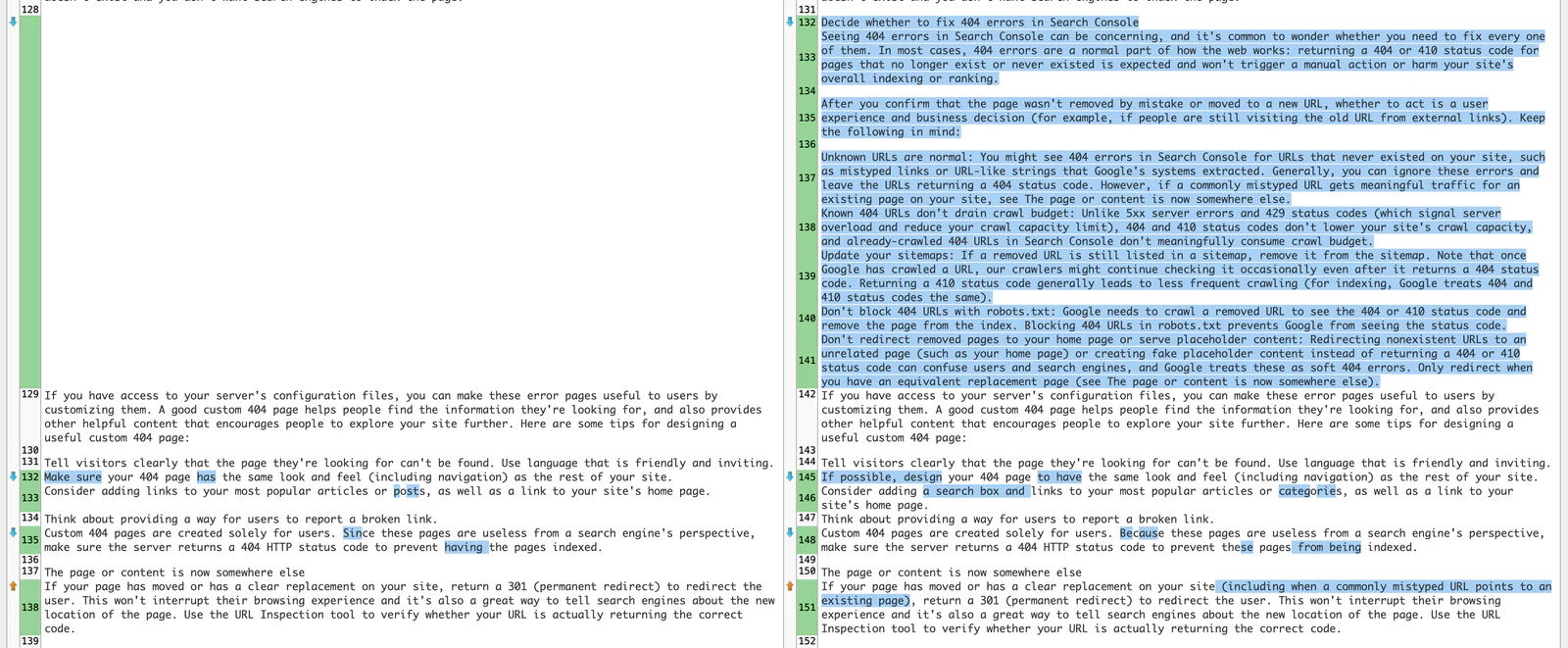 Side-by-side documentation diff showing Google's new Decide whether to fix 404 errors section
2. Five Concrete 404 Rules Added by Google
Once you verify that a 404 URL was not removed by mistake and has no true replacement URL, deciding whether to intervene is strictly a user experience and business decision (such as rescuing broken high-authority inbound backlinks). Google's updated guidelines spell out five critical boundaries:
2.1 Unknown URLs Are Normal Noise
Search Console regularly logs 404 URLs that never existed—originating from user typos, broken third-party links, or URL-like JavaScript fragments extracted by crawlers. Leave them serving 404. Only redirect a mistyped URL if it drives meaningful legitimate traffic to an existing equivalent destination.
2.2 Known 404s Do Not Drain Crawl Budget
Separating HTTP client-gone status codes from infrastructure bottlenecks, Google draws a bright line:
5xxand429Server Errors: Signal server overload and directly shrink your site's crawl capacity limit.404and410Responses: Never reduce crawl capacity, and previously crawled404URLs inside Search Console do not meaningfully consume crawl budget.
2.3 Clean Out Sitemaps & Use 410 to Reduce Recrawls
Never promote dead URLs inside an active XML sitemap while returning 404 on the wire. Note that Google's crawlers occasionally revisit previously discovered 404 URLs just in case they recover; serving 410 Gone prompts crawlers to back off more quickly, even though Google treats 404 and 410 identically for indexing removal.
2.4 Never Block 404 URLs via robots.txt
Blocking deleted URLs in robots.txt stops Googlebot from fetching the page—preventing Google from ever observing the 404 or 410 header needed to drop the obsolete URL from its index.
2.5 Never Redirect Dead Pages to Your Homepage or Serve Placeholder Copy
Redirecting unrelated nonexistent paths straight to the homepage or displaying generic "coming soon / removed" text on an HTTP 200 status confuses visitors and causes Google to flag the URL as a Soft 404. Reserve 301 permanent redirects exclusively for true, topic-equivalent replacement pages.
3. Sitemaps Documentation Refresh: Preserving Timeless Guidance
In parallel, Google migrated enduring technical rules originally published in early Search Central blog posts (dating back as far as 2005) directly into the What is a Sitemap specification page:
 Documentation diff clarifying that removing a URL from a sitemap does not block crawling or indexing
| Sitemaps Topic | Official Updated Google Stance | Correct Implementation |
|---|---|---|
| Hiding Private or Low-Value Pages | Omitting or deleting a URL from your sitemap does not prevent Google from crawling or indexing it if discovered via links elsewhere | Enforce exclusion using the noindex meta tag or X-Robots-Tag HTTP header |
| Nested Sitemap Indexes | Unsupported — you cannot nest one sitemap index file inside another sitemap index | Keep a single flat sitemap index pointing to child sitemaps under 50,000 URLs / 50MB each |
| HTML Sitemaps in GSC | Google Search Console does not accept HTML sitemap submissions | Serve XML, RSS/Atom, or plain-text sitemaps to crawlers while keeping HTML maps for human navigation |
4. Technical SEO Audit Workflow with Evaoo Tools
- Audit
robots.txt& Sitemap Signals First: Run your live domain through the EVaoo AI Readiness & Technical Crawl Inspector to verify that no unintentionalrobots.txtrules choke index cleanup and that XML sitemaps, canonicals, andllms.txtsignals resolve cleanly. - Verify Redirect Destinations & Metadata: After mapping legitimate
301replacements, inspect destination HTTP status, canonical tags, and open-graph cards in EVaoo OG & Meta Previewer. - Explore Further: Pair these rules with our 3-Layer GSC Organic Traffic Drop Debugging Guide or visit the SEO Playbooks Hub.
Found this actionable? Copy standard citation & summary
Formatted with canonical attribution link and executive summary—ready for Slack, Notion, or LLM context.
Put Into Practice: Companion Browser Workbenches
AI Readiness & GEO 5-Stage Checker
Audit 26 atomic signals across 5 GEO stages including llms.txt, Product Schema & MCP readiness.
OpenGraph & Social Card Live Debugger
Audit and preview Open Graph, Twitter Cards, and meta tags across global social platforms.