
Google Launches Search Ranking Transparency Hub & Updates AI Training Controls: Dec 2026 Core Update Pre-Notice, Hashtag Feedback & Google-Extended Matrix
On November 24, 2026 (UTC), Google officially launched the Google Search ranking hub on Search Central as a centralized transparency portal covering how Google ranks results and communicates algorithm updates. On the exact same day Google wrapped up the November 2026 Core Update, the company took the rare step of pre-announcing the December 2026 Core Update and completely rewrote its generative AI training and grounding control documentation around Google-Extended.
For cross-border DTC brands, SEO leads, and Generative Engine Optimization (GEO) practitioners, this seven-document release resolves two long-running operational questions: first, when Google gives advance notice of core updates and how site owners should triage post-update anomalies; second, the exact technical boundary between blocking AI model training via robots.txt and staying eligible for live citations in Google Search, AI Overviews, and AI Mode.
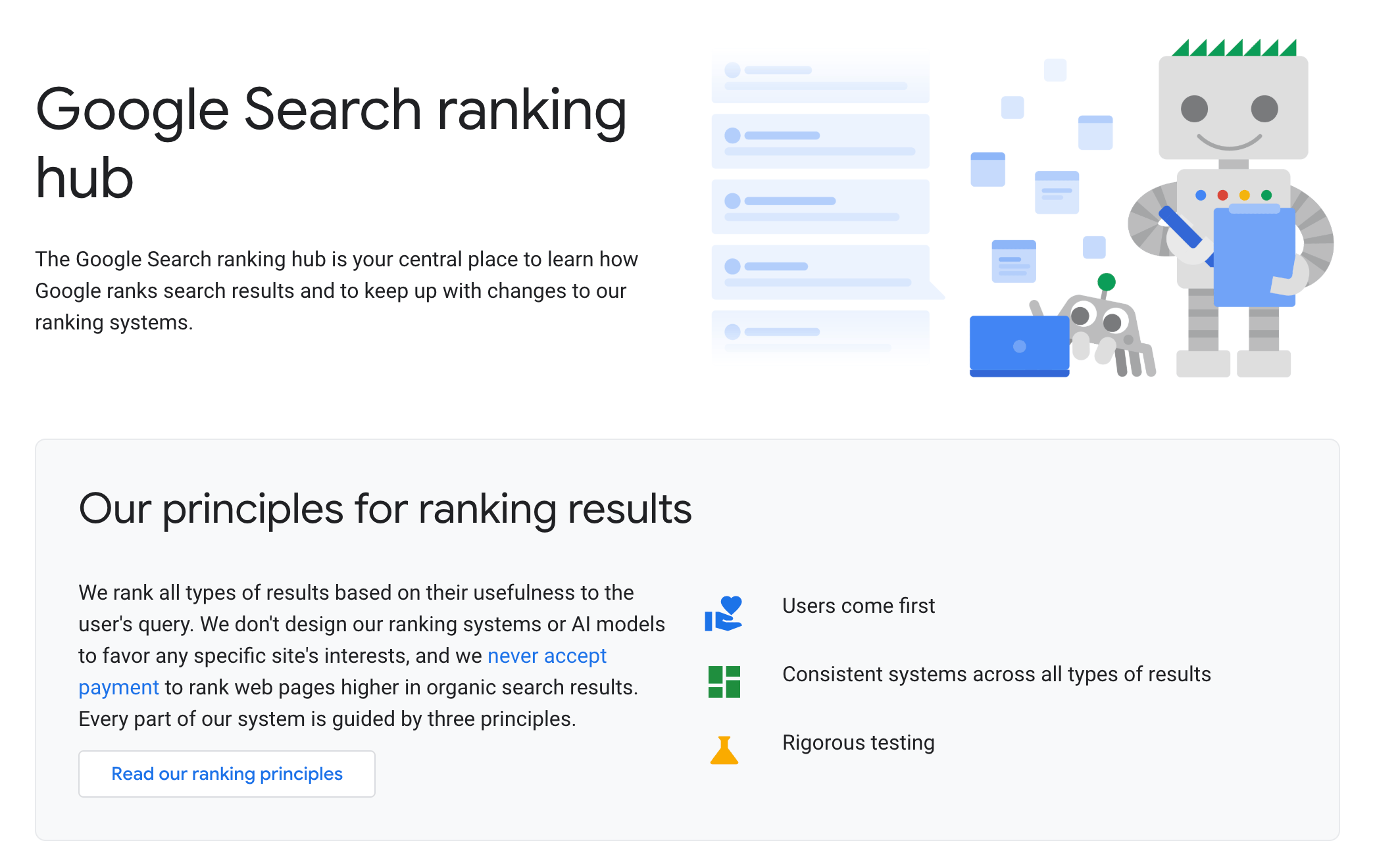 Google Search ranking hub homepage and three core principles
Directory of All 7 New and Updated Google Documents
The table below catalogs every Search Central and Crawling Infrastructure document launched or rewritten on November 24, 2026 (UTC), along with its core operational scope:
| Module | Official Document (Direct Link) | Key Addition or Clarification |
|---|---|---|
| Central Portal | Google Search ranking hub | Single hub unifying ranking principles, advance update notices, feedback pathways, traffic-drop debugging, and community support |
| Foundational Standard | Our principles for ranking results | Formalizes three pillars: users first, consistent utility across all result formats, rigorous testing, and zero paid organic ranking |
| Pre-Announcement Policy | How to stay informed on Google Search ranking updates | Defines advance notice triggers (including UK CMA fair-ranking requirements), official RSS feeds, and post-rollout wait windows |
| Structured Triage & Appeals | Submit feedback about ranking changes in Google Search | Introduces Search Console update hashtag feedback (e.g., #NovemberCoreUpdate2026) plus six formal dispute/appeal tracks |
| Crawler Token Spec | Overview of the Google-Extended token | Product-agnostic phrasing, no separate crawler, zero impact on Search indexing/ranking, four exemptions, and 2027 signal preview |
| Controls Combination Guide | Control how your content is used for generative AI at Google | Separates AI model training from Grounding (RAG) and provides a 5-control / 7-goal configuration matrix |
| AI Search Citations | Attribution and factuality in Search generative AI features | Explains how AI Overviews and AI Mode select links from the Search index, run query fan-out, and enforce factuality |
Companion Deep Dive: For a technical breakdown of the final document above, see our dedicated analysis: Google Explains How Links Are Selected and Shown in AI Overviews and AI Mode.
1. The Google Search Ranking Hub and Three Core Ranking Principles
Google consolidated its scattered guidance on ranking systems, status dashboards, traffic diagnostics, and publisher feedback into one unified Google Search ranking hub. In the companion Our principles for ranking results documentation, Google states that every layer of Search—from classic ranking algorithms to deep learning models and generative AI experiences—is governed by three core principles:
- Users come first:
- Every search can match hundreds, thousands, or millions of web pages. Google prioritizes helpful, reliable information created to benefit people so searchers can connect with creators, businesses, and organizations across the open web;
- Reaffirming its Honest Results Policy, Google states explicitly on the hub that it never designs ranking systems or AI models to favor any specific site's interests and never accepts payment to rank web pages higher in organic search results.
- Consistent systems across all types of results:
- Blue links, images, videos, charts, maps, carousels, and AI Overviews / AI Mode are all evaluated under the same baseline standard: utility (how helpful a result is for the query). No result format receives preferential treatment;
- Helpfulness standards are anchored in the publicly published Search Quality Rater Guidelines, validated with independent quality raters. Google states it does not apply manual adjustments to alter search rankings except to comply with legal obligations or enforce clearly defined Content Policies.
- Rigorous testing and ongoing accountability:
- Every ranking change must prove measurable utility improvements across the overall Search results page before shipping, backed by senior review and transparent documentation.
2. Advance Core Update Pre-Announcements: December 2026 Core Update Previewed
The newly published How to stay informed on Google Search ranking updates codifies when Google gives advance notice, where updates are tracked, and how long site owners must wait before diagnosing traffic shifts.
When Google Provides Advance Notice
Google issues notices on the Google Search Status Dashboard when a change falls into either of two categories—explicitly noting that for updates where UK users may experience significant ranking shifts, Google provides advance notice in accordance with the UK Competition and Markets Authority (CMA) fair ranking conduct requirements:
- Actionable policy changes: Revisions to Search content policies, technical guidelines, or eligibility rules where publishers must modify site markup, architecture, or content workflows to remain compliant;
- Significant ranking changes: Broad algorithmic updates—such as core updates—expected to produce noticeable ranking shifts across many queries and sites.
First Proof Point: Pre-Announcement of the December 2026 Core Update
Immediately upon completing the November 2026 Core Update on November 24, Google pre-announced the upcoming December 2026 Core Update (no exact launch date set yet, rollout scheduled for December 2026 across all languages and regions). Notably, Google highlighted three specific areas where this December rollout will drive meaningful change:
- Relevant content understanding & ranking: Multiple improvements to how Search systems understand and rank relevant pages;
- Longer and more complex questions: Better comprehension and matching for multi-clause, nuanced queries;
- Personalized results: Enhancements to personalized Search results for users who have Search personalization enabled.
Official Tracking Channels & Post-Rollout Waiting Rule
- Three Official Feeds: Track pre-announcements, rollout start dates, and completion timestamps via the Google Search Status Dashboard (with Atom / RSS feed), the Google Search Central Blog (RSS), and the Search Central Documentation Changelog (RSS);
- Mandatory Wait Window Before Auditing: Google explicitly advises site owners to wait until an update is marked complete on the Search Status Dashboard plus at least one full week of post-rollout data before evaluating Search Console drops and submitting ranking feedback.
3. Hashtag Ranking Feedback Triage & Six Formal Appeal Tracks
The new Submit feedback about ranking changes in Google Search page separates engineering systemic feedback from site-specific dispute resolution.
Structured Ranking Feedback via Dedicated Hashtags
Once a significant ranking update or actionable policy change posts to the Search Status Dashboard, verified site owners can click Submit Feedback inside Google Search Console and tag their report with the dashboard's update-specific hashtag (for instance, #NovemberCoreUpdate2026). Google recommends including six diagnostic details in every submission:
- Performance report snapshot: Screenshot or export from Google Search Console;
- Search queries and locale: Exact query strings, target country, and language affected;
- Example URLs: Affected URLs alongside competing URLs ranking inappropriately (Google explicitly cites scraped content outranking an original source as a prime example);
- Impact: When and how traffic shifted, backed by visual charts if relevant;
- Context: Why current top results fail to satisfy searcher intent, plus pre- and post-update GSC impressions and position metrics;
- UK market impact: How the shift affected the functioning of a UK market in which the business operates.
Scope Boundary: Google engineers evaluate submissions in aggregate to catch systemic issues. Submitting ranking feedback never triggers manual ranking adjustments for an individual URL.
Six Formal Dispute Resolution & Appeal Channels
If your site experienced policy enforcement or index exclusion rather than an algorithmic core update shift, use the dedicated formal channel below:
| Enforcement / Exclusion Category | Trigger & Official Appeal Workflow |
|---|---|
| Manual actions & spam reconsideration | Review flagged URLs in GSC's Manual Actions report, remediate every affected page against spam policies, and file a reconsideration request directly inside the report |
| Counterfeit goods policy appeals | Submit a dedicated appeal if a page was erroneously removed under Google Search's counterfeit goods policy |
| SafeSearch misclassification review | Troubleshoot and clean flagged pages; wait at least 2–3 months for classifiers to reprocess after fixes (sites that have always followed guidance may request immediate review) |
| DMCA / copyright counter notice | File a copyright counter notice if removed content was misidentified or you hold legal rights to publish it |
| UK CMA whole-site indexing appeal (Live Dec 17, 2026) | Available starting December 17, 2026 for sites serving web content, goods, or services to UK users whose entire domain was manually excluded from the Google Search index |
| EU DMA Article 6(12) appeals | For European Economic Area (EEA) sites meeting DMA Search access conditions that fail to appear in Search after verifying indexing health in GSC |
4. AI Model Training vs. Grounding (RAG): Deep Dive into Google-Extended
The rewritten Overview of the Google-Extended token and brand-new Control how your content is used for generative AI at Google finally resolve how web controls interact across Search, AI Overviews, and standalone Gemini products.
Training vs. Grounding: Two Completely Independent Stages
When web content is accessible to Googlebot, Google notes two distinct uses across its generative AI systems:
- AI model training: Teaching future generations of foundation models (such as Gemini models) general language patterns, reasoning skills, and world knowledge before a model is deployed. Those trained models power both standalone commercial products (like the Gemini app) and Search generative AI features;
- Grounding (Retrieval-Augmented Generation / RAG): Fetching fresh, relevant pages from the Google Search index at prompt time—after a model is trained and deployed—to boost factuality, accuracy, and relevance while surfacing clickable web links. Grounding occurs inside Search AI experiences (AI Overviews, AI Mode, Discover) as well as non-Search products (like the Gemini app).
Six Key Technical Truths About Google-Extended
- Product-agnostic documentation, unchanged enforcement: Google stripped specific product names from the token spec so the contract stays stable as AI products evolve, while stressing that enforcement has not changed.
- Zero Search ranking or indexing penalty: Disallowing
Google-Extendeddoes not exclude your site from Google Search and is not used as a Search ranking signal. - Controls foundation model training + non-Search grounding—NOT Google Search AI features: Disallowing
Google-Extendedblocks future model training and prompt-time grounding inside commercial Google AI products aside from Search and other Search services. To opt out of AI Overviews and AI Mode, you must use theSearch generative AI controlin Search Console. - No separate
Google-Extendedweb crawler exists: To conserve publisher server bandwidth, Google does not dispatch a standaloneGoogle-Extendedcrawler. Instead,Googlebot,GoogleOther, and related crawlers read your rootrobots.txtdirective during standard crawls and pass the flag downstream to enforce training and non-Search grounding restrictions (site-wide or per path). - Four explicit exemptions: Even when disallowed,
Google-Extendeddoes not apply to: (a) spam, abuse, security, and fraud-prevention models; (b) specialized standalone task models (e.g., robotics models not incorporated into broad multimodal systems); (c) accessibility, transcription, and translation models/features; and (d) products governed by separate consents. Furthermore, disallowingGoogle-Extendedon your domain cannot stop third-party sites (that allow it) from mentioning or linking to you, so AI answers may still reference your brand via external pages. - Early 2027 industry standard incoming: Google confirmed it intends to support the shared machine-readable AI training preference signal (
user-agent: __usage_ai-training) in early 2027.
5. Five AI Controls & Seven Goal-Based Configuration Recipes
Site owners can mix and match five orthogonal mechanisms to align Search traffic acquisition with content-licensing policies:
Complete Control Mechanism Reference
| Control Mechanism | Where Configured | Exact Scope of Control |
|---|---|---|
Search generative AI control | Google Search Console settings | Controls grounding and link/content display inside Search and Discover AI features (AI Overviews, AI Mode). Does not affect model training or core Search ranking |
Google-Extended | Root robots.txt | Restricts future commercial foundation model training and non-Search AI grounding. Zero effect on Search indexing or ranking |
GoogleOther | Root robots.txt | Blocks Google's generic crawler used for R&D and one-off non-Search fetches without touching Search |
nosnippet / data-nosnippet / max-snippet | HTML <meta name="robots">, inline HTML attribute, or X-Robots-Tag HTTP header | Caps snippet length or removes previews across Search, AI Overviews, and AI Mode; nosnippet and max-snippet also prevent targeted content from serving as direct input for AI Overviews and AI Mode |
noindex | HTML <meta name="robots"> or X-Robots-Tag HTTP header | Removes the page completely from Google Search and all Search generative AI features |
Official 7-Scenario Configuration Matrix
| Business Goal | Official Configuration Recipe |
|---|---|
| 1. Full Search + AI Search + Training + Non-Search Grounding (Recommended default for DTC growth) | Keep pages crawlable by Googlebot, do not disallow Google-Extended in robots.txt, and do not exclude via Search Console's Search generative AI control |
| 2. Keep Classic Search & Allow Training, Opt Out of AI Overviews / AI Mode | Set Search generative AI control in Search Console to "Exclude my site's links and content from Search generative AI features", and leave Google-Extended allowed |
| 3. Keep Search (Including AI Overviews / AI Mode), Block Training & Non-Search Grounding | Disallow Google-Extended in robots.txt while keeping Search generative AI controls enabled |
| 4. Stay in Classic Search Only (Opt Out of Both Search AI & Model Training) | Exclude the site via Search generative AI control in Search Console AND disallow Google-Extended in robots.txt |
| 5. Limit Snippet Length or Shield Proprietary Copy Blocks Inside Indexed Pages | Deploy max-snippet:[N], data-nosnippet (section-level opt-out), or page-level nosnippet |
| 6. Remove Pages Entirely from Google Search & AI Experiences | Apply noindex via HTML robots meta or X-Robots-Tag headers (ensure crawlability so Googlebot reads the directive) |
| 7. Index Paywalled Content While Controlling AI Overviews Previews | Pair paywalled structured data with data-nosnippet or max-snippet directives |
Ready-to-Use Implementation Snippets
Protecting Model Training While Keeping Full AI Overviews Visibility (robots.txt)
| # Keeps Googlebot indexing & AI Overviews / AI Mode citations intact |
| User-agent: Google-Extended |
| Disallow: / |
Shielding Sensitive Pricing Tables from AI Grounding Input (data-nosnippet)
| <!-- Excludes this block from Search snippets and direct AI Overviews / AI Mode input --> |
| <section class="wholesale-margin-table" data-nosnippet> |
| <h3>Distributor Wholesale Tiers</h3> |
| <p>Confidential B2B pricing schedule...</p> |
| </section> |
6. Five-Point Action Checklist for DTC Brands, SEO & GEO Teams
- Audit
robots.txtsoGoogle-Extendednever accidentally blocksGooglebot: If leadership asks to restrict foundation model training, targetUser-agent: Google-Extendedspecifically. Never blockGooglebotor flip offSearch generative AI controlin Search Console unless you intentionally want zero traffic from AI Overviews and AI Mode. - Prepare high-value pages ahead of the December 2026 Core Update: Google explicitly called out longer, more complex questions and personalized results for next month's core update. Upgrade category guides, product comparison hubs, and buyer FAQs so they cleanly resolve multi-constraint commercial queries rather than thin single-keyword templates.
- Enforce the Status Dashboard + 7-Day Diagnostic Wait Rule: Subscribe your SEO engineering channel to the Search Status Dashboard RSS feed. Hold off on reactive template rollbacks until an update hits Completed plus at least seven days of clean post-rollout GSC data—and log any scraper-outranks-original cases using Google's new update hashtag feedback flow.
- Track regional appeal readiness for UK & EEA storefronts: Teams selling into the United Kingdom should bookmark the new UK CMA whole-site indexing appeal launching December 17, 2026, while keeping UGC/review moderation clean to avoid 2–3 month SafeSearch classifier delays.
- Put
user-agent: __usage_ai-trainingon your Q1 2027 technical roadmap: Flag Google's upcoming early-2027 support for the shared machine-readable AI training preference signal so compliance and DevOps teams can adopt a single standardized policy.
Primary Sources & Official Documentation
- Search Engine Roundtable: New Google Search Ranking Hub, Ranking Principles, Feedback & AI Training Control
- Search Engine Roundtable: Google Preannounces December 2026 Core Update - Complex Queries & Personalization
- Google Search Central: Google Search ranking hub
- Google Search Central: Our principles for ranking results
- Google Search Central: How to stay informed on Google Search ranking updates
- Google Search Central: Submit feedback about ranking changes in Google Search
- Google Crawling Infrastructure: Overview of the Google-Extended token
- Google Search Central: Control how your content is used for generative AI at Google
- Google Search Central: Attribution and factuality in Search generative AI features
- EVAOO Google Research Lab: Google Explains How Links Are Selected and Shown in AI Overviews and AI Mode
- EVAOO News Archive: New Google Search Ranking Hub, Ranking Principles, Feedback & AI Training Control
Found this actionable? Copy standard citation & summary
Formatted with canonical attribution link and executive summary—ready for Slack, Notion, or LLM context.
Put Into Practice: Companion Browser Workbenches
Shopify GTM & GA4 Web Pixel Generator
Generate production-ready Shopify Customer Events Web Pixel code for GA4, Meta, and TikTok.
UTM Builder Pro Matrix Workspace
Reverse URL parser, GA4 channel group diagnostics, and dynamic ad macro batch CSV export.