
GEO from 0 to 1: A Complete Guide for Beginners
Author: 黄小木
When buying products or finding tools, more and more people are no longer using search engines, but directly asking Doubao or ChatGPT. If your product does not appear in the answers provided by AI, no matter how good it is, you simply do not exist in front of this new traffic entrypoint. This article explains in detail: How to get AI to recommend your product.
Chapter 1: What is GEO and Why Must AI Products Implement It
1.1 What is GEO
GEO (Generative Engine Optimization): Optimizing your content so it can be seen, understood, cited, and recommended by AI systems.
Compared to traditional SEO (Search Engine Optimization), the difference can be summarized in one sentence:
SEO is about ranking high on search results lists—like fighting for a spot on a supermarket shelf so users spot you; GEO is about getting the AI to directly say your name—like an expert in-store guide proactively recommending your product.
For example, when a user asks AI: "What are some good AI meeting note tools?"If the AI directly lists NoteFlow (a virtual product) and explains why it's great, that is GEO in action. The user didn't search or click links; the AI fed them the answer directly.
1.2 The Shift in Traffic Entrypoints
Why did this suddenly become crucial? Because user behavior has shifted. Previously, you typed keywords and filtered through a list of blue links to find and evaluate information. Now, people directly ask AI for a single, synthesised answer.
This has introduced "Zero-Click Searches": Previously, checking the weather meant clicking a link. Now, AI tells you directly: "Sunny, 25°C." You leave without clicking anything.
For AI products, this changes the game. Past success relied on search rankings; today, it relies on being cited by AI. The cited brand becomes the authority.
1.3 Why AI Products Specially Need GEO
While GEO benefits all businesses, it offers an exceptionally high return for AI products—especially those targeting global markets:
- Global AI networks are open: Global AI models (ChatGPT, Perplexity, Google AI Overviews) crawl and index the open web directly. Unlike fragmented ecosystems, your official website is immediately accessible to them.
- AI models trust high-quality official sites: A structured, factual, and informative product website is treated as a highly authoritative source by AI models.
Chapter 2: Is Your AI Product Suitable for GEO?
2.1 What Kinds of Businesses Benefit Most
The core test: Do users search, read reviews, or compare options before paying?The more research a purchase requires, the higher the ROI of GEO.
Three typical categories suitable for GEO:
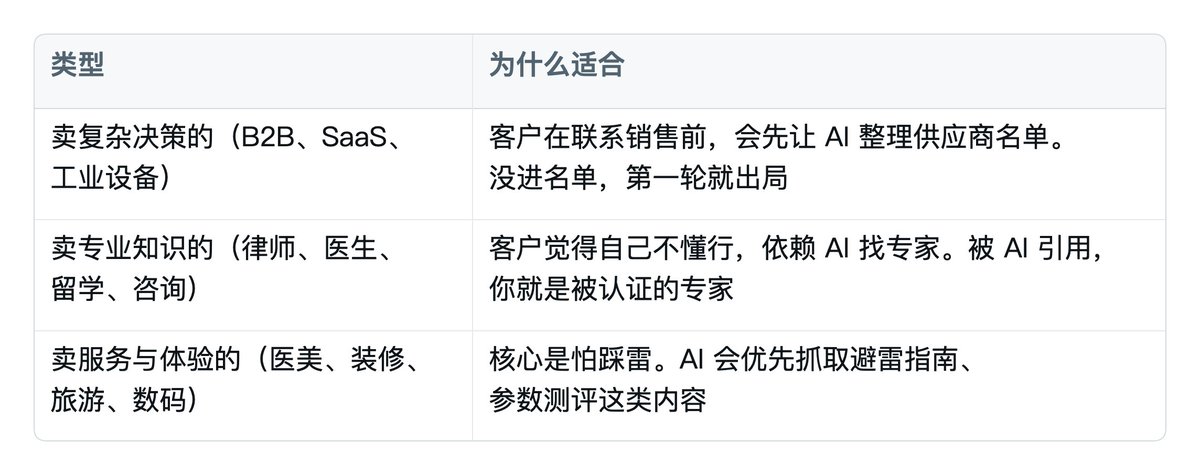
Our example, NoteFlow, falls into the SaaS tool category. Since users compare multiple options before subscribing, it sits right in the GEO sweet spot.
2.2 Two Entry Conditions
AI doesn't index just anything. You must meet two basic prerequisites:
- Have actual content: If your website contains only marketing slogans without concrete specifications or use cases, AI has nothing to extract.
- Leave online footprint: If your website is the only place mentioning your product, AI won't trust it.
Dispelling a common myth: Advertising spend does not translate to AI familiarity. AI learns from indexed factual data—such as third-party reviews and comparisons—not marketing copy.
Chapter 3: Why Does AI Recommend You
3.1 The Two Steps of AI Answering: Retrieval and Generation
Most AI search engines utilize RAG (Retrieval-Augmented Generation):
- Retrieval: When a query is made, AI searches the web to pull relevant articles, forum posts, or official product pages.
- Generation: The model reads these sources, extracts key facts, and rephrases them into a coherent response.
If your content isn't retrieved, or if it is too unstructured for the model to extract facts, you won't appear in the final answer.
3.2 The Three-Tier Content Filter Funnel
AI filters candidate pages through three distinct layers:
- Discoverability (Retrieval): The baseline. AI must find your page. Models prefer high-authority sites and skip pages that block crawlers or load too slowly.
- Understandability (Formatting): AI prefers structured, high-density facts. It ignores vague marketing fluff and appreciates clear lists, parameters, and tables.
- Trustworthiness (Cross-Verification): AI checks multiple sources to verify claims. If your site, a review blog, and a tech forum all mention the same fact, the model accepts it as true.
3.3 The Core Formula of GEO
In practice, this means: High Recommendation Rate = Authority Channels + Structured Content + Data Backing.
Chapter 4: How to Write Content AI Wants to Cite
AI does not care about literary style. It treats content as a fill-in-the-blank exercise. Your goal is to write structured manuals.
4.1 General Writing Rule: Conclusion First
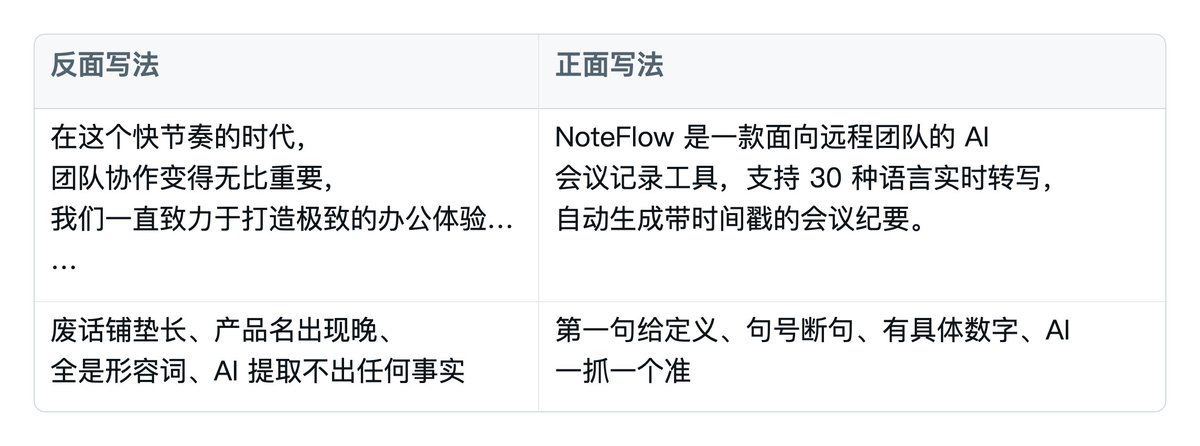
Put your core point at the very beginning of the paragraph. Keep sentences short, use lists, and label steps clearly so models can extract facts instantly.
Comparison of the two product descriptions:
4.2 Four Key Content Templates
Template 1: Definition-Based (Capturing "What is" queries)
Formula: [Product Name] is a [Market Position] featuring [Unique Value] founded in [Year].
Example: "NoteFlow is a cross-border AI meeting note tool featuring 30-language real-time transcription, launched in 2023, serving over 5,000 corporate clients."
Template 2: List-Based (Capturing "What features" queries)
"Three core benefits of NoteFlow:
1. Multilingual Support: Transcribes 30 languages with 98% accuracy.
2. Automation: Generates summaries and action items in under 1 minute.
3. Integrations: Connects with Slack, Notion, and 8 other apps."
Template 3: Anchor-Based (Leading to a conclusion)
Use concluding phrases like "Therefore, NoteFlow is the optimal choice for multinational teams that require high-speed multilingual transcriptions."
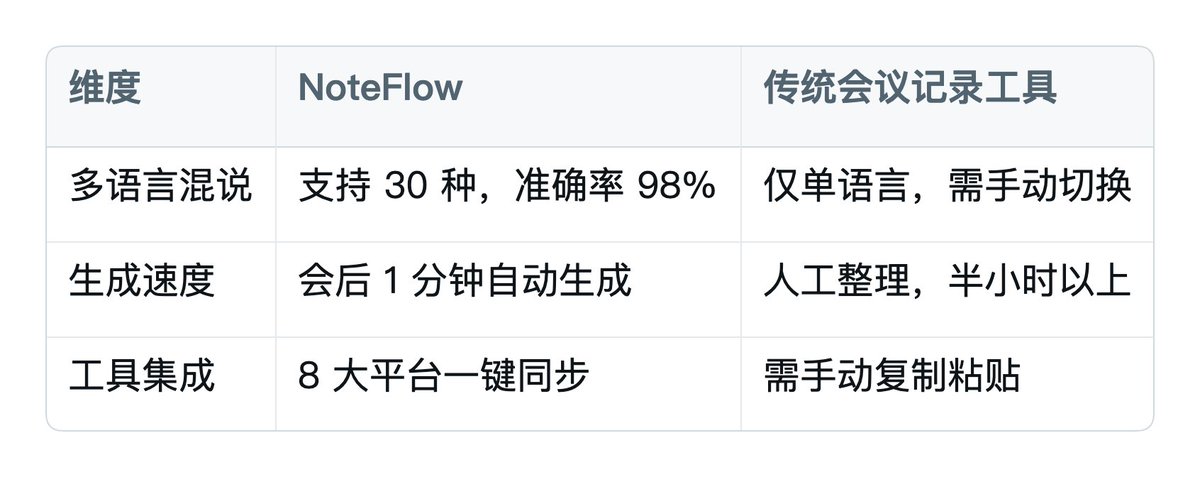
Template 4: Tabular Comparisons (Capturing "Which is better" queries)
AI prefers tabular configurations when answering comparison queries:
4.3 Three Hooks to Boost Trust
- Use concrete numbers: Avoid words like "very fast" or "cheap." Write "1-minute generation" or "60% cost savings."
- Authority citations: Include phrases like "according to Gartner's report" or "certified with ISO 27001."
- Showcase author expertise: End with a bio: "Written by [Name], B2B Product Director with 10 years of SaaS experience."
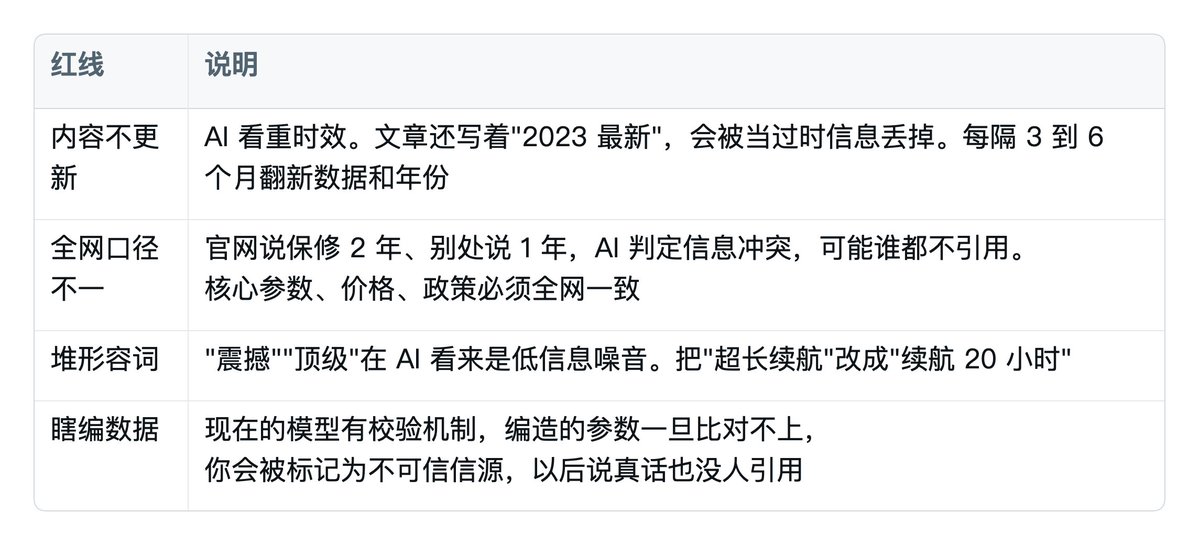
4.4 Four Writing Red Lines
Avoid hidden texts, fake reviews, or leaving zero footprints. AI check mechanisms check and penalize bad content.
Chapter 5: Setting Up Your Standalone Website
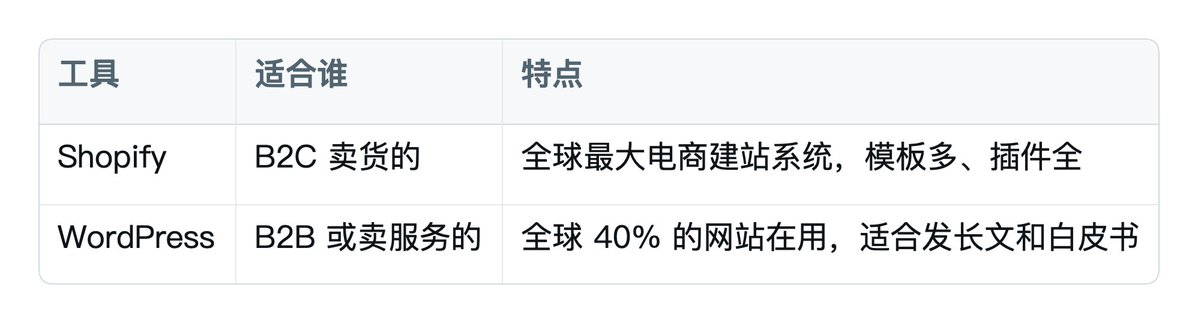
5.1 First, Build the Site
Launch a blog or resource section. Publish white papers, tutorials, and product specs rather than internal news.
5.2 Adding a "Spec Sheet" to Your Page: Schema
Use JSON-LD schema markup to explicitly tell AI crawler bots what your page content is about:
{
  "@context": "https://schema.org",
  "@type": "Product",
  "name": "NoteFlow Pro",
  "description": "AI meeting recorder supporting 30 languages",
  "offers": {
    "@type": "Offer",
    "price": "29.00",
    "priceCurrency": "USD"
  }
}
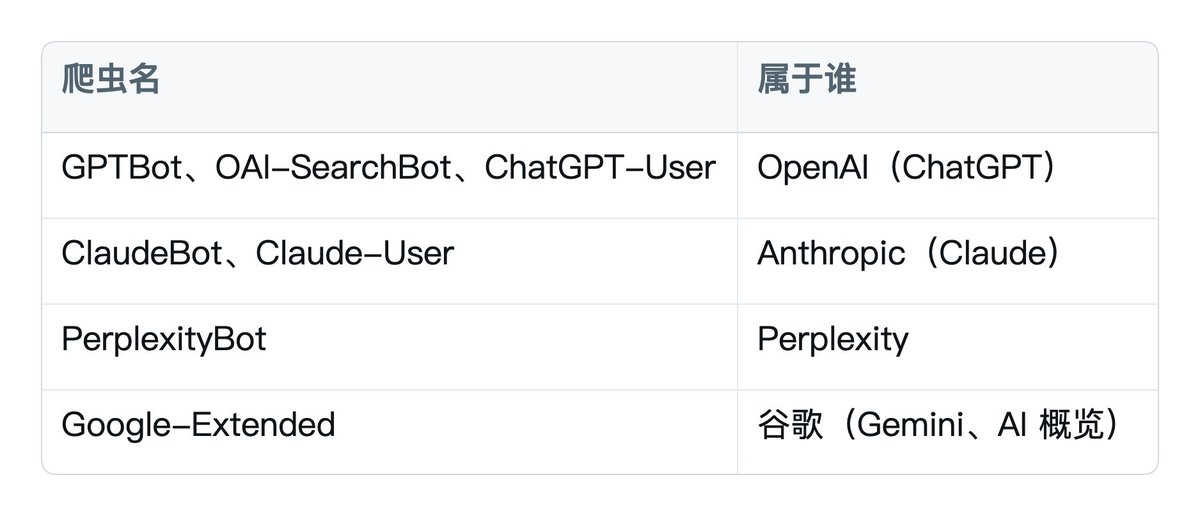
5.3 Open Your Website Gates to AI
Ensure your robots.txt allows AI crawlers to index your pages. Know who they are:
5.4 Hand a Directory to AI: llms.txt
Provide an /llms.txt file in your root folder summarizing website structures and key assets for LLMs to easily digest.
5.5 Two Easy Writing Formats to Adopt
- Conclusion First: Answer queries in the first paragraph.
- Questions in Headers: Write subtitles as explicit questions that users frequently search.
Chapter 6: Content Layout and Topic Research
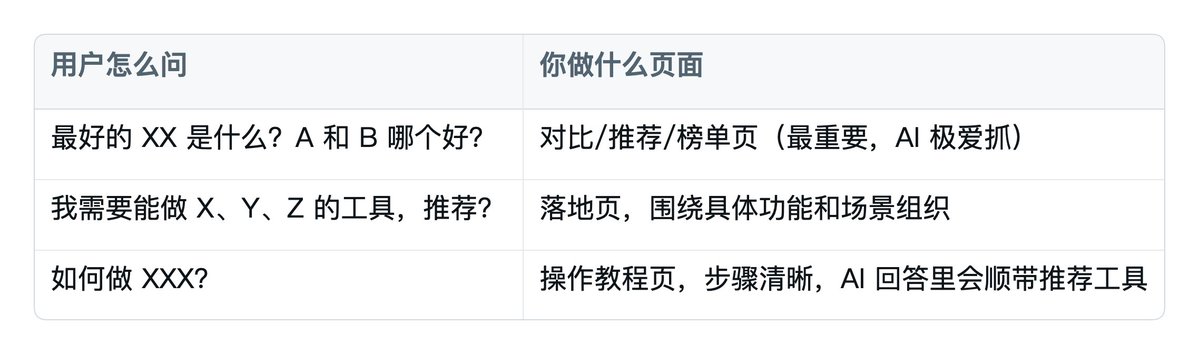
6.1 Three Essential Page Types
Build three main page types: comparisons ("best tools"), features, and tutorials.
6.2 Researching Topics: Watch Suggestion Dropdowns
Identify what users are asking by watching search engine auto-complete dropdown lists, and softly integrate keywords into your content.
6.3 Soft-Kits for Key-Attributions
Keep brand word densities low (about 3 times per article) to avoid being flagged as spam by LLM search algorithms.
Chapter 7: Verifying AI Indeed Recommends You
7.1 Three-Step Manual Verification
Query AI models directly after 3-7 days of publishing. Check for index availability, general recommendation lists, and reference source citations.
7.2 Remediation for No Recommendations
If competitor tools are recommended instead, write product-comparison articles or focus on niche, long-tail key phrases.
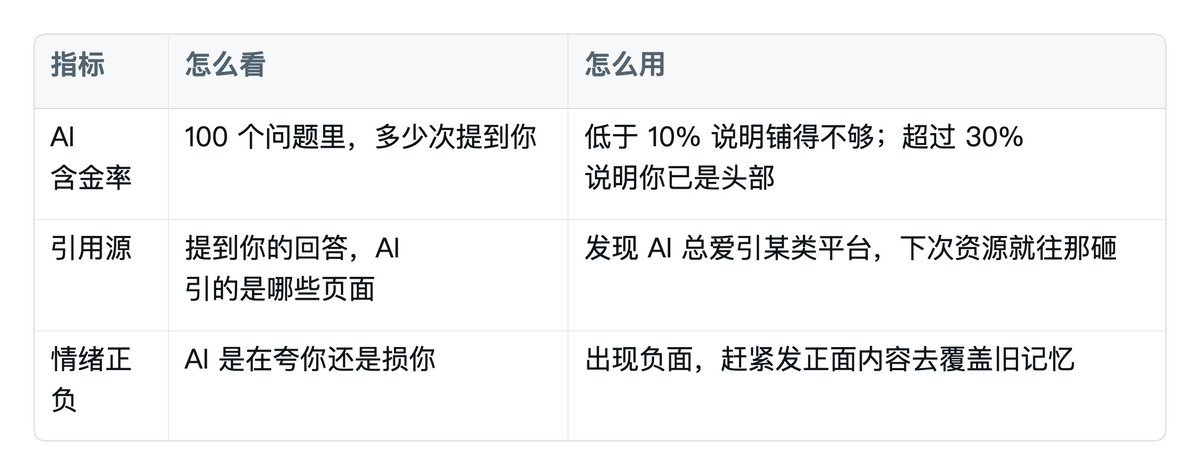
7.3 Monitoring Three Core Metrics
Monitor your success by tracking:
Chapter 8: Pitfalls and the Future
8.1 Three Forbidden Red Lines
Never write fake metrics, keyword stuff, or hide texts on page backgrounds.
8.2 Future Opportunities to Target
Prepare for the future by optimizing image Alt tags for Multimodal GEO, and highlighting founder names to establish professional authority.
GEO is a dynamic game. Optimize early to establish authority while competition is still low!