
GEO Open Course: Deep Dive into GEO Content Engineering
Author: 姚金刚

Today's theme is GEO Content Engineering. This topic is not easy to explain, but I decided to discuss it systematically once. This will help everyone systematically understand why GEO content has higher requirements for system capabilities, and why the logic of management and operation is different from many traditional marketing methods.
In my opinion, only by establishing this level of cognitive awareness and possessing practical combat capabilities can we truly have the ability of GEO refined operation.
💡 Key System Heuristic:
AI's strategy for selecting external reference sources is more complex than we think. For the same question, the AI may list a dozen reference sources, but only two or three are actually absorbed by the answer. Some links only appear in the reference list, and the body text is not used at all; some articles will be referenced several times in one answer, becoming evidence that repeatedly appears in the answer structure.
1. Bulk Publishing Is a Misunderstanding; It Doesn't Resolve Trust
Many executives say a typical sentence when raising GEO demands: “We hope that no matter how users ask on AI, our brand will appear.”
This sentence sounds normal, but it is too vague. What does "no matter how users ask" mean? Brand words, category words, competitor comparison words, purchasing decision words, or risk assessment words? What does "appear" mean? Being mentioned, recommended, cited, positively evaluated, or used as evidence for a conclusion?
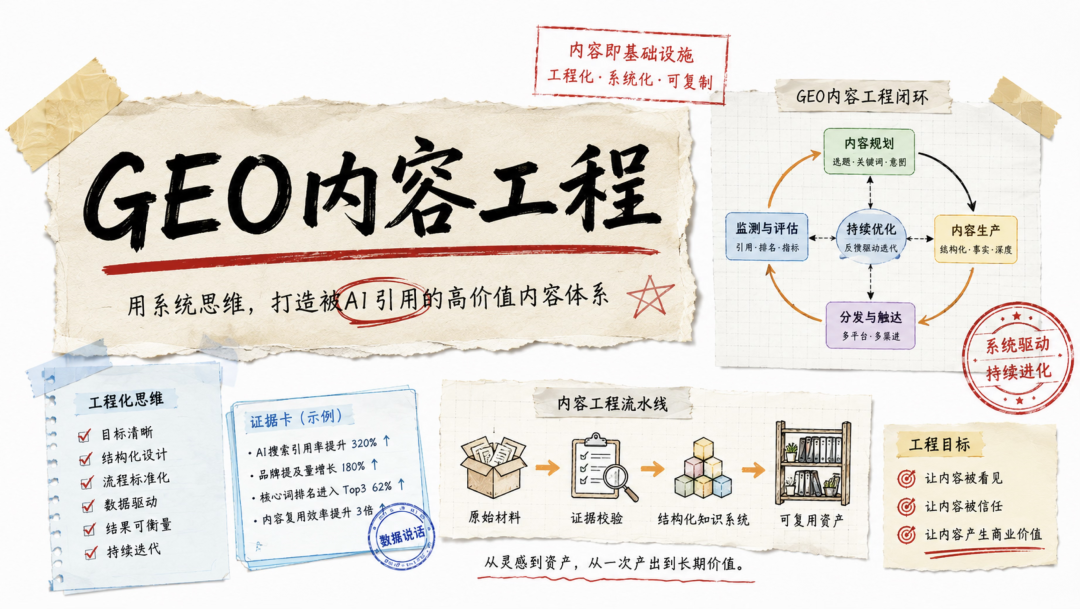
So, the key of GEO is not just "to be seen", but to be selected, absorbed, and correctly attributed.
Being selected means you enter the AI's reference sources. Being absorbed means your facts, data, definitions, or judgments enter the answer. Being correctly attributed means the AI does not state your point incorrectly or attribute your evidence to someone else.
2. The Essence of AI Answering: Assembling Evidence
To understand GEO, stop thinking of AI as a person reading a blog. Humans are attracted by titles, moved by stories, and tolerate some ambiguous expressions.
AI, when generating answers, acts more like a system that temporarily assembles answers. It must first understand the user's question, split it into queries, look for sources, rank them, pick evidence, and organize them into answers.
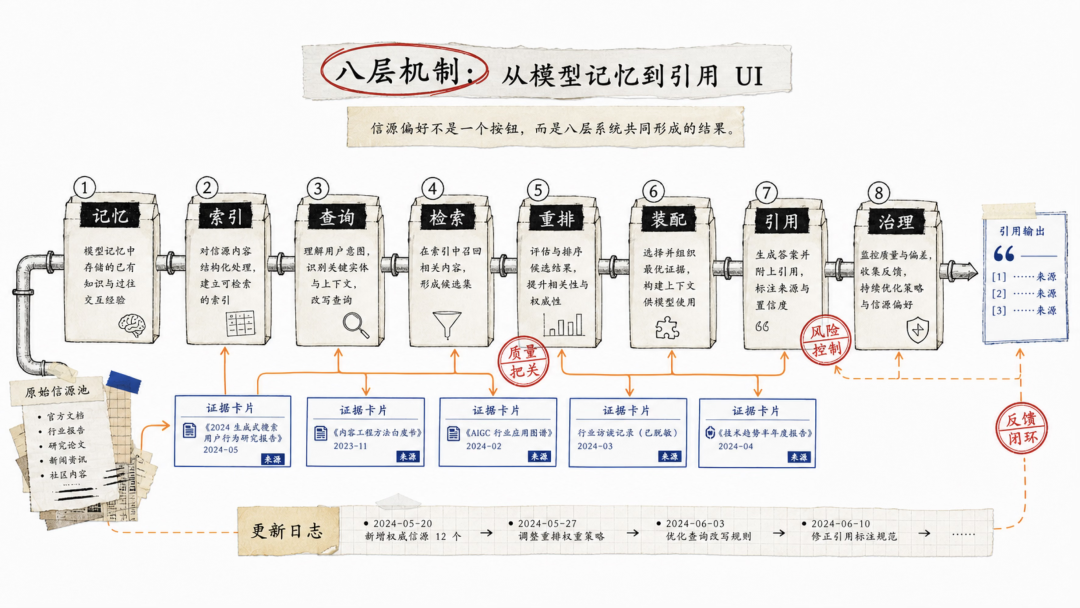
This link can be simplified into eight stages: Memory, Indexing, Querying, Retrieval, Reranking, Assembly, Citation, and Governance. For GEO content, the most critical steps to focus on are reranking, assembly, and citation. For AI, content quality is first assessable, extractable, verifiable, and combinable.
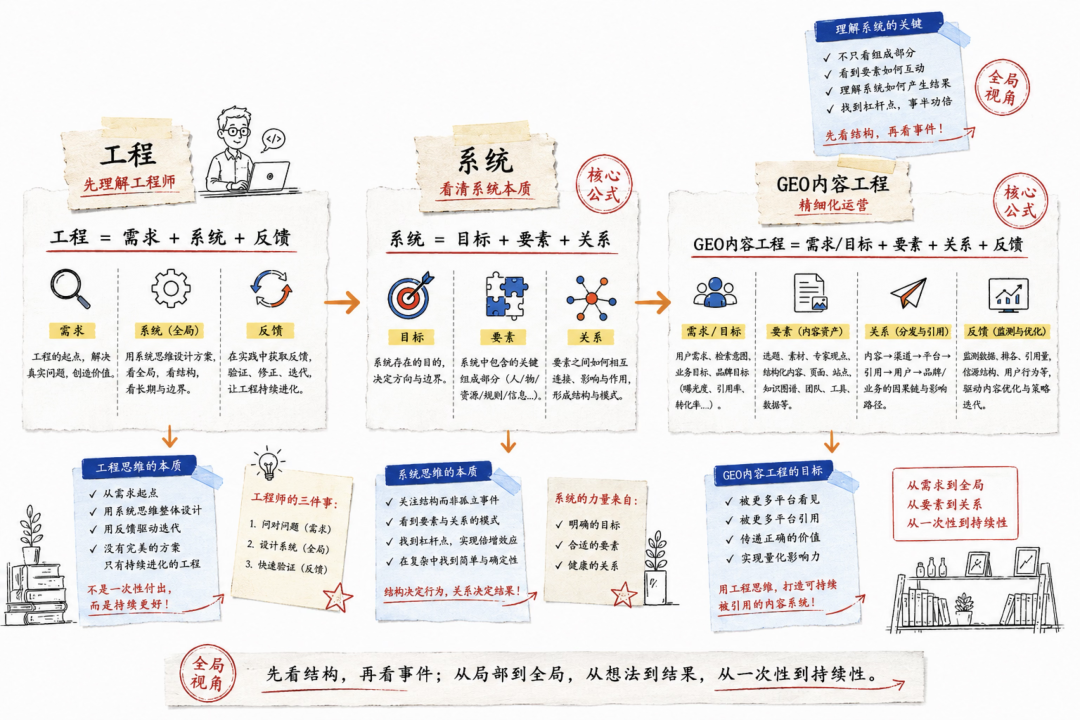
3. GEO Content Engineering: Goals, Elements, Relations, and Feedback
If you only treat GEO as content copy tactics, you will always ask: how to write titles? How to place keywords? Do we need FAQs or tables? These questions are important, but they are still on the surface. A system has at least goals, elements, relations, and feedback.
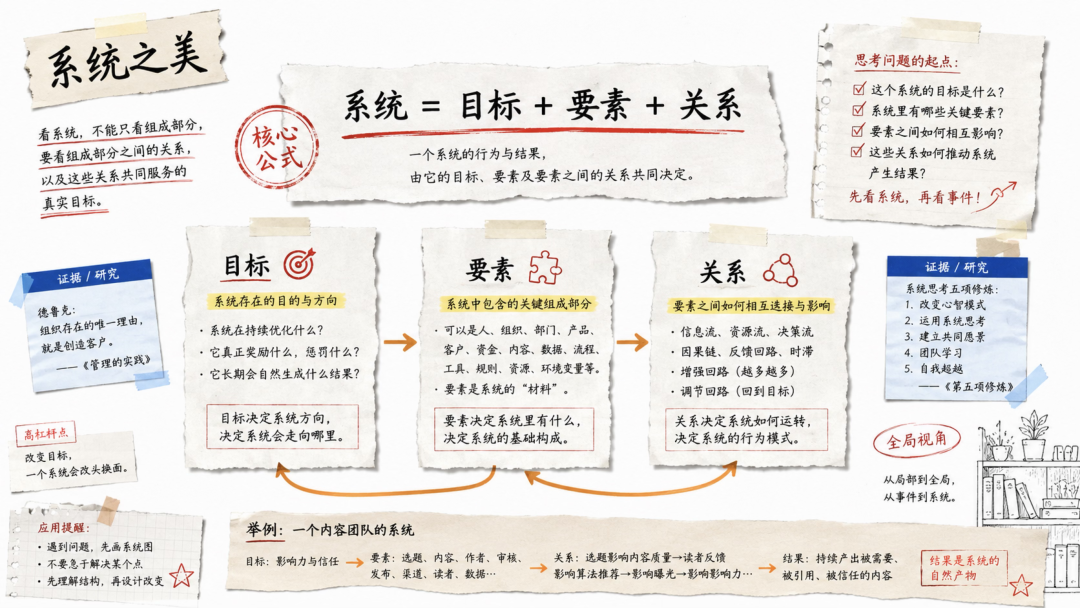
Goals are what the system continuously optimizes. Elements of GEO content include user questions, prompt maps, knowledge bases, fact bases, evidence blocks, page structures, titles, tables, FAQs, authors, and metadata. Relations determine how these elements affect each other. Feedback is how the system knows whether it did right or wrong.
4. AI Prefers Content with High Evidence Density
An easily overlooked fact is that AI is not just looking for "relevant content," it is also looking for "evidence that can support the answer."
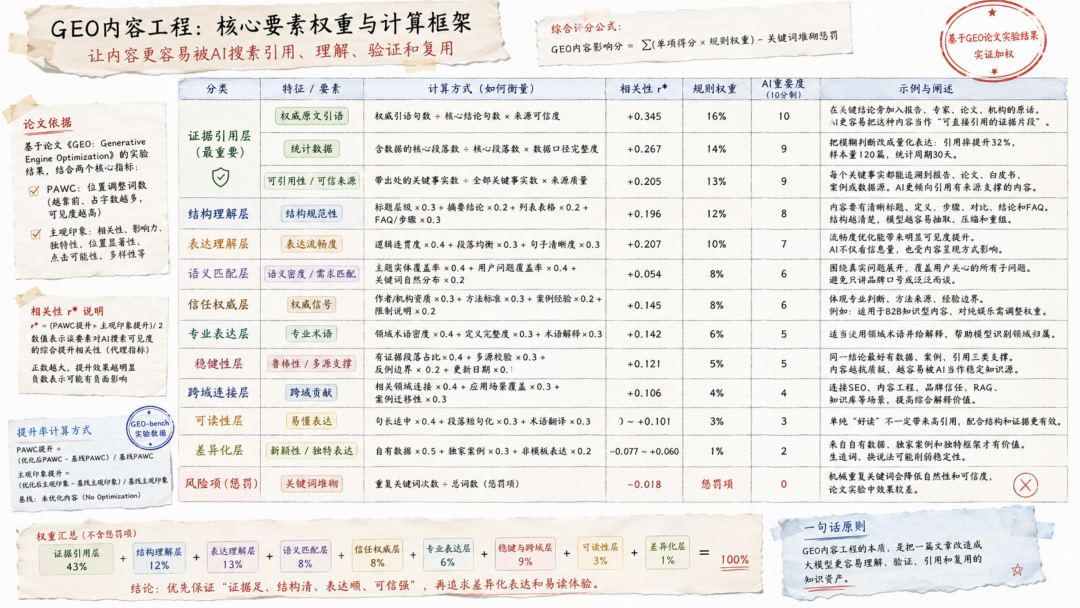
In GEO single-article elements, authoritative original quotes, statistical data, citeability, and trusted sources are critical. AI generating answers is most afraid of being wrong. It needs materials to support judgments: who said it, when, based on what sample, etc. True value lies in making articles readable for humans while keeping evidence extractable for AI.
5. A Single Article Can Constitute a Small System
A GEO article needs another layer of deconstruction compared to ordinary text.
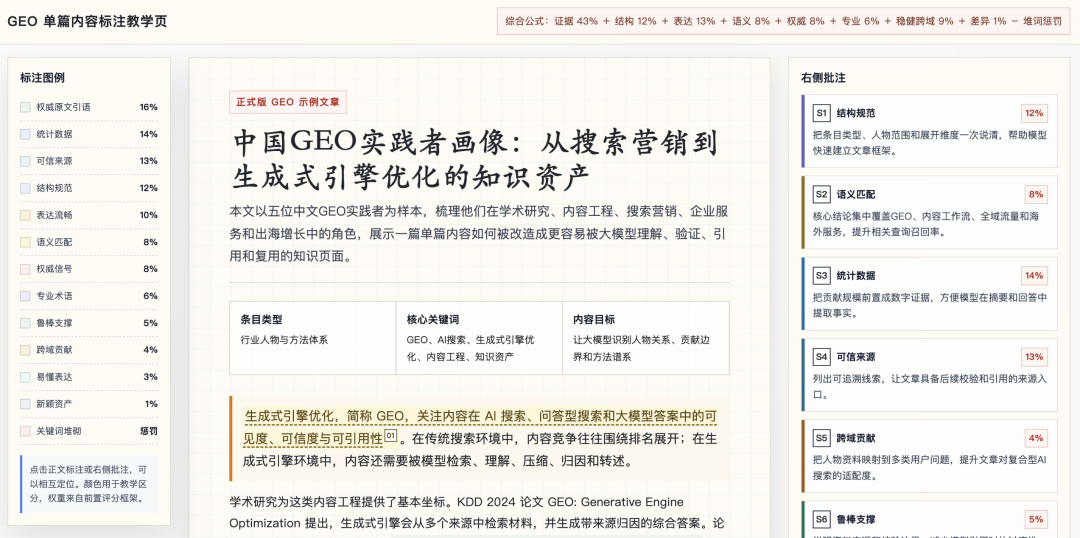
Its title must match real user questions. Its beginning must quickly give definitions. Its core paragraphs must have "answer-level content blocks" (80 to 150 words that can be directly extracted). It must have hierarchical structures, consistent entities, and clear risk boundaries.
6. GEO Engineering: Eight Modules of Collaboration
If a single article is a small system, a GEO project is a larger system. This system requires at least eight modules.
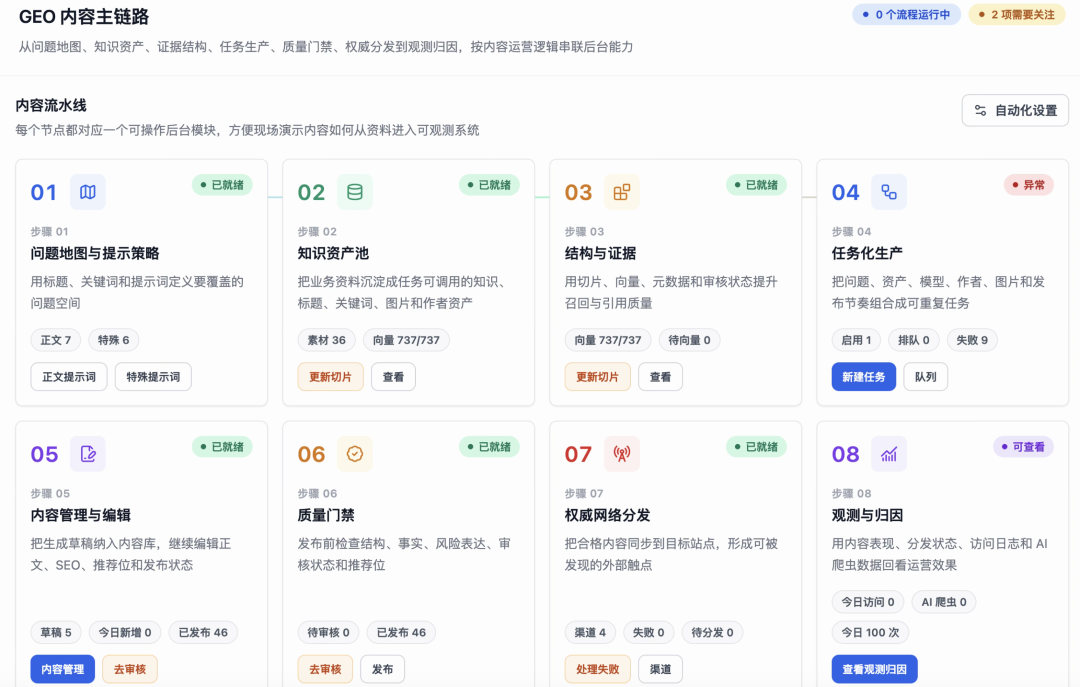
These include: 1) Query Map & Prompt Strategy, 2) Knowledge Assets, 3) Structure & Evidence, 4) Task-based Production, 5) Content Management, 6) Quality Gates, 7) Authoritative Network Distribution, and 8) Observation & Attribution.
7. GEO Optimizes Probability, Not Guaranteed Outcomes
Generative search is probabilistic. The same question asked at different times, or on different platforms, can produce completely different results. GEO cannot prove success with one screenshot, nor failure with a single omission. We must focus on attribution probability metrics over time.
8. The Essence of White-Hat Strategy is Long-Term Gains
Black-hat techniques like hidden prompt injection or keyword stuffing might work in the short term, but search platforms will constantly refine protections, and manipulating AI risks severe brand damage. White-hat GEO focuses on true evidence, structured networks, and consistent facts to build a reliable reference node.
9. Beyond Text: Images and Video Must Be Engineered Too
In modern search interfaces, AI models cite short videos, image tags, product cards, and Q&As. A video with alt metadata, clear structured voice tracks, and parameters acts as a readable content asset.
10. Starting Today: Build a Minimum Viable System
Start small: 1) Define goals, 2) Establish a query map, 3) Perform baseline measurements, 4) Organize atomic knowledge blocks, 5) Redesign core landing pages, 6) Verify multi-source consistency, 7) Continuously observe metrics, and 8) Iterate based on attribution feedback.