
How to Build a Rock-Solid SEO Foundation? A Complete Novice-to-Pro Indie Web Playbook
How to Build a Rock-Solid SEO Foundation: The Complete Indie Web & Tool Site Playbook
Distilled from hundreds of real-world indie hacker case studies: why you must research keywords before registering a domain, how to calculate Keyword Golden Ratio (KGR < 0.25), and how to structure tree-like internal links.
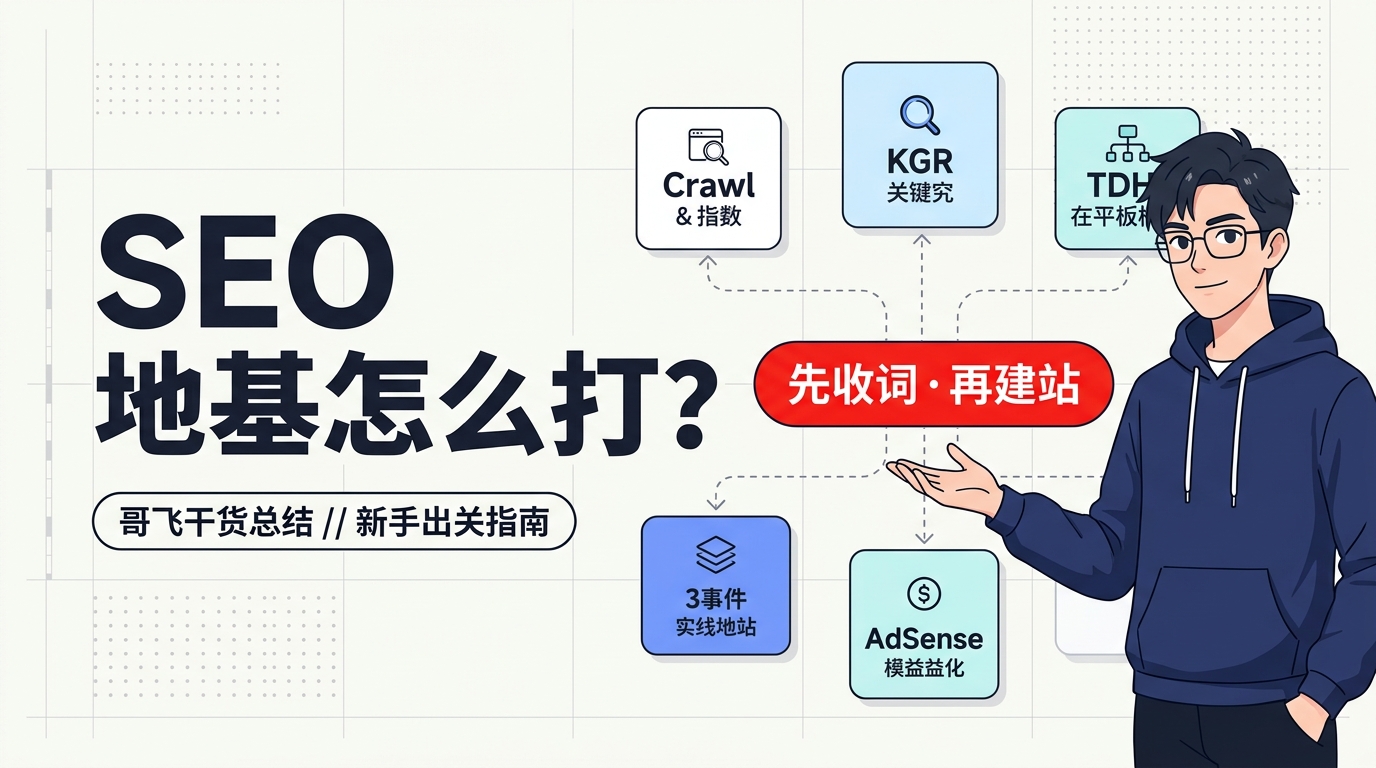
1. The Iron Law of Indie Web SEO: "Collect Keywords First, Build Sites Second"
The #1 fatal mistake novice indie hackers make is falling in love with a product idea, spending 3 weeks coding a polished web app, buying a domain, and only then asking "How do I get traffic?"—only to discover zero search volume or entrenched DR80+ giants.
The foundational methodology reverses the sequence: mine long-tail tool queries using root modifiers (`generator`, `converter`, `checker`, `maker`, `builder`, `calculator`), verify competition via KGR (`allintitle / monthly volume < 0.25`), and let the exact keyword dictate your domain, URL slug, Title, Description, and H1.
- 6 High-Intent Tool Roots: generator, converter, checker, maker, builder, calculator.
- Keyword Golden Ratio (KGR): `KGR = allintitle results / monthly search volume` (for keywords with volume <= 250). KGR < 0.25 indicates an underserved blue-ocean opportunity.
- 3-Stage Practice Roadmap: Site #1 (Static content blog to learn GSC & indexing) -> Site #2 (Single-keyword utility tool site) -> Site #3 (Multi-page programmatic hub with tree-structured sub-routes).
2. On-Page TDH Engineering & Above-the-Fold Tool Priority
Search engines evaluate relevance through strict structural alignment across URL, `<title>`, `<meta name="description">`, `<h1>`, and `<h2>` subheadings—while evaluating user satisfaction through immediate above-the-fold interaction.
- Keyword Density Target: Maintain natural 3%–5% core keyword density across headings and body copy without robotic stuffing.
- Above-the-Fold Core Workspace: Place the interactive tool workbench immediately in the first viewport (LCP < 2.5s) and push educational guides and FAQs below the fold.
- Tree-Structured Internal Linking ("Categorize & List"): Ensure every sub-page is reachable within <= 4 clicks from the homepage via semantic category hubs.
// [Keywords First, Sites Second] TDH & Tree-Structured Internal Link Blueprint
Target Keyword: image to pixel converter (Monthly Vol: 220 | allintitle: 38 | KGR: 0.172)
URL Route: https://yourdomain.com/en/tools/image-to-pixel-converter

<title>Image to Pixel Converter — Free Online Pixel Art Maker (No Signup)</title>
<meta name="description" content="Convert any photo into crisp retro pixel art in seconds with our free browser-based Image to Pixel Converter. Custom palette, block size, and instant PNG export." />
<link rel="canonical" href="https://yourdomain.com/en/tools/image-to-pixel-converter" />

<h1>Image to Pixel Converter</h1>
<!-- Viewport 1: Interactive Upload & Real-Time Pixelation Workbench (LCP < 2.5s) -->
<h2>How to Use the Image to Pixel Converter in 3 Steps</h2>
<h2>Key Features & Supported Retro Palettes</h2>
<h2>Frequently Asked Questions (FAQPage JSON-LD)</h2>
<!-- Footer Hub: Categorized internal links to related converter & generator tools (Click Depth <= 3) -->
Engineering Comparison Matrix: Anti-Patterns vs. Production Best Practices
| Dimension | Common Anti-Pattern | 2026 Production Standard |
|---|---|---|
| Project Launch Sequence | Build product for 30 days -> Buy domain -> Look for keywords afterward | Mine root keywords -> Verify KGR < 0.25 -> Lock TDH blueprint -> Ship MVP in 48 hours |
| First-Screen Layout | Giant marketing hero banner pushing the actual tool below the fold | 100% above-the-fold interactive workbench + educational guide & FAQ at bottom |
Pre-Flight Production Verification Checklist
- 01Verify KGR < 0.25 (or low-DR SERP top 10) before writing a single line of application code.
- 02Align exact target keyword across URL slug, `<title>`, `<meta description>`, `<h1>`, and at least two `<h2>` tags.
- 03Submit sitemap to Google Search Console on day one and build categorized hub-and-spoke internal links.